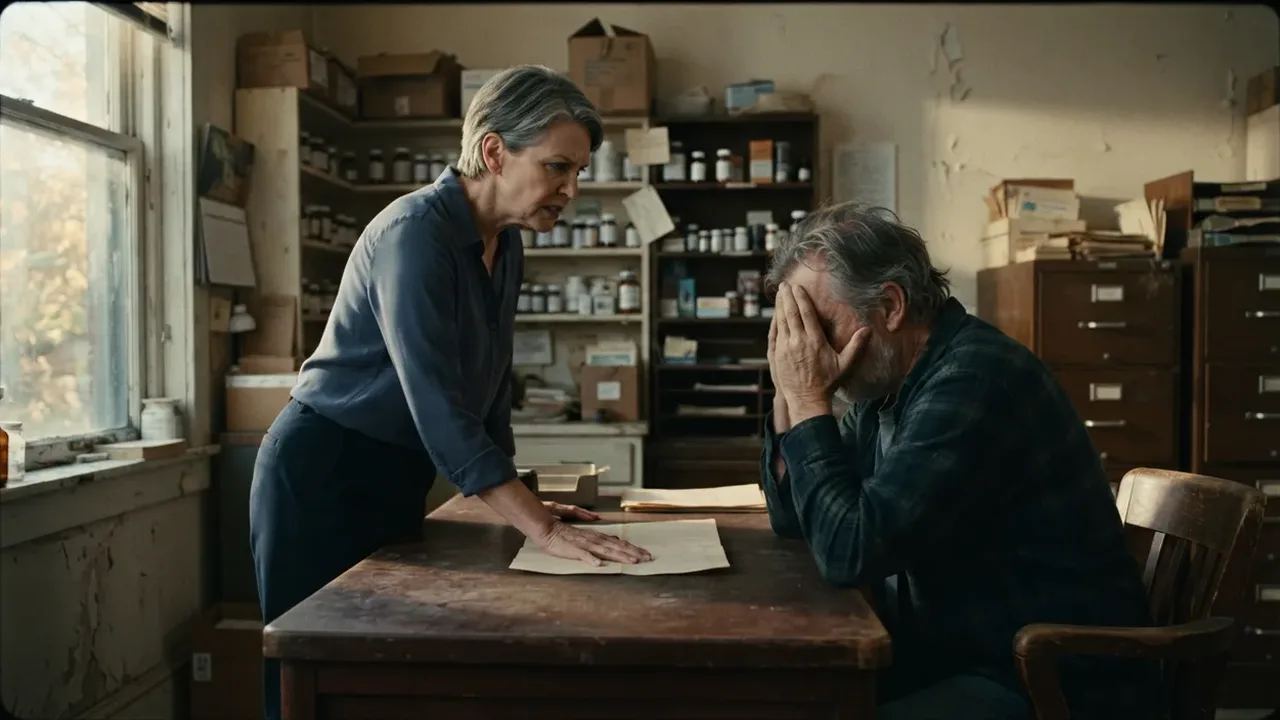
My brother needed seventy-five thousand dollars by the end of the month, or he said we would lose our father's pharmacy. He said it standing in my kitchen, in work boots that had left a faint trail of dust across my tile.
The sum was exactly half of what I kept in my brokerage account, the whole cushion of a pharmacist's retirement. The building on Main Street, worth about four hundred thousand dollars, was the only other thing Martin and I owned together.
"Itemize it," I said. "Every debt, every creditor, every due date."
"I can't do that, Kate."
"Then I can't write a check."
Martin turned his cap in his hands. He is sixty-four, four years younger than I am in the way that matters least and older in the way that shows. His knuckles were split from some job I had not asked about.
"It's the building," he said. "If I don't have it by the deadline, it goes."
"The building was left to us free and clear. Dad told me so himself, long before he died. So either you have borrowed against something that is half mine, or you are describing a problem that does not exist."
"I didn't borrow against anything."
"Then explain the deadline."
He said nothing. I poured myself iced tea and did not offer him any, which was a petty measure, and I knew it as I took it.
"Martin, you have owned a tile showroom and a hot tub franchise and a share of a gutter company. Each one began with a loan and ended with an apology. Our father kept a ledger every day for forty years and never carried a balance past the month. Prudence is not a personality. It is a habit, and you have declined to form it."
"You sound exactly like him," Martin said.
"Thank you."
"I didn't mean it as one."
He put his cap on and let himself out. The door closed with no more force than a cabinet drawer makes, and that was worse than a slam.
I washed the glass I had poured for him and never filled. Then I dried it and set it back in its row, rim down, and felt entirely right and entirely alone.
I called Tuesday and again Thursday. Both times his phone rang out to the recording of his voice reciting his license number.
The following Sunday evening, my niece called from Phoenix. Olivia is thirty-two, a paralegal, and she asks her questions in order, each one leading to the next.
"Aunt Kate, did Dad tell you what the money is for?"
"He told me it was for the building. He would not tell me why."
"Did he tell you he sold the truck?"
I set down my fork. A Fry's rotisserie chicken sat half-eaten on the counter, and I looked at it as though it might supply the answer.
"The Ford?"
"The one he's driven since I was in middle school. He'd have sold the house before that truck. He drove to the buyer's place in Prescott himself, and he came home in my cousin's car."
"A man bailing out a failed hobby business does not sell the tools of his trade," I said slowly. "Olivia, that doesn't fit."
"No, it doesn't." She waited a moment. "He's not just broke, Aunt Kate. This is different. He's desperate."
"What do you think he's hiding?"
"I don't know. I'm asking you to ask better questions than the ones you asked him."
She said it kindly, which did not make it easier to hear.
I did not sleep that night. I lay in the dark and went through my brother's failures one at a time, as I would audit a drawer of mislabeled stock, and every item I pulled out was the wrong size for the shelf I had put it on.
The tile showroom had folded when Olivia was in high school. The last of his ventures, the gutter company, had been dissolved for years before our father's stroke. Whatever Martin owed, he had not been in a position to owe it recently. Yet he was selling his truck now.
At seven I made coffee, and at eight I opened my laptop. I did not drive over to his house and go through his mail. I went to the Maricopa County Recorder's website, typed in the parcel number from my property tax bill for the pharmacy, and waited for the record to load.
It loaded.
There were two documents recorded six years ago, in the same week. One was a deed of trust, a second mortgage on our father's building in favor of Saguaro Bridge Lending, a private lender whose name I had never heard. The other was a UCC filing against the fixtures and equipment.
The principal was two hundred fifty thousand dollars. The maturity date was the last day of this month.
I put my finger on the trustor's signature, the signature of a man whose capital D I could have picked out of a thousand. It was Frank Dunn's. It was notarized, and the date fell a year before he died.
Martin's last business had been dead and buried by then. I held that fact against the timeline, and the timeline held.
I sat very still. I had been so certain that I had nearly handed him a lecture in place of a question, and now I was left with a sentence I had never expected to form: my father had owed something he never mentioned.
I did not yet allow the other possibility, that Martin had not made the debt. I decided instead that my brother had leaned on a trusting old man in his last good year, and I let that theory stand because it was the only one that kept my father clean.
I called Walter Pierce that afternoon. He had been Dad's closest friend for fifty years and the executor of his will, and he answered in the tone of a man expecting a bill.
"Walter, I want to hold a final meeting to settle the estate. Martin, Olivia, and you. I would like you to bring the complete file."
"Katherine." He cleared his throat. "Are you certain you want that?"
"I am certain I want it done properly."
"Then I'll be there," he said, and he did not sound relieved.
I reserved Room B at the Red Mesa Community Center for fifteen dollars an hour. The front desk gave me a key on a rubber band and pointed me past a bulletin board advertising pickleball and a Tuesday quilting circle.
On Thursday morning, a week before the deadline, the four of us sat down around a laminate table that smelled faintly of floor cleaner. Someone had left a coffee urn on the back counter, and no one touched it. Through the window I could see the parking lot already shimmering, though it was only late spring.
Martin took the chair nearest the door. Olivia sat beside him with her hands folded. Walter placed his worn leather briefcase on his knees, as he did everywhere, and kept both arms around it.
I had printed the record and clipped it into a folder. I took it out and laid it before my brother, turned so he could read it.
"I know about the second mortgage, Martin," I said. "You should have told me you were in this much trouble."
I had prepared for several outcomes. I expected an outburst, a plea, or a long silence ending in a confession, and I had my response arranged for each.
He read the first page. Then he looked up at me, and his face held no guilt at all, only a fatigue so complete that I felt it like a draft.
"I didn't want you to know, Kate," he said quietly. "I promised Dad."
"Promised him what?"
"I can't tell you."
"Martin, a lender has filed a lien against our building. You owe a balloon payment that falls due this month. If you have a reason for all this, now is when it belongs on the table."
"I know what's on the table."
"Then talk to me."
He shook his head once. His hand went to the edge of the folder and stayed there, steady, as though it were holding the paper down against a wind that only he could feel.
Olivia watched him and said nothing. I turned in my chair, because the person I trusted to behave sensibly was the one I had known longest.
"Walter. You have to know what this is."
Walter Pierce let out a long, tired breath. He unbuckled the briefcase and took out a file thick with rubber-banded statements, and he set it on the table gently, as though it might wake.
"Katherine, he's telling you the truth," he said.
"That is not an answer."
"Your father made a bad investment, in a venture I begged him to stay out of. When it failed, he borrowed against the building to cover the loss. He told no one but me, and he made me swear to keep it from you."
I heard the words and tested them against everything I owned. "My father was the most careful man I have ever known."
"He was. That's why it destroyed him." Walter slid the file toward me. "Martin found the paperwork in the office safe after the stroke. The lender was about to call the loan. He's made every payment since, out of his own pocket, so that neither of you would lose the building."
"Every payment?"
"Look at the ledger."
I looked. I had read ten thousand prescription logs in my life, and I could read a column of figures faster than most people read a menu. The payments were monthly, entered in Martin's cramped block hand, and they had not missed a single month. Beside them ran a second column in the same pencil, and it recorded what he had sold or skipped to make each one.
A bandsaw. A set of scaffolding. A second vehicle, long ago. Now the truck.
"The seventy-five thousand," Walter said, "is the final balloon. If it isn't paid, the lender takes the building, and the whole of what Frank spent his life on goes with it."
The room was quiet enough that I could hear the refrigerator hum behind the coffee urn.
I looked at my brother. I thought of his boots on my tile, the iced tea I had not poured, and the lecture on habit that I had delivered to the one person in the family who had never missed a payment.
"I called you irresponsible," I said.
"You called me a lot of things." He didn't say it unkindly.
"Why didn't you tell me?"
"Because you would have had to stop thinking he was perfect." He rubbed his eyes with the heel of his hand. "And you were happy thinking it, Kate. I wasn't going to be the one to take it."
Olivia reached over and set her hand on his sleeve, and he let it stay there.
I closed the folder with great care, as I used to close the narcotics cabinet after the last prescription.
"Thank you, Walter," I said. "I would like a copy of all of it."
Martin came to my condo that evening. He knocked, which he had never done in all the years I had lived there, and when I opened the door he stood on the mat with his cap already off.
"Come in," I said. "I made a pot of decaf. I'll pour it into a glass you will actually use."
He almost smiled.
My dining room table is oak, and I polish it on Saturdays. I had cleared it of everything except a single check, written that afternoon at my desk, payable to Saguaro Bridge Lending, in the full amount.
I slid it across to him.
"This is my half," I said. "I'm sorry, Martin. For not trusting you."
He looked at the check, then at me. "It's the whole balloon, Kate. You'd be covering all of it."
"It is my half of what you have already put in, and I will square the rest with Walter's ledger. I don't intend to argue the arithmetic. I've done it, and I'm right."
"You usually are."
"Not this month."
He nodded. That was all, one nod, but the muscle that had held in his jaw since I met him at the door let go. We sat there while the decaf cooled in front of us.
"Tell me about Dad's last years," I said. "I would like to hear them from the person who was in the room."
He took a long time. Then he told me about the afternoons our father sat in the pharmacy office after closing, doing sums that never came out, and the Sunday he said he'd made a mistake that couldn't be fixed. He told me that Dad had cried in the hospital, once, and made Walter promise, and that he, Martin, had never been told to keep it and had kept it anyway.
I listened without correcting him, which for me is the rarest form of attention. When he finished, the father I had carried for sixty-eight years had a crack down the middle, and I could not mend it and did not try.
The sun had dropped behind the neighbor's roof. I reached over and straightened the check on the oak, and I tapped it once with a fingertip.
"Once the title is clear," I said, looking at my brother, "what do you say we find a new tenant? Maybe a young pharmacist just starting out, someone who needs a chance."
Comments