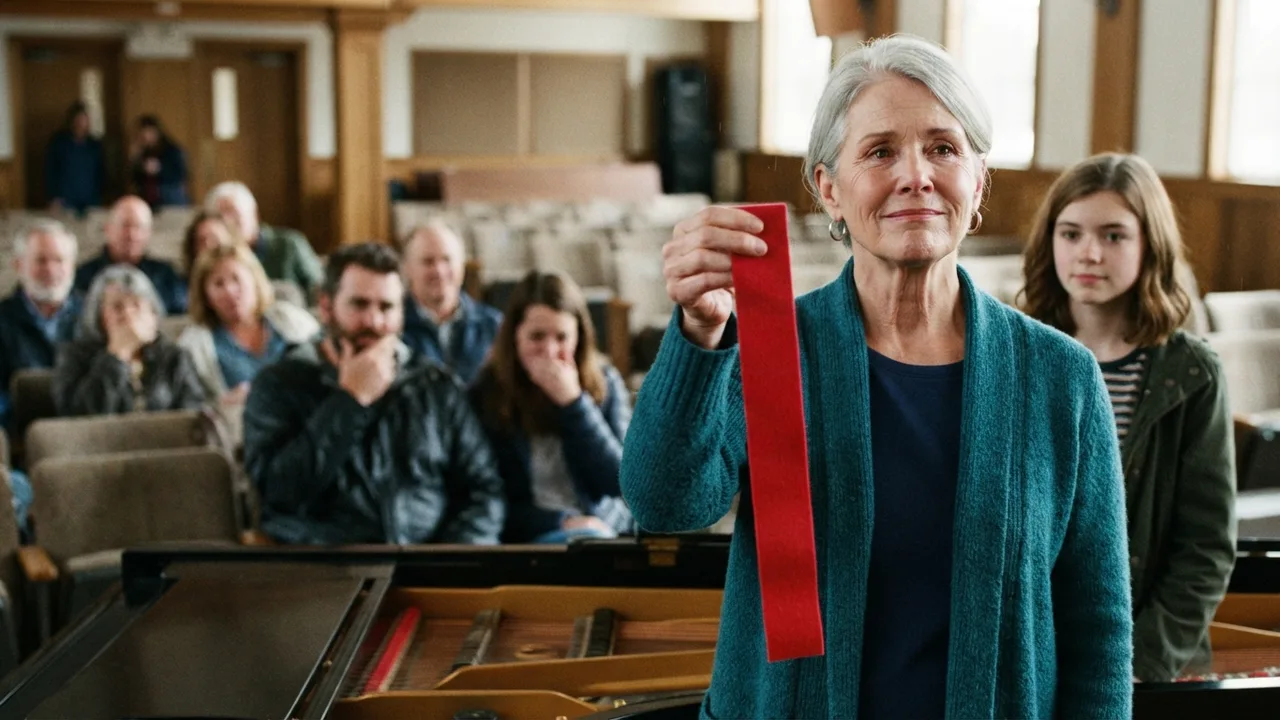
Halfway through the Chopin, Tanner Holst walked up from the third row, reached into the Playhouse's grand piano, and held up a strip of red felt so a hundred and forty neighbors could see what I'd left in it.
"Happens to the best of us," he said, kindly, into the hush.
The guest pianist from Tacoma didn't look at Tanner. He looked at the front rows and said that whoever had tuned this instrument should find other work. That sentence took the Playhouse contract, eleven thousand two hundred dollars a year for seven pianos, and carried it out of the hall.
I sat in row six with my hands in my lap. My own strip was wound twice around my left wrist under my sleeve, where it had been since eleven that morning. A tuner owns more than one strip, though, and nobody in that room was going to ask me to roll up a cuff.
I had heard it coming. Hollis Ferreira had opened the program with the Debussy, and the middle of the keyboard had gone thin and dead, like a piano with a wool sock in it. I've tuned her family's upright since she was six. She walked off that stage with her chin up and her eyes wet.
Then the professor started the Chopin, stopped, and frowned at the keys.
A temperament strip is a ribbon of felt woven between the strings so only one string of each note sounds. You set your tuning on those and pull it out when you're done. Left in, it makes exactly the sound I'd heard.
Tanner played the rest of the evening's rescue with a smile. The professor finished on a cleared piano. Thirty-one people left at intermission, and I watched them go.
Afterward I walked through the lobby past people I'd known twenty years. Nobody met my eye. The refrigerator in the kitchen pass-through hummed a flat note, and I tuned to it so I wouldn't have to look at anyone.
I lay awake until four, going over the morning. I'd finished at eleven. I'd locked up at 11:15. I could not find the place where I'd left it.
---
Ruthanne called Monday.
"The board reviews the contract at the May 5 meeting," she said. "Tanner Holst has put in a bid. Eight thousand four hundred, with a letter."
"I'd like to hear the letter."
"Dagny."
"One line."
Paper rustled. "'I arrived as an audience member at 6:30 and was as surprised as anyone.'"
I said thank you and hung up. Then I did the arithmetic at the kitchen table. The contract was my mortgage, nine-fifty a month, and nearly a quarter of what I earn. Annika's fall bill from Washington State was already counted against it.
By Wednesday, Tanner had posted in the Lowry Harbor Neighbors group. Warm, generous, no shame to anyone. He had offered to "help Dagny brush up," and he'd gladly step in if the town needed him.
Sixty-some people liked it. I counted them twice, which is a habit I have with anything that hurts.
St. Anselm's parish hall canceled its June tuning that afternoon. Three hundred forty dollars, gone with one email. Then my phone buzzed with a text from Celeste Ferreira.
*Tanner will do our upright from now on. No hard feelings, he's cheaper and Hollis likes him.*
Ten years of Celeste's piano, and she'd signed off like a receipt. Annika called from Pullman that night.
"Mom, I saw the post."
"It's fine, honey."
"You're doing the voice. The one where the fridge is louder than you."
"It's a sharp unison, not a tragedy," I said. She laughed, and I held the phone until she hung up.
---
I walked to Ruthanne's blue cottage on Spruce Street the next morning, rain coming sideways off the canal and rhododendrons dripping on her gate. She let me in. She had a pencil in her cardigan pocket, as always, and she did not offer coffee.
"Tanner planted it," I said. "He put that strip in after I left."
"What do you have besides being sure?"
I opened my mouth. Nothing came, and I could hear how long the nothing lasted.
"That's what I thought." Ruthanne's band-director voice came down like a baton. "Dagny, he has a baby due in July. If you stand up in that lobby and accuse a young father, you'll look bitter. The board will judge the bids on merit."
"I've held that contract since 2009."
"Then it will speak for itself."
"It hasn't so far," I said, and went out into the rain.
I walked the four blocks uphill to Alder Street ashamed of my own voice, which had come out flat and grabby, a woman guarding a bone.
---
That night I worked it through the way I'd work a piano that sounded wrong. A strip in the middle octaves can't go unheard. The professor had rehearsed at one that afternoon and complained of nothing. And every Saturday for two years, Hollis had played that grand from four to quarter to five, because I'd arranged the slot myself.
So the strip went in after quarter to five. I knew the sound of that middle register down to the hammer.
I drove to Cedar Loop the next afternoon. Celeste opened the door in her Harbor Grocery fleece, name tag still pinned on.
"She's sixteen, Dagny. Leave her out of your business fight."
"One question, Celeste. Then I'll go."
Hollis appeared behind her in a school hoodie, hair clipped up. "It's okay, Mom."
"How did the middle sound at four?" I asked. "On the grand. That Saturday."
"Clean," Hollis said. "Really clean. That's why I thought I'd choked. I kept going over it." She looked at her sneakers. "Sorry, this is probably nothing, but Mr. Holst was at the piano when I was packing up. Ten to five, maybe. He had the lid up. He said you'd asked him to check it, because it was a big night."
Celeste's hand went to the doorframe.
"I never asked him," I said.
"I know that now," Hollis whispered.
---
On Thursday, April 30, I drove out Highway 106 to the bay behind the marine supply store. Tanner was alone, regulating the action of an old upright with its front panel off. A radio played low. He looked up and smiled.
"Dagny. No worries, come in."
"Hollis played until quarter to five," I said. "The piano was clean. Right after, you were at the open lid, telling a sixteen-year-old I'd sent you."
His screwdriver stopped at *quarter to five*. Then it started again.
"You held me up in front of my whole town," I said. "And you let that girl believe she'd ruined her own piece."
"I stopped in for five minutes," Tanner said. "Dropping off business cards. I glanced at the piano as a courtesy. That's all."
He kept his eyes on the open action of the upright.
"Your letter says you came at 6:30."
"Letters are short." He wiped his hands on a rag, talking faster now. "You've had this town to yourself for twenty years, Dagny. You charged what you liked. I've got a baby coming and eleven hundred a month in rent for this bay. You'd have done the same."
"No."
The radio slid into an ad for a car dealership in Tacoma. Tanner set the rag down on the bench.
"Look, I'll withdraw the bid. All you do is let the Facebook thing die quietly."
"No," I said again. "I'll tell the board on Tuesday. I'm telling you first so you know it's coming from me."
He didn't answer. I listened to the radio for a few more seconds, then went out to the Element, and my thumb shook against the steering wheel until Mill Road.
---
The Playhouse lobby on Tuesday night held about a dozen townspeople on folding chairs, there because of the Facebook post. Ruthanne sat at the long table with three other board members and the secretary, who had a laptop. Tanner stood by the coat rack in a clean flannel. Celeste and Hollis sat in the second row.
"Let's keep this on the record," Ruthanne said. She read his bid aloud, eight thousand four hundred, and then the line from his letter. "'Arrived as an audience member at 6:30.'" She looked up. "Dagny. Do you wish to respond?"
I stood. My knees were not what they'd been that morning.
"I'll match the board's budget," I said. "Nine thousand eight hundred. So price is off the table. I'd ask the board to judge me on the night of April 18 and nothing else."
A murmur ran down the chairs. Somebody's folding chair creaked.
"Tanner," I said. "What time did you get to this hall that day?"
"Six-thirty. It's in my letter."
He didn't move from the coat rack, and he didn't look at the second row.
"Hollis Ferreira played the middle of that piano until quarter to five, and it was clean. Right after that, she saw you at the open lid."
"Hollis," Ruthanne said gently. "Do you want to say something?"
Hollis stood beside her mother with her hands twisted in her hoodie. "He told me Dagny asked him to check it," she said. Then she sat back down.
Tanner laughed, a short one. "A sixteen-year-old's memory of a time isn't evidence. I'm a tuner. I'm near pianos all day. Okay, I dropped off cards, five minutes, I glanced at it as a courtesy. And with respect, Dagny's been running an overpriced monopoly on this canal for—"
"I've matched the budget," I said. "Let's leave money out of it."
He stopped.
"Then you were at that piano before she'd packed up her music. So either the strip was in there, and you said nothing and let Hollis walk out on that stage and cry. Or it wasn't in there yet." I waited. "Which was it?"
The refrigerator in the pass-through hummed. I could hear it plainly, and so could everyone else, because nobody was speaking. Tanner looked at the board table, then at the minutes on the secretary's screen, then at the floor.
Celeste put her hand on Hollis's shoulder.
"I withdraw my bid," Tanner said.
Ruthanne kept her eyes on the minutes. "Let the record show the bid is withdrawn. The Playhouse will not be using the services of Holst Piano Service. And the board expects the $775 it refunded for the ruined concert to be made good."
"Fine," Tanner said.
He crossed to the lobby counter, took a checkbook from his jacket, and wrote it out standing up. The tear of the check was loud. He set it by the donation jar. Then he turned toward the second row.
"I'm sorry, kiddo," he said to Hollis. "It wasn't your fault."
He did not look at me. He put his hood up and went out into the rain, and the door shut behind him.
---
The vote was four to zero, two years at $9,800. Ruthanne signed the contract on the lobby table and slid it across to me with the pencil from her cardigan.
"I was wrong at my cottage," she said, low, so the secretary wouldn't have to type it. "You had something. I didn't ask you the right way."
"You asked it fine," I said. "I had nothing yet."
I signed. A difference of fourteen hundred a year, I thought, and I'd feel it every January when the numbers came up. I had also put a sixteen-year-old in a room full of adults to say what she saw.
At the door, Celeste stopped me with her coat half on.
"I'll call you about June," she said.
"The upright's a little flat in the tenor."
"I know." She nearly smiled. "I can hear it too."
---
On Saturday morning I let myself into the Playhouse at nine, tool case in one hand, thermos in the other. The rain had quit. Hollis sat on the edge of the stage with her sneakers swinging, a notebook open on her knee. She had asked, on Wednesday, whether she could learn from me now. I'd said bring a pencil.
"Sorry," she said. "Is it okay if I ask questions while you work?"
"Ask after the unisons. I can't hear you over them."
She nodded and kept quiet. I set the temperament across the middle octaves, felt woven between the strings. I set the pins one at a time and tuned the octaves out from there. Hollis never moved except to write.
At eleven I played a slow scale up through the middle. It rang, every note of it, and the room took the sound and gave it back.
I pulled the red felt out of the strings, one loop at a time. I held it up so Hollis could see it come out clean, and wound it twice around my left wrist.
Comments