"Dad always wanted this land to be wild again, Mom," my son told me, sweeping his arm toward the creek. "He said it right here, on this very spot."
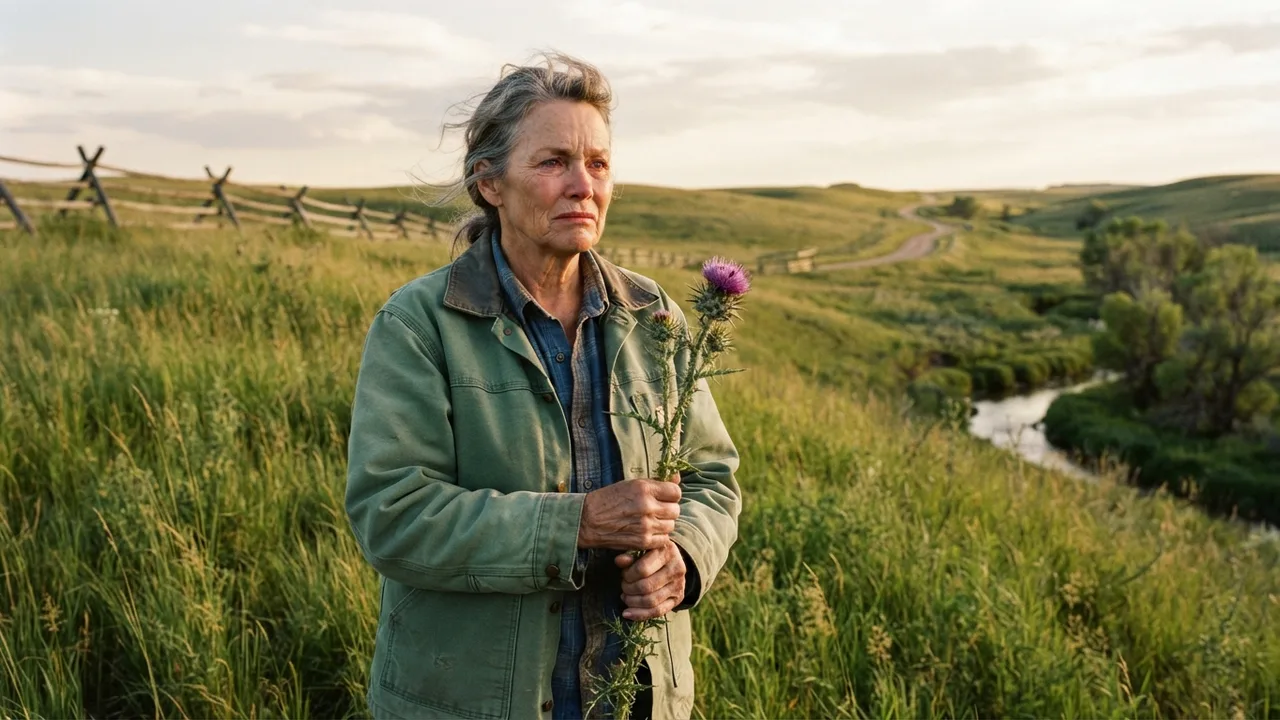
He wanted me to sign forty acres of creek pasture over to his company, and he said it standing in a gateway where the thistle rosettes came up to his new brown boots.
"Your father never said that to me," I said.
"He wouldn't have. He said it to me, the evening we were mending fence."
I'm Marjorie Whitaker. For thirty years I've been the only large-animal vet in this county, and Gary and I built this farm on pragmatism, not poetry. We cash-rent three hundred sixty acres of corn ground to a neighbor. The other forty is the creek pasture, half a mile down the dirt lane from the house, and it has been mine outright since Gary died. We always meant it for Hannah and Lachlan, half each.
Gary used the word "vision" only when he talked about his eyes. Lachlan came home from Chicago with a laptop and a vocabulary, and I tried to hear the boy in it.
Within the week he had built a website. The Whitaker Wildlife Sanctuary, it said, with a donate button in forest green and a story about a farmer who dreamed, privately and for years, of letting the creek go back to the way God made it.
The photo at the top was Gary mending fence. I took that picture myself, and he was cussing a staple when I did.
Forty-one neighbors gave $3,400 in a week. The mayor, Ardis Brannigan, put in $250 and told everyone at the Casey's.
The phone rang all week. Arlene Voight from church said Lachlan was a wonderful son. The Hagstroms sent a card.
I stood in my kitchen and said "Thank you, he's worked hard," and each time I felt like a woman stealing from a collection plate. Hesitating made me the villain. So I smiled into the receiver and said nothing, and my husband's face stayed on a stranger's screen asking for money.
Then Lachlan laid the deed on the table beside my coffee.
"Whitaker Sanctuary LLC," he said. "I'm sole manager, so donations and grants can come in properly. We do it at a groundbreaking, down at the creek, with the notary from the bank. Saturday after next."
"All forty acres."
"A sanctuary can't be half a sanctuary, Mom."
I did not sign. I told him I'd think, and he looked at me the way he used to when he was small and I'd said we would see about the pony.
Hannah called from Omaha that night. She teaches high school biology and she asks three questions before she gives an opinion, but she gave me the opinion first.
"It's what Dad would want, Mom."
"Did he ever say so to you?"
"He didn't have to. Lachlan's story, the way he told it, that sounded like Dad."
It sounded like a stranger who had read about Gary. I let it go.
The Prairie Creek Chronicle came out Thursday. The headline was "Prodigal Son Honors Father's Dream." Josie Fenner's story had Lachlan on the creek bank looking toward the light. Near the end it said his mother was "still weighing the gift."
At the Corner Café the next morning, Dwayne Kolterman stopped by my booth with his cap in his hand. He has run cattle for as long as I've treated them.
"Doc, I don't mean to pry. You don't believe in your own husband?"
"I believe in him fine, Dwayne."
"Well. Boy's trying." He put his cap back on and paid at the register without looking at me again.
I lay awake that night with the furnace ticking and counted the cracks in the ceiling plaster, because counting them was easier than counting what I had already lost. I had lost the quiet I'd lived in, and my standing in town, and some of my daughter.
On Sunday I went looking for a photo. Hannah's birthday was coming and I wanted the one of Gary holding her first show heifer. Gary had set up a shared account on the kitchen tablet years back, and everything any of us did still landed in it, calendars and receipts and pictures alike.
I found the heifer. I also found a receipt for a website host, charged to a card in the name of Innovate Forward LLC.
I had never heard that name.
I sat at the counter with my reading glasses on and went to the Illinois records. The company was dissolved. Under it, a Cook County judgment named Lachlan personally, as guarantor, for $152,000.
My son's boots were on the mat by the door. I looked at them for some time.
Then I opened his calendar, because it was right there, with a dozen of his Chicago entries scrolled above it. One said "Omni Terra site walk – Whitaker creek parcel." It was dated the morning I'd been out at the Hagstrom place pulling a calf in a spring rain.
Omni Terra's website had canvas domes on platforms, soaking tubs under the stars, and rates that made my truck payment look like pocket change. The photographs showed creek country that could have been mine.
I took pictures of every screen with my phone. My hands were steady and my chest felt like it had a stone in it.
I could not tell Hannah. I could not be wrong about this and still have a son. I needed to be sure, and the only way to be sure was to make him prove it.
On Monday I walked into Orville Teasdale's office on Main Street and paid him $450 to redraft the deed. I told him what I wanted. The land could be used only as wildlife habitat. If it was ever sold or developed, title reverted to me.
"That's a clean clause," Orville said. "Your son's going to read it?"
"He'll read it."
That evening Lachlan was stirring a pan of something on my stove, and I told him I'd sign at the groundbreaking. His whole back loosened. He turned and hugged me, and I stood there with my arms at my sides until I made them rise.
"I knew you'd come around, Mom."
It was the first lie I had ever told that boy. Hannah called to say she'd be there Saturday morning, and I said wonderful, and let her drive three hours believing in him.
Saturday came bright and windy. A banner snapped between two fence posts, and there was a folding table with a deed on it, a pen laid across the paper, and a shovel with a red ribbon tied to the handle. A dozen neighbors stood in the grass in their church shoes. Mayor Brannigan had come, and Eunice Plank from Prairie Creek State Bank held her notary stamp against her chest like a hymnal. Josie Fenner had her notebook out.
Hannah found me and squeezed my hand. "You look tired, Mom."
"I'm fine."
Lachlan spoke well. I'll give him that. He told them about a man who loved the land too much to say so out loud, and about an evening by the water. He said "legacy" twice. The neighbors clapped warmly, and Arlene wiped her eyes.
I stepped up beside him in my barn coat.
"Lachlan, show everyone the exact spot where Dad told you."
He smiled. He had his father's smile and he used it. "Right over there, Mom." He pointed to the grassy rise thirty yards from the water.
"That rise?"
"That rise."
I turned to the crowd. "That rise is solid musk thistle. It has been since before any of you gave us a nickel. Gary sprayed it and dug it and cursed it every June for thirty years. He would no more stand there admiring anything than he'd admire a tick."
A few of the neighbors laughed, and then stopped. Dwayne Kolterman studied his boots.
Lachlan laughed too, a little high. "Mom, it's a weed. You're lost in details."
"I came to sign," I said.
I took the folded paper out of my coat. The wind tried to take it, so I held it in both hands and read the clause aloud in the voice I use for the owner of a sick animal.
"'The property shall be used solely as wildlife habitat. Should the grantee sell, convey, or develop any part of it, title shall revert to the grantor.'"
I laid it on the table beside his clean copy and held out the pen.
"As sole manager of the grantee, you sign first."
He did not take it.
"A clause like that scares off grant funders," he said, easily, to the faces in the grass. "Let's sign the clean one today and fix the wording later."
"No."
"Mom."
"This gives your company the land. It gives you the habitat and every donation and grant that comes. It takes away two things only. You can't sell it, and you can't build on it."
He shifted his weight, and the new boots creaked.
"My mother's having a hard time letting go of Dad," he said, softer, to Mayor Brannigan. "This isn't about one patch of weeds."
I heard Hannah draw a breath beside me.
"I'm not the one who can't let go of your father, Lachlan. I'm the one who remembers what he hated. A sanctuary doesn't need a buyer. The only man this clause stops is a man who means to sell."
I took out my phone and held it up so Hannah and the mayor could see. The wind flapped my sleeve against it.
"That's his own calendar, synced from his own account. 'Omni Terra site walk – Whitaker creek parcel.' It's dated the morning I was delivering the Hagstrom calf. And this one is a Cook County judgment with his name on it."
"Mom, put that away."
"I don't know what Omni Terra offered you. I know you walked them down this creek while I was elbow-deep in a heifer, and I know you owe $152,000. Everything a sanctuary needs is on that paper. The only things it keeps from you are a sale and a bulldozer. Those are the things you won't sign."
Nobody said anything. A meadowlark went on singing somewhere out past the fence.
"If you sign it, Lachlan, I will apologize to you in front of every person here."
He looked at the pen. He looked at Hannah. His hands, which had been sweeping at the creek all morning, hung down at his sides.
He left the pen where it lay. Nobody in that grass needed it explained.
I picked up both deeds, his clean copy and the one I'd paid for, and tore them in half. The sound carried. I tore them again.
"The creek pasture stays in my name," I said. "When I'm gone it goes half to Hannah and half to Lachlan, as Gary meant."
Hannah's face had gone the color of the paper.
"And the $3,400 goes back today," I said.
Lachlan took out his phone. He stood in the grass with the banner snapping over him and opened the fundraising page, and one by one he refunded forty-one neighbors. Mayor Brannigan watched his own $250 come back on his screen, his mouth set in a line. Eunice Plank put her stamp in her purse.
People drifted off without speaking much. Josie Fenner lowered her notebook and did not write anything down while I was looking.
Lachlan walked me a few yards off, to where the red-ribboned shovel leaned against a post. His voice dropped.
"Omni Terra would pay enough to clear everything. And I'd cover Hannah's share in cash. Nobody gets hurt, Mom."
"No."
"You'd be saving me."
"I won't sell the pasture, and I won't pay the $152,000." I kept my voice where I keep it for a frightened animal. "If you ask me, I'll help you find work. Not with your father's name on it."
Hannah had come up behind us. She looked at her brother the way she looks at a lab report that has come back wrong.
"You'd have signed my half away too," she said.
He did not answer her.
That evening I stood at the kitchen sink and listened to him upstairs, the closet door, the zipper of a bag. I heard his boots on the porch steps. His car started and went down the lane, and the gravel under it faded into the sound of the wind.
He never came to the kitchen to say goodbye. Hannah stayed the night and we ate cold ham at the counter without talking much.
In the morning she drove back to Omaha. I pulled on my boots and walked the half mile down the lane alone.
The rise was green and bristling in the sun. I went up it to the tallest musk thistle I could find, a stalk nearly to my shoulder with a purple head already nodding. I set my feet and took hold of it bare-handed, through the spines, and I pulled.
The long taproot gave all at once, the way it always did for Gary.
Comments