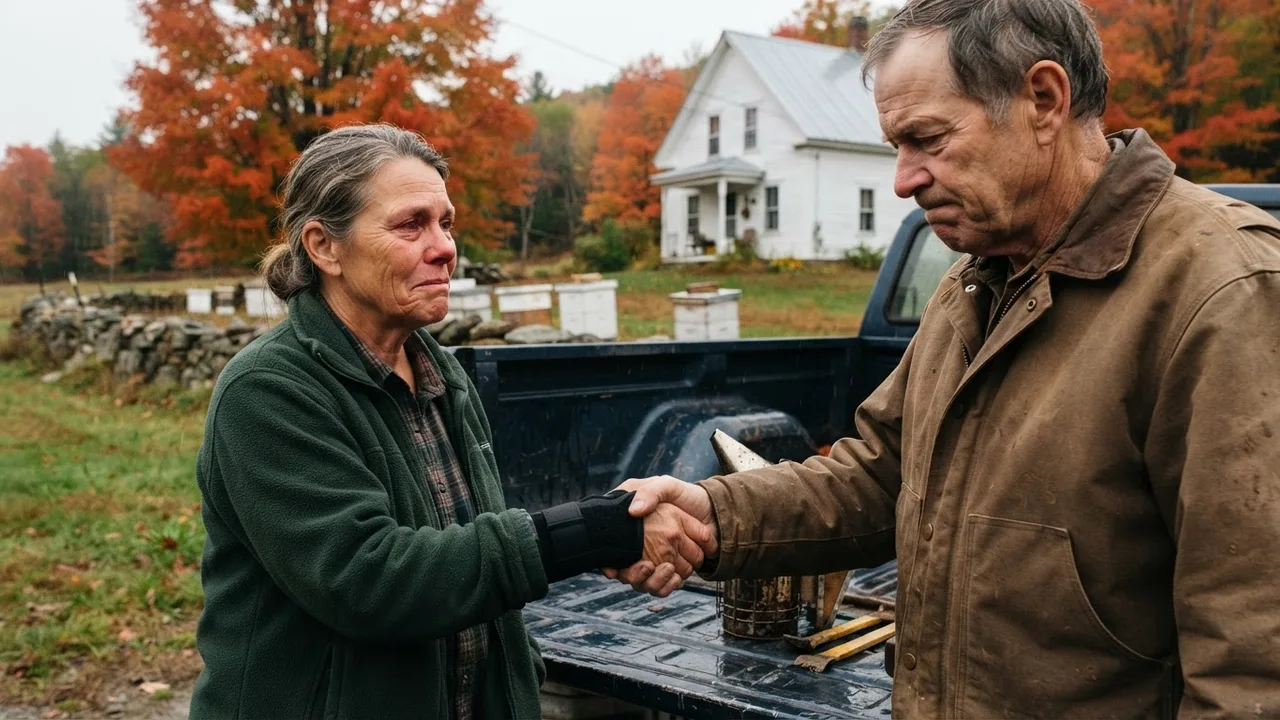
The handshake that sold my house, my forty acres and my bees for $212,000 came eleven days after everyone agreed the fire in my honey house was my fault. I wasn't there for it. I was at my kitchen sink, rinsing smoke out of a curtain, still thinking the worst thing on the hill was a burned shed.
I'd driven home from Keene that Thursday with the empty honey totes rattling in the truck bed. At the top of Larrabee Hill Road I saw a fire truck in my dooryard and a black rectangle where my honey house had been. It was 6:20.
The chief was a heavy man, and he held his helmet against his belly while he talked. "Started at the bench, Bernice. Where your smoker sits. Amos called it in at a quarter to six, but it had a good head start."
Gone were the extractor, nine hundred pounds of fall honey and the tanks and jars. I stood in my boots on the wet gravel and said I hadn't lit that smoker since the tenth of September. The chief nodded as if I'd told him my age.
I called Jeremy from the porch. He said he'd be up in the morning.
He came at eight with two Dunkin' coffees and a pair of leather gloves from his truck. He raked the wet ash with me for an hour and never once checked his phone. I thought, he's a good boy. I thought it right up until he stopped raking.
"Mom, listen," he said. "Here's the thing. I'm not blaming you."
"Then don't start."
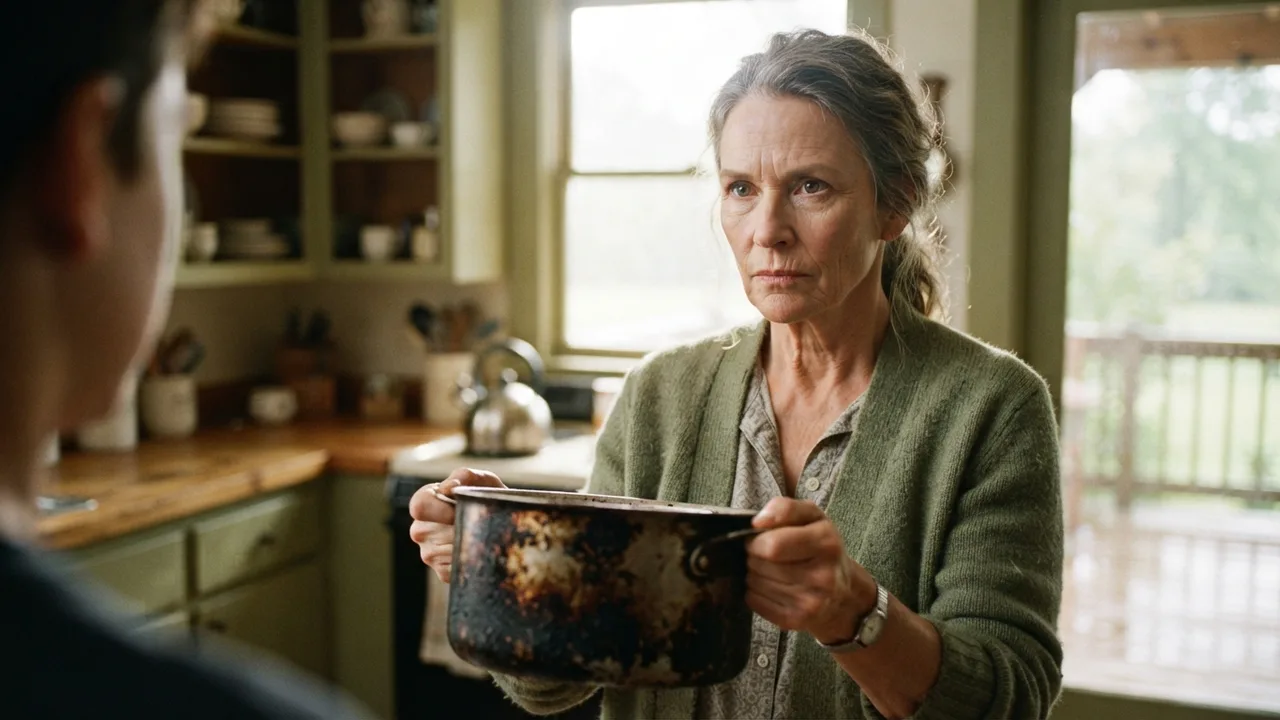
"The smoker was lit. The chief said so. And with the burner in August..." He jingled the keys in his pocket. "I saw it, Mom. The whole kitchen smelled like a hot pan."
"Well, now," I said. "There hasn't been a flame in that smoker since I pulled the supers."
"You think there hasn't."
He said it so kindly that it went in like a splinter. He told Tasha the same thing that night, and I know because she told me so herself the next day. She came up Saturday with her hair in a claw clip and her belly out in front of her. She helped me bag wet ash and wash the curtains, and she never mentioned the burner once. She didn't have to.
The loss came to $11,400, honey and extractor and all. My own mind was worth more than that, and I couldn't find the receipt for it. I lay awake running that Thursday hour by hour. Coffee at 5:30. The totes at 8:15. Gas in Marlow. Where had my hands been when I wasn't watching them?
On Tuesday, Jeremy's Silverado pulled in behind Amos Purington's pickup. Amos took his cap off at the kitchen door the way he'd done for thirty years, when Merritt was alive and the three of us drank coffee at that table.
He sat down slowly. He spoke slowly too, with a kindness I'd heard people use on my mother-in-law.
"Bernie, Jeremy and I talked. We shook on it. Two hundred twelve thousand for the house, the land and the hives. His lawyer, mine I mean, will draw it up. Sunday the eighteenth, if that suits you."
I looked at Jeremy. He was studying the sugar bowl.
"You shook on my house," I said.
"On the idea of it," Jeremy said. "Nothing's signed, Mom. It's so you have options."
Amos had asked for my lower meadow every spring for years, and Merritt had told him no every spring. Now Amos was folding his hands on my oilcloth like a man at a bedside, and I heard my own mouth say, "I'll think on it."
About my own house. In my own kitchen. After they left I washed their two cups and scrubbed them longer than they needed.
On Friday the insurance man told me my homeowner's policy paid $2,500 for business property. That left me $8,900 short, and I wrote the number on the calendar beside the feed store coupon.
On Sunday Tasha called. She said it gently, the way you'd lay a blanket on someone. "Bernice, we've been talking. When the baby's here, we'd rather he not sleep over on the hill. Not yet. Just till things are settled."
"Of course," I said.
I hung up and stood holding the dish towel. That baby wasn't born yet and I'd already lost the nights.
The adjuster released the site on Thursday, and on Sunday I went out with a wheelbarrow to clear the bench area. My left wrist still ached when the weather turned. The smoker had survived, a dented tin can with a blackened bellows. I'd have thrown it on the pile, but I took it by the spout and tipped it over a bucket to empty it.
Sumac and pine needles came out first, gray and crumbled. At the very bottom was a wad that didn't crumble. It was a charred fold of corrugated cardboard, brown at the center and black only at the edges, and when I turned it over there were red letters on the flat side. BRACKETT LUMBER & SUPPLY.
I have never burned cardboard in twenty-two years of keeping bees. The glue and the ink make the whole colony sick for a week, and I keep my fuel in a burlap sack on that same bench, dry and clean. The lid had been shut, I realized. Whoever lit it had shut the lid on a fire starved for air, and the cardboard had sat in the dark and waited for me.
Jeremy worked for Brackett. Half the county bought from Brackett, Amos among them, and I stood in the ash a good while thinking about Amos and the meadow.
Then I did my fall check, because the hives needed wrapping before the first hard frost. Twenty-nine of them looked the way I'd left them. Hive four's inner cover was on backward, with the notch to the rear. I set it notch to the front, every time, because Merritt taught me that and I never changed it. It also sat a finger's width off its old propolis ridge, and along the new edge ran a fresh, pale line of bee glue, thin as a pencil mark.
I hadn't touched that hive since the tenth. Somebody had opened it and put it back wrong. I got the sticky of it on my palm and didn't wipe it off.
I called Jeremy that night and asked him to come up Wednesday after work. I told him I'd make a pot roast.
He ate two helpings. He told me about a builder in Henniker who'd paid in cash, and he looked at his phone twice. When I cleared the plates, I took the cardboard out of my cardigan pocket and set it on the oilcloth, red logo up.
He stopped chewing.
"I have never put cardboard in a smoker," I said. "Not once. The glue sickens the bees. I burn sumac and pine needles. I found this at the bottom of the can, under a shut lid."
"Mom." He put his fork down. "It's a scrap. You must've grabbed one out of that box of porch screws I brought in August. It was sitting on your bench. And you don't remember, because lately you've been..." He stopped, then said it anyway. "Forgetting things."
"For three weeks I've believed I was turning into your grandmother." I kept my hands in my lap so he wouldn't see them. "I lay awake. I said 'I'll think on it' to Amos Purington about my own house. Tasha doesn't want the baby up here overnight. Do you know what that cost me?"
"I never said that. Tasha's just being careful."
"Hive four," I said. "The inner cover was on backward, and it sat off its ridge. I set it notch forward. I always have."
"I put it back the way it came off."
He heard himself. His keys went still in his hand, and the kitchen was quiet except for the refrigerator.
"Well, now," I said.
"Fine," he said, too fast. "I looked at your bees. I was worried about them. That doesn't mean I started anything."
"Then what happened to my honey house?"
"You tell me." His voice climbed. "You fell off a ladder, Mom. You're up here alone. Tasha's due in January, and I'm supposed to just sit in Concord and wait for the phone call?" He closed his fist around his keys. "Look, here's what I'll do. I'll buy you a new extractor. Just let the sale go through."
"No."
"Then think about what happens if you tell Tasha this story." He had Merritt's shoulders and Merritt's chin, and he stood in the doorway with both of them. "She'll never leave that baby alone with someone who accuses her husband. You'll lose him anyway."
He left without agreeing to anything. I listened to his tires go down the hill, and then I washed the dishes, and I didn't cry until the roasting pan.
I called Amos on Thursday. I told him to come on the eighteenth as planned, but that I would bring my own paper. He said, "All right, Bernie," in the old voice, and I couldn't tell what he thought.
On Friday I drove the four miles into East Sutter village and paid a lawyer $350 to draw up an agreement for the twelve-acre lower meadow only, at $48,000. That was the rebuild and the $8,900 and the cost of staying. She asked if I was sure. I said I had never been surer of anything I hated.
Sunday came cold and bright, with a hard blue sky and the maples gone red along the road. The hives hummed low at the meadow's edge, tightened up for winter. Amos's pickup was already pulled up by the ruin when Jeremy's car came up the hill, and Tasha got out of the passenger side with her cardigan pulled across her belly.
"Jeremy said it's signing day," she said. "I wanted to be here."
"I'm glad you came."
Amos had put his cap in his hand. He laid his lawyer's folder on his tailgate, thick and official, the whole farm in it. I laid my own thin paper beside it. Then I set the smoker on the tailgate with the cardboard wad on top, red letters facing up.
"I won't sign for the house," I said. "I'll sell you the lower meadow, Amos. The one Merritt wouldn't. Forty-eight thousand dollars, because that's what it costs to rebuild and stay. I'd rather choose what I lose than have it chosen."
Amos looked at the meadow, then at me. "Bernie, I never meant..."
"I know." I turned to Tasha. "I didn't start the fire. That smoker sat cold from the tenth on. This cardboard is from Brackett. I've never burned cardboard in my life, and I'll tell you why." I told her about the glue and the ink, and about the fuel sack on the bench. I told her about hive four's cover with the notch turned to the rear.
"Mom." Jeremy's keys jingled. "This is cruel, doing this in front of Tasha. It changes nothing about you living alone."
"Jeremy." Tasha had not raised her voice. She waited a moment, the way she does with patients. "Were you here that Thursday?"
He opened his mouth and nothing came out. A crow went over the burned beams. Amos looked down at his boots.
"Say it to me," Tasha said.
"I spent three weeks believing I was turning into your grandmother," I said to my son. "You watched me believe it."
That was what did it. I saw it go through him like a draft through a house.
"I came up while you were in Keene," he said. His voice cracked on *Keene*. "I wanted pictures of the hives. I thought they were dying. I lit your smoker with cardboard from my truck because I didn't know what you burned, and I shut the lid, and I set it on the bench." He swallowed. "When the chief said it started at the smoker, I let you take it."
"Jeremy," Tasha whispered.
"I was so scared of losing you the way we lost Gram that I let you think you were already going." He wiped his face with the back of his wrist. "I've been the steady one my whole life. Dad died and I was the steady one for Mom. Now I'm the one who did this, and you're all going to know it."
"Yes," I said. "We are."
"I'll pay for the extractor. The thirty-six hundred. Out of my own account."
Amos picked up his folder from the tailgate. He slid it back into the truck cab without a word, and he took a pen from his barn coat and signed my thin paper on the tailgate. His hand was steady. I signed under him, and the pen shook once on the *B*.
"Bring the extractor up yourself in April," I said to Jeremy. "I'll show you how to light a smoker."
He nodded but couldn't look at me. He walked down to his car first and sat behind the wheel with the door open.
Tasha stayed a moment, her hand on the tailgate. "The baby will come up in the spring," she said. "In the daytime. Both of us." Then she walked down the hill after him, and he didn't hug me, and I didn't ask.
Amos stood a while longer. The hives hummed behind us, twenty of them I'd keep and ten I'd have to find ground for, and none of them would have goldenrod come August.
He held out his hand over the tailgate. I shook it, my palm still sticky with propolis. It was my handshake this time, for twelve acres and $48,000, made to my face and not over my head for the whole hill.
Comments