My half of Mama's house came to $68,000, exactly enough, with what I had saved, to buy the building where I had recovered other people's chairs for twenty-two years. My landlord wanted $85,000 by the thirtieth of October, the day the house closed, or he would sell to somebody else.
Mama had died in August. Cecil and I had taken the first offer on the Long Street house, and I was clearing the last rooms alone, evenings after I locked up the shop on Main Street.
Aunt Vell was the only one who wanted anything. She was eighty-four and moving out of her Franklin Street duplex into Azalea Gardens, and she asked for Mama's wingback chair. "Just as it is," she said, twice.
I had other plans. In my shop was a bolt of peacock-blue cotton velvet she had run her hand over once and called too good for anybody's sofa. I meant to surprise her.
That Saturday I tipped the chair on its side in Mama's front room. The pecans were coming down on the roof in the warm afternoon, one thump at a time, and I pulled the black dust cover off the bottom.
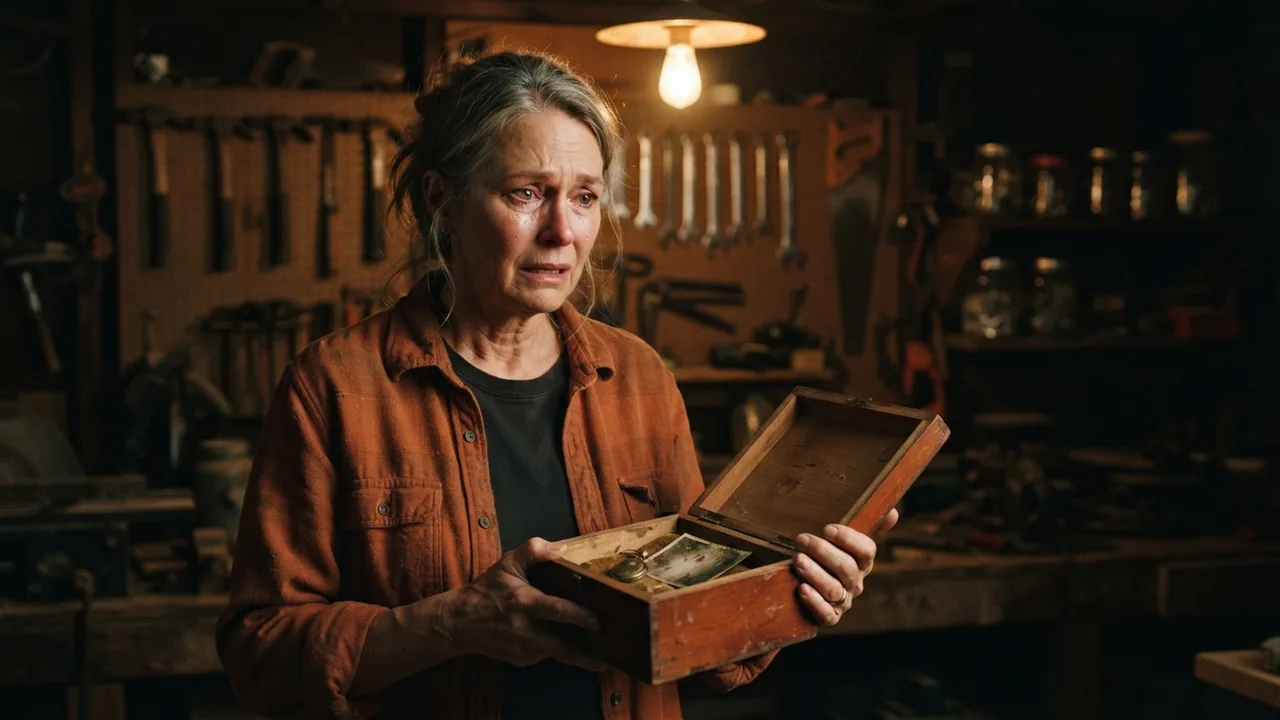
Something was tied to the frame rail in one of Mama's handkerchiefs, the one with the blue D in the corner. A tack held the knot to the wood.
I untied it. It was a ring, a small diamond in a square setting, and I got my reading glasses up off the cord to see the inside of the band. *D.S. to L.G. 6-71.*
Mama never owned a diamond. She wore a plain gold band for fifty-some years and said Daddy couldn't afford better, and she said it fondly.
The dust cover had been tacked back with her big-headed upholstery tacks, set right over my own staples from 1998. I would know my staples anywhere. Mama had opened my work after I finished it and put this inside.
I sat on the floor with the ring in my palm until the light went orange in the window. L.G. could have been Lavelle Gandy. But Aunt Vell had never worn a ring in her life.
The next day Cecil backed his truck up to the porch to haul the last furniture. He leaned in the front doorway, cap pushed back, and watched me set the stripped chair upright.
"Sis, you've got a face on you," he said.
"Well." I held out the ring on the handkerchief. "I found this under the dust cover. Mama tacked it in there after I did the chair in 1998."
He laughed and took it, turning it over with his black-knuckled fingers. "Mama never had a diamond."
"That's what I said."
Out in the yard a pecan hit the truck bed and rolled.
"So it's a customer's. Daddy fixed half of Aberdeen's cars on the side. Or somebody pawned it to him." He dropped it back in my hand. "Put it in the bowl with the costume jewelry. The estate sale folks come Tuesday."
"It's engraved. D.S. to L.G."
"Then it's Dewey Somebody to Linda Somebody. Sis, we close on the thirtieth. You've got a building to buy." He pointed at me with his chin. "You always make a thing bigger than it is."
"It was hidden, Cecil. Nobody hides a customer's ring."
He said nothing, and I folded the handkerchief back around it.
"I'm not putting it in the bowl," I said.
He studied me a moment. "Mama's detective," he said, and he took the last end table out to the truck by himself and drove off to Amory.
He did not come back that week. I carried the lamps and the card table and Mama's winter coats out alone, and nobody teased me about any of it.
A week later I carried the ring two doors down to Ludie Swearingen's kitchen. She was eighty-six and tall as a doorframe, stooped over her stove with a pencil behind her ear, and she had been Mama's friend since before there was a Long Street to live on.
She poured sweet tea I hadn't asked for and told me about her hip, then her sister in Corinth, then the new preacher. I let her finish. Then I opened the handkerchief on her table.
Ludie pushed her thick glasses up her nose and bent over the ring until her pencil fell on the floor. She read the inside of the band with her lips moving.
"D.S." she said. "Lord, honey. That's Delbert Sowell's ring."
"Who?"
"Delbert Sowell. He gave it to your Aunt Vell the summer of '71. She wore it all summer and showed it to the whole choir, held her hand out like a queen. Then it was gone, and Delbert was in Houston before Thanksgiving, and your mama wouldn't let a soul ask about it."
My tea sat untouched. "Aunt Vell was engaged?"
"Lord, yes. A teacher marrying a man with a job in Houston." She picked her pencil up off the linoleum. "It was a hard year, honey. The plant cut your daddy's hours that summer, and Dot put the family on the prayer list. Same fall your daddy burned the house note out back. Dot made a pound cake."
She said it the way she said everything, three things when I had asked for one, and she never put them side by side. I sat with my hand on the handkerchief and put them side by side by myself.
That night I lay awake in my own bed and counted out loud, the way I do, in the dark. Yards, tacks, dollars. I always came back to the same number, which was mine. In the morning I called my landlord, Harlan Pruitt, and asked him to wait.
"Stacy, I'd like to," he said. "There's another buyer looking. I can't promise anything past the thirtieth."
I thanked him and hung up. Then I took the chair to the shop.
Nearly two weeks later I carried Mama's wingback into Aunt Vell's new room at Azalea Gardens, with Cecil on the other end. It was recovered in the blue, with the welt pulled tight along the arms, and I had put the dust cover back on with new tacks.
Cecil went to get the dresser from Franklin Street, which was a twenty-minute round trip. Aunt Vell stood in the middle of her room in her cardigan and her church brooch, hands folded, her right thumb working at her left ring finger.
She looked at the chair a long time. She went white.
"I asked you for it just as it was," she said.
"I know. I'm sorry." I took the ring out of my apron pocket and set it on the blue arm. "It was under Mama's tacks. Ludie read me the name. Delbert Sowell."
She sat down on the edge of her bed, small and upright.
"I told Cecil it was a hidden thing," I said, "and he told me I was making a mountain, and I nearly put it in the estate-sale bowl. Five dollars, Aunt Vell. I came within a day of letting it go for five dollars. And every Thanksgiving for forty years I've sat there laughing with Cecil about how particular you were."
"Hush, now."
"I won't. What happened?"
She was quiet. Down the hall somebody's television was playing a game show.
"Delbert gave me that ring in June," she said. "He had a job waiting in Houston. I chose not to go. Your mama needed me here." She looked at the chair, not at me. "I couldn't bear to look at it, so I gave it to Dot to keep. She told me in July where she'd put it. That's why I wanted the chair."
"You said once you had a house fund. I was sixteen, saving for the Escort."
"I did." She said it flat, tired, as if reading from a roll book. "I had thirty-nine hundred dollars. Seven years of teaching."
"Where did it go?"
"Every dollar of it went where it was needed."
Her hand went to her mouth after she said it. She looked at me, and then she did what she did when a fourth-grader had gone too far. She folded her hands.
"Hush, now," she said. "Your daddy has been gone eighteen years. Let him keep his doubles."
Nothing in the room moved but her thumb.
"Give me the ring, Stacy," she said softly. "Please. And let it rest."
"I can't, Aunt Vell. Not yet."
The ring went back in my apron pocket. Her thumb kept at her finger, and I went out to the lot.
On the tailgate of my truck, in the warm afternoon, I typed *$3,900 in 1971* into the calculator on my phone, because I have counted every dollar of my life and could not stop now. It came to about $30,000.
The other things came back to me in order. Aunt Vell never bought a house and rented on Franklin Street for fifty years. Ludie said the plant cut Daddy's hours that summer, and I have kept a shop's books long enough to know what cut hours do to a payment. A man whose hours were cut does not pay off a house in one season on doubles.
And *let him keep his doubles* was as good as a yes. I knew who had paid.
Cecil pulled in with the dresser roped in the truck bed. I did not tell him. I helped him carry it in, and Aunt Vell thanked us both in her classroom voice.
On Friday morning, at nine, Cecil drove Aunt Vell to Long Street, because she wanted one last look. The kitchen was bare. Pecan shells lay across the yard, and the sun came through the window over the sink onto the linoleum.
Cecil leaned in the doorway. Aunt Vell stood with her purse in both hands.
"Well," I said. "Cecil, I need you to hear this. Aunt Vell paid off this house in 1971 with the thirty-nine hundred dollars she'd saved to marry Delbert Sowell. Every dollar of it. The plant had cut Daddy's hours. He didn't do it with doubles."
Cecil's cap came off. He looked at me, then across the kitchen.
"Aunt Vell," he said. "Tell her that's not so."
She did not say a word. A pecan dropped on the roof and rolled off, and the empty kitchen went quiet again. Then Aunt Vell set her purse on the counter.
"The balloon payment was forty-five hundred," she said. "Clovis had six hundred toward it. Dot was twenty-six with you at three years old, Cecil, and they were going to lose the house. I gave them what I had."
"You'd have been married," Cecil said.
She shook her head, slowly, at the window.
"I'd have been in Houston. Your daddy asked me on the porch to promise you children would never know a woman paid his note. He was ashamed, Cecil. He was a proud man. Dot promised too." She straightened a cuff. "He burned the note at Christmas, and I let him have his bonfire."
Cecil turned the cap in his hands. "I stood up at First Methodist," he said, "and told the whole town Daddy never owed a man a dime."
"He owed somebody," I said. "It was a woman, and we've called her too particular every Thanksgiving for forty years."
"I started that."
"You did."
He looked at the floor a good while. When he looked up, his face had no joke in it anywhere.
"Nobody says that again," he said. "Not at my table. I'm the one who started it, and I'm the one stopping it." He wiped his eyes with the heel of his hand. "I told my boys about a man who worked doubles, Sis. I don't know what I tell them now."
"The truth, maybe," I said. "He was proud. He wasn't bad."
I took the ring out of my apron and set it on the windowsill over the sink. Out past it was the patch of yard by the clothesline pole where the note had burned.
Then I took out my checkbook and the pen from my apron and wrote Lavelle Gandy, thirty thousand dollars, dated that day. I laid it under the ring.
"Don't cash it until after two," I said. "The wire comes at closing."
Aunt Vell looked at the check and pushed it back across the sill with one finger. "You need that for your building."
"Then it goes to Azalea Gardens in your name," I said, "and you can fuss at them about it."
She stood very straight for a moment. Then her shoulders let go a little, the way a chair cushion does when you finally sit.
"For fifty-five years," she said, "it was the one thing I ever did that nobody could thank me for. Now it's out in a kitchen." She picked up the check and folded it into her purse, and clicked the clasp. "Well. I suppose that is what it costs."
She held out her hand. I put the ring on her right hand, and she looked at it a moment.
"Not the left," she said. "The left is for a man who went to Houston."
Cecil took her by the elbow and walked her out to the truck.
We closed at two in a bank office in Aberdeen with a box of tissues on the table and a woman named Pat who stamped everything twice. The money came that afternoon, and I sat in my truck in the parking lot and called Harlan Pruitt.
"Sell it to the other buyer," I said. "I'll rent from whoever buys. I expect the rent will go up."
"I'm sorry, Stacy. I truly am."
"So am I," I said, and I found I meant it only partly.
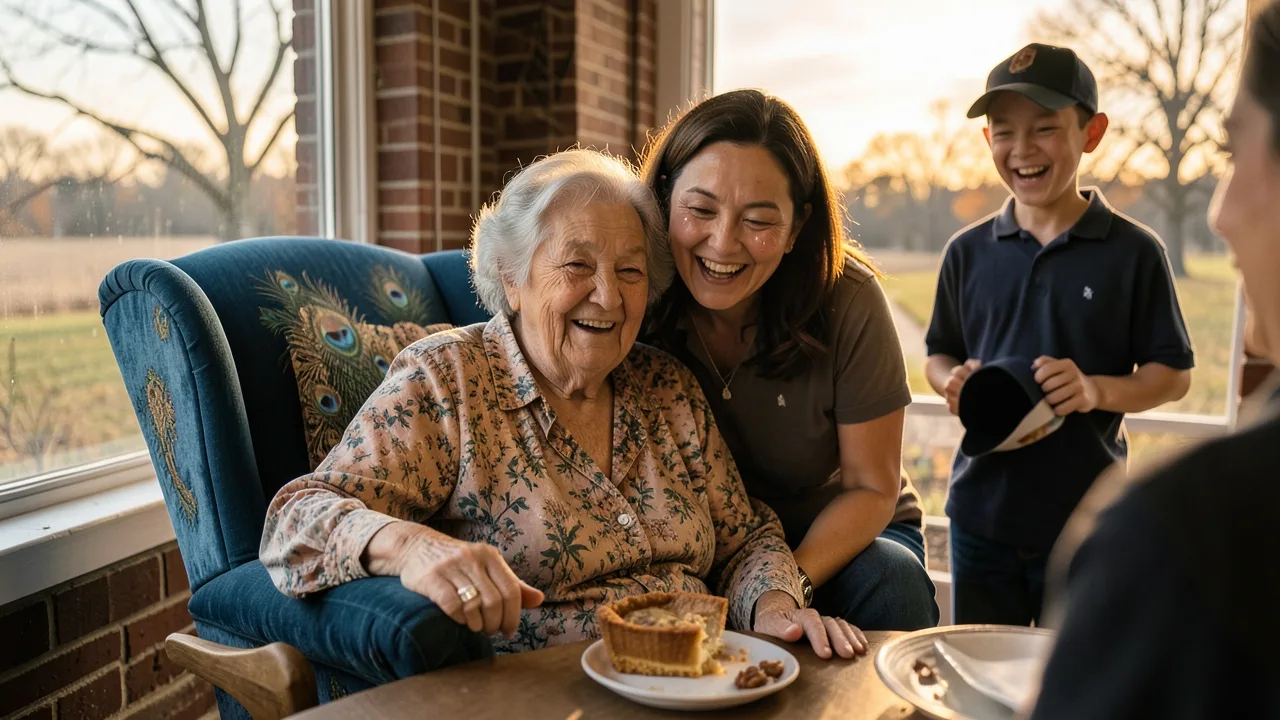
That evening I stopped at Azalea Gardens. A pecan pie sat on the dresser with a slice gone and a fork across the plate.
"Your brother came by an hour ago," Aunt Vell said. "Stood right there with his cap in his hands and ate standing up. Said he'd come Sundays." She sniffed. "I expect he'll bring a pie each time and I'll have to tell him about my sugar."
She was in the blue wingback, with a lamp on beside her and the television off. Her hand moved along the arm, patting the welt where I had pulled it tight, and the ring on her right hand caught the lamp.
"It is a very good blue," she said.
"It's the best chair I ever did," I said, and it was the only one that had never been somebody else's.
Comments