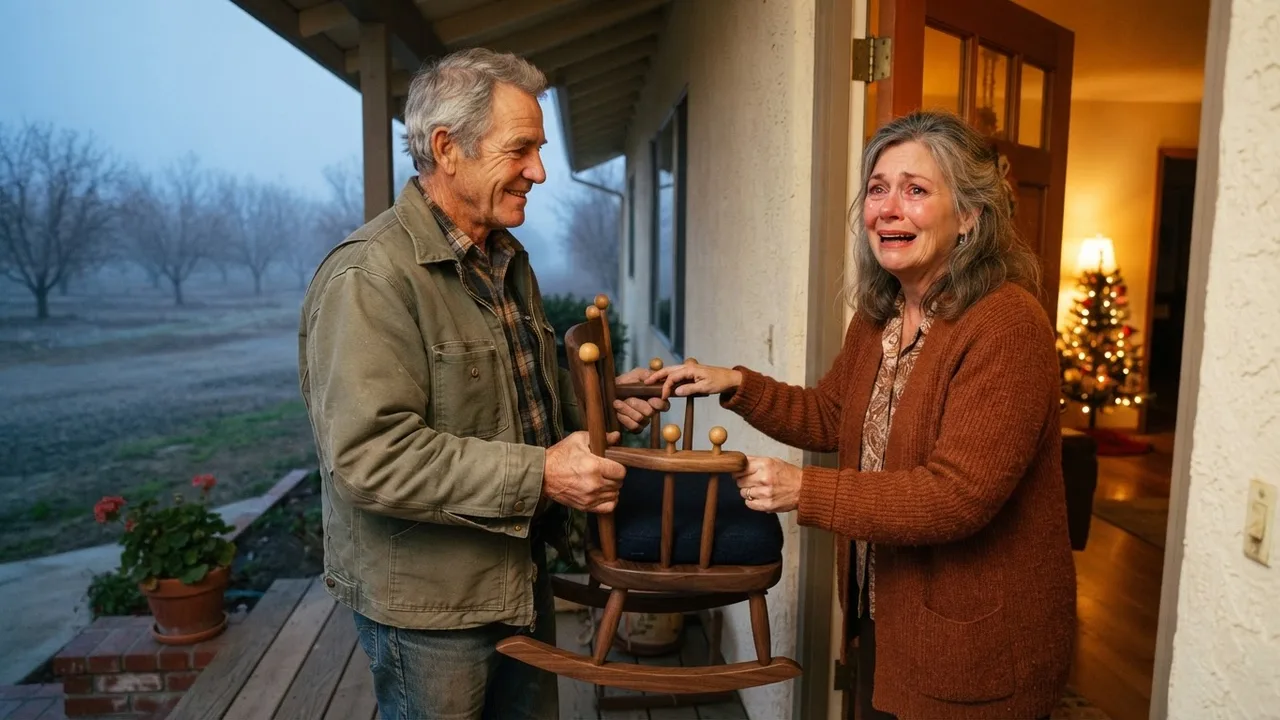
Mom was leaving Turlock for good on December 27, five hundred miles north to my brother's in Oregon, and I had one job before the movers came: carry out the little rocker Dad built me.
I did it on a Thursday, in the tule fog, with the house on Geer Road half in boxes behind me. Mom stood on the porch in her cardigan, buttoned to the throat, and watched me settle the rocker on a moving blanket in the truck bed.
"Mind the runners," she said.
"Well, now, Mom, I've been minding them since I could walk."
"Bend has no room for it. Better you than the Goodwill."
I drove the three miles to Kovach Upholstery on East Main Street with one hand on the rocker the whole way. At the shop I set it on my bench under the lights. Dad had left his walnut pegs proud and sanded them round, so they felt like knuckles under my thumb. He taught me at this kind of bench, and I still check a joint the way he did, by feel first.
My phone buzzed against the tack tray. The testing site Craig had pushed on us last Christmas, the one whose kit I'd mailed and forgotten.
*New match. Ernest Silveira, Hilmar, CA. 2,614 centimorgans shared. Close Family. Predicted relationship: full sibling.*
Under it was his message. *I was adopted as a baby in February 1965. I think you may be my sister. I don't want to upset anybody.*
I sat down on the stool without deciding to.
I had read the help page once, to be polite to my brother. A full sibling meant the same mother and the same father. Mom and Dad married in 1967. I was born in 1968, and all my life I'd been told I was the first, the proof that they had waited.
Hilmar was fifteen minutes from where I sat. I looked at the rocker, then at the phone, and I typed nothing at all.
---
Nine days passed before I answered him, and the first thing I did on that Saturday was lie.
"Mom, I can't make it for the china," I said into the phone, standing in my own kitchen with my truck keys already in my hand. "The Delgados' sofa has to go out Monday and the springs are shot."
"Well." I heard tape screech off a roll. "I'll wrap it myself."
"Craig's coming in two weeks. Save the heavy ones."
"I know how to wrap a plate, Ilona."
I hung up and drove to the Blue Jay Diner on Golden State Boulevard with my face hot. In fifty-eight years I had never told her a lie bigger than a hairdo.
He was in the back booth in a pressed Western shirt and a Cal Poly cap, hands folded on the table beside a cup of coffee he hadn't touched. He stood when I came in. He had a gray mustache and a long jaw I knew from my father's wedding picture.
"I'm sorry to ask you to come," he said. "I'm Ernie."
"Ilona." My voice came out smaller than I liked. "Sit down, please."
He slid a photo across the table, a school picture of a boy of fourteen in a clip-on tie. The jaw was Dad's exactly. I put the photo down because my thumb had started to shake.
"I'm sorry," he said. "May I ask your parents' names? That's all I'd like to ask."
"Emil and Alma Kovach."
He took a napkin from the dispenser and wrote both names in careful block capitals. Then he looked at the napkin instead of me.
"Is your mother still living?"
"Yes."
"I'm sorry to ask that too." He folded the napkin once and put it in his shirt pocket, behind the pen. "Is she close by?"
"She's leaving in four weeks. Oregon. My brother's."
Ernie nodded slowly, like a man hearing a delivery date he couldn't move.
"I don't want anything from her," he said. "Only to see her once, if she's willing. I hope you know that."
I paid for both coffees, $3.25 apiece, and drove home with the photo of a fourteen-year-old boy in my glove box, and a Saturday gone that I would never get back in my mother's house.
---
The next Saturday, he carried his rocker into my shop himself, wrapped in a quilted moving blanket, and set it on my bench next to mine.
They were twins. Same walnut, same rake to the back, same pegs proud and sanded round. His had a worn plaid seat, brown and orange, the kind every shop put on in the 1990s.
"It's for my grandson," Ernie said. "Under the tree. I'd be obliged if it looked like something."
"Well, now. Let's see what's under there."
I pulled the first staples with my tack puller and the plaid came away in a stiff sheet. Underneath was a layer of batting gone to dust, and under that, tacked down hard in a pattern my own hands had learned that summer, green brocade.
I stopped breathing for a second. I knew that fabric by its pattern of leaves. I had held the other end of it at eleven years old while Dad stretched it across six dining chairs on the garage floor.
"Somebody redid this before," I said, to keep my voice working.
"A man at a church fix-it day in Hilmar, summer I was fourteen. Mom, my mom, took it in because the seat was torn. He did it free." Ernie smiled at the floor. "He kept it a week. When I carried it up the porch he was in a truck down the lane. I remember he'd asked me about my grades."
"What did you tell him?"
"Mostly Bs."
I laid the tack puller down. The pegs beside my hand were my father's, and I couldn't have said whose voice I was using when I spoke.
"That was our father. That cloth is off our mother's dining chairs. I tacked it myself."
Ernie said nothing for so long that a truck rattled past outside and the front glass hummed with it. Then he took off his cap and held it in both hands.
"Would she see me before she goes? Only once."
"I'll ask her."
I cut a palm-sized square from the best corner of the brocade and put the rest in a bag for him. He told me to keep the square. I folded it into the bib pocket of my apron, and that was a promise I had no idea how to keep.
---
Craig found me in Mom's garage the next Saturday, the thirteenth, among the moving boxes, with a roll of packing tape and a face like a storm front.
I had come to load the pickup for the Goodwill run. He didn't say hello. He ripped off a strip of tape and sealed a box of canning jars.
"I opened my matches last night," he said.
My stomach dropped, and all I got out was his name. "Craig."
"Ernie Silveira, out of Hilmar. I sent him a message, and he wrote back that he's already sat down with you. Twice." He still hadn't looked at me. "Three weeks, Ilona."
He had used my whole name. When my brother is happy I am Lo.
"I was going to tell you."
"When? In Bend?" He slapped tape across a seam. "Mom is old. She leaves in two weeks. And you're out here doing exactly what she did, deciding for everybody what they can stand to know."
"A man has been told he has a mother, Craig. He's asking to see her once."
"Then let her go. Let her leave in peace." He lifted two boxes at a time, the way he always did, and stacked them against the wall with a bang that rattled a shelf. "You don't get to do this to her."
"And what do I get to do?"
He pulled off his cap and put it on again. "Load the truck," he said. "I've got the rest."
He walked into the house, and I loaded the truck alone.
---
On Thursday the eighteenth, I found Mom alone in the emptied kitchen with her coffee at the bare table. The green dining chairs stood stacked along the wall where Craig had moved them for the movers' pads.
"Sit down, Lonnie," she said. She calls me that only when she's soft, and that day it nearly stopped me.
I sat. "A man named Ernie Silveira, from Hilmar, was born in February 1965. He matched me on that DNA site as my full brother. Craig knows, too."
Her cup went down on its saucer. "Those tests are wrong half the time."
"Not this one, Mom."
"They're a racket. Craig gave them to us for a laugh."
"For fifty-eight years I thought I was the first." I leaned in. "For three weeks I've been lying to your face about sofas and china so you'd get out of this house believing it. I won't do it anymore."
She stood and put one hand on the back of a chair, the way she does when she's holding up a floor. The kitchen clock ticked. I did not move.
"I was eighteen," she said at last. "My father sent me to my aunt in Sacramento. The baby went through the county, and two years later your father and I were married. We never knew where they took him. That was the rule."
"Mom."
"I'm leaving in nine days." She said it like an order. "Let me leave this house as your mother."
"You're my mother either way."
"Well." She picked up her cup, found it empty, and put it down. "That's that."
I drove back to the shop with the square of green in my apron pocket, and I took it out under the dome light in the truck. The fabric Mom had sat on every Christmas of my life. The fabric Dad had put on Ernie's rocker the same summer.
Dad never kept anything from her. He told Mom the price of every board and every hinge. If he had found the boy that summer, she knew where he was.
She knew, and she had stayed away.
On Saturday I called Ernie and asked him to come to Christmas Eve dinner at six.
---
On Wednesday, the twenty-fourth, I stacked three green chairs at the table and pulled a fourth from the wall.
Mom had insisted on the dining room, with the good cloth and the little tree in the corner among taped boxes. She was in the kitchen with the ham. Craig came in with a bowl of potatoes and stopped.
"Four places. Who's the fourth for?"
"I've asked Ernie to come at six." I put a fork down. "Mom can turn him away at the door herself if she wants."
"You have no right." His voice had gone clipped. "Not on Christmas. Not to her."
Mom came to the doorway with a dish towel in her hands. "Who is coming?"
I took the square of green from the pocket of my apron and laid it on the white tablecloth in front of her.
"Dad found him," I said. "He sat in this same cloth. You knew where he was."
She looked at it a long time. The towel hung from her fingers.
"Emil went once," she said. "That summer. He saw it at a fix-it day in Hilmar and he knew his own pegs. I rode along when he took it back." Her mouth worked. "I sat in the truck at the end of the lane and watched that boy carry it up the porch."
Craig lowered himself into a chair.
"That night I made your father promise never to go back. Rose Silveira had a right to her son. And I knew if I saw him again I would never get out of that truck." She touched the corner of the cloth. "I have sat on these chairs every Christmas since, knowing that."
"Mom," Craig said, and could not say more.
"Craig," I said. "I'm not doing this to her. He has never once sat at his mother's table, and in three days this table goes on a truck to Oregon. You gave us those kits because you wanted to know where we came from."
He rubbed his face with both hands. "I gave a toast at my wedding," he said, rough. "About Mom and Dad being the ones who waited. I've told my girls that their whole lives."
"I know."
"It was a good toast."
"It was," I said. "It can still be."
The knock came at six. Nobody moved for a moment, and then Craig pushed back his chair, crossed the hall, and opened the door.
Mom stood with her hand on the back of the fourth green chair until Ernie reached it.
---
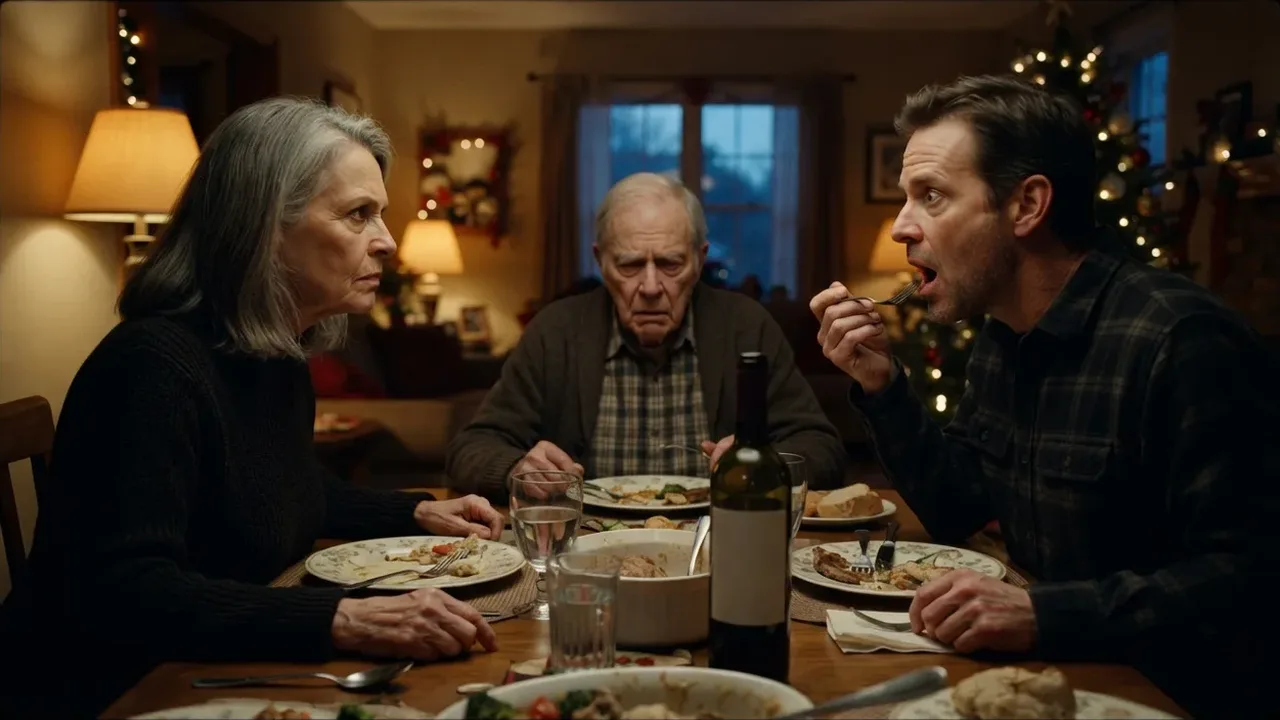
Ernie sat. He held his cap in his lap until Mom took the potatoes from Craig and passed them to him herself.
"How old is your grandson?" she asked, in the voice she used to total the feed store's books.
"Four, ma'am. He turned four in March." He took a spoonful, carefully, as if the bowl might break. "The rocker Ilona re-covered for me is meant for under his tree tonight."
"It's in my truck," I said. I went out and brought in both of them through the cold, his in new navy wool and mine in its old faded blue, and set them side by side by the little tree. Mom looked at the pair of them and set down her fork.
Craig cleared his throat. "Ernie, bring your wife up to Bend in the spring. There's a guest room. It's got a lousy mattress, but it's yours."
"I'd like that," said Ernie.
The jokes came slower than they used to. I had lost the parents who waited, and the first child they were so proud to have, and a father who knew where his son was and never once told me. Craig waited a beat before each one and watched Mom's face. Nobody made a speech. We ate the ham and the rolls, and Ernie told us about the dairy and the feed route, and Mom listened with her chin up.
Late, while Craig and I stacked plates, I heard her speak low across the table.
"I watched you carry that rocker up your mother's porch steps," she said. "You were fourteen. Your mother kept you well."
Ernie put his hand over his mouth. Then he nodded.
When the night was done, I lifted my rocker under one arm and his under the other and walked down the hall into the cold, with the fog standing in the yard. Behind me, my older brother held the door.
Comments