Mother always said she was the last of her family, so when a man in Ephrata showed up on my phone as my first cousin, I knew one question could cost me the only parent I had left.
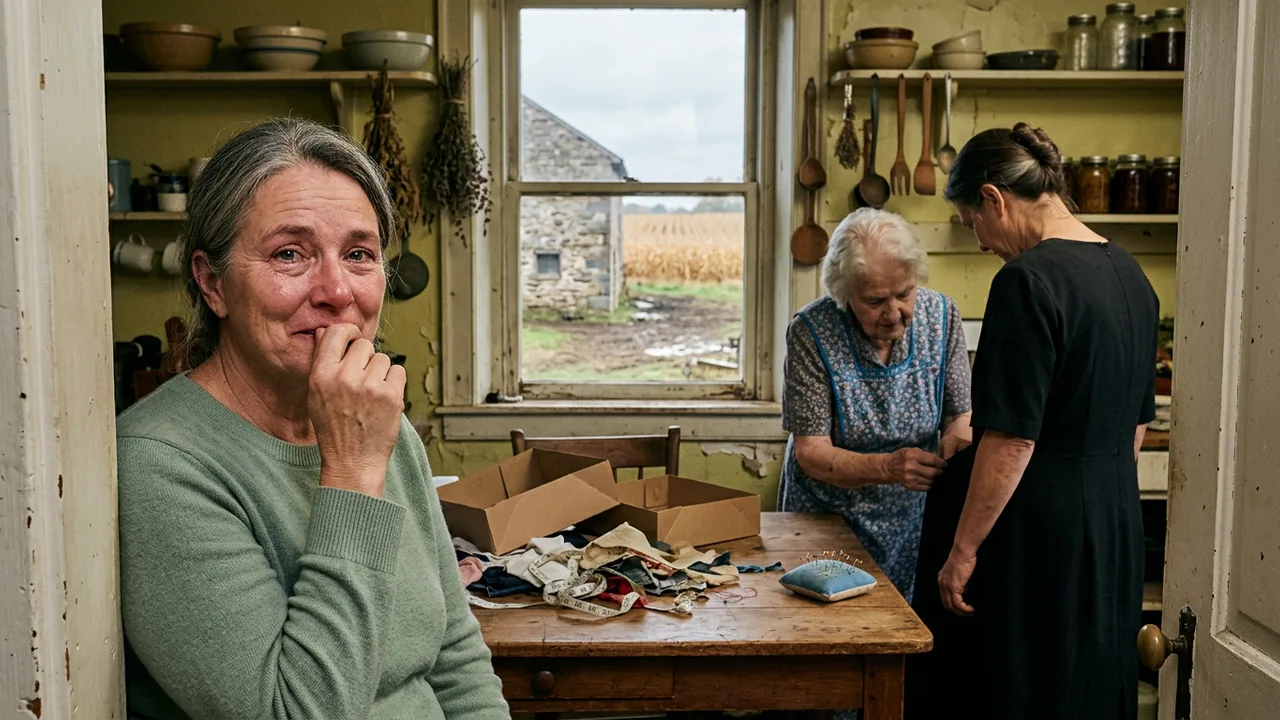
I was sitting at the kitchen table on Locust Street with the phone propped against the sugar bowl. Across from me Mother was fastening the front of a new housedress, taking straight pins one at a time from the little blue pincushion and setting them down the placket like stitches.
*Aaron Nolt, Ephrata, Pennsylvania. First cousin. 912 shared centimorgans.*
I read it with my glasses on and then with them off. It said the same thing both ways.
"You've gone quiet," Mother said. She didn't look up. "That'll be the electric bill."
"It's nothing, Mother."
My father had been an only child. Mother had always said she was one too, an orphan raised by an aunt in Reading, with nobody left. A first cousin meant that one of them had a brother or a sister nobody ever named.
I had bought the test in July to learn about the Lenhart side. I hadn't told her, because I didn't want her thinking I was shopping for other people.
She was eighty-seven. Last winter pneumonia had put her in a hospital bed, and I had slept in the chair beside it and heard her say something in her sleep. I had taken it for the name of a dog.
I turned the phone face down and asked if she wanted tea. She said she'd have it when the hem was done.
I messaged Aaron Nolt the next morning. He wrote back the day after that and asked if I would come by his shop.
---
The next Saturday I told Mother I had an eye appointment in Reading. She said to take my sweater, because the offices run cold.
It was the first lie I had told her in seven years under her roof. It sat in my mouth the whole way out Route 422 and then 322, thirty miles of it.
Aaron Nolt's shop was a cinder-block building behind a house, with lawn mowers lined up outside and a Pepsi machine by the door. He was lean and gray-bearded, in a canvas coat, wiping his hands on a red rag.
"You'd be Robin," he said. He kept wiping. "You've got my mother's forehead. I didn't think that was a real thing."
"My mother is Doris Lenhart. Born Ruppert, she says. In 1939."
He nodded slowly, as if I'd given him a number to check against another number. "My mother had an older sister named Leah. Born 1939. She left before I was born and nobody said her name again. Mother says it maybe twice a year, when she thinks the house is empty."
"Sensenig," I said. I had read it on the match page, in the surname list.
"That's us." He folded the rag. "My mother is eighty-four and her heart is not good. She's moving to Ohio on October 12, to my sister's place in Holmes County. She won't be back."
"I don't know that my mother is your aunt."
"No," he said. "But you're here."
I showed him the picture on my phone, Mother at eighty-five in her garden chair, white hair in its bun. He looked at it so long I thought he'd forgotten I was there.
"May I show this to my mother?"
My mouth said yes before the rest of me agreed. He wrote his number on the back of a repair tag.
Mother was at the sewing machine when I got home. "How were the eyes?"
"Fine."
"They put the drops in? Your glasses are crooked."
I said they'd put them in. She went back to her seam, and I stood in the kitchen with my coat on, feeling like a girl who has taken money from a purse.
---
Jim lives two miles from me, in a ranch house behind his tire shop, with a gray work shirt on every hook by the door. I went on Sunday the thirteenth with a pound of scrapple as an excuse.
I told him at his kitchen counter, all of it, in the plain order I used to give the feed mill's accountant. The match, the shop, the aunt named Leah.
He listened with his arms crossed over his stomach. When I finished he laughed, a short one.
"A spit test, Sis."
"Nine hundred and twelve centimorgans."
"I don't care if it's nine million. Mother is eighty-seven with a bad heart, and you're about to break it over something you mailed to a lab."
"I haven't said a word to her."
"Good. Keep it that way." He picked up the scrapple, put it down. "Bring this up at Sunday dinner and I won't be there. I mean it."
"Jim."
"She's got nobody, she's got us, and that was good enough for forty years." He walked me to the door, and I could hear him not following me out to the car.
He skipped our Tuesday coffee at the Wawa. I called Wednesday, Thursday, Friday, and got his voicemail, his big cheerful greeting over and over. For six days my brother did not pick up. I ate my eggs alone and watched Mother sew.
---
Aaron called the following week and said his mother had seen the photograph. "She wants to see you," he said. "Not the picture."
He met me at the end of the lane that Saturday, the twenty-sixth. The Nolt home farm sat three miles outside Ephrata, white house and red barn, a clothesline with dark dresses lifting and falling in the wind.
The kitchen was full of boxes. Newspaper heaped on the counters, tape guns on the table. Lovina Nolt sat in a chair beside her walker, stooped and broad-shouldered, a white covering over her gray hair.
I held out the phone. She took it in both hands and looked.
"Leah," she said. Then she cried, without covering her face, the way you cry when nobody has asked you to be quiet for years.
Aaron looked at the floor. I stood with my tissues in my fist.
"Our father put her under the ban," Lovina said, soft and halting. "Her name was not spoken in the house. He would not let anyone sit in her place on the bench. Forty years, that place stood empty at the table, and Mother wiped the spot like it was a plate."
"I'm sorry," I said, which was a foolish thing.
"You are Leah's girl?"
"I'm Robin."
Her dress was pinned down the front with straight pins, the heads in a neat row. I knew that row. On the sewing table by the window sat a hard little cushion of faded blue cotton ringed in black stitching.
It was a twin of my mother's pincushion, the same as the one on the sill on Locust Street.
I put a hand on the back of a chair.
"Bring her to me before I go," Lovina said. "October twelfth, the van comes at noon. Will you try?"
"I'll try."
She took my wrist. Her fingers were swollen and warm. "Say it plain."
"I'll bring her."
I lay awake the whole night after, listening to Mother's cane tap the floor of the next room, knowing I had made a promise she'd never agreed to.
---
I told her on Sunday the fourth, at the kitchen table, with the sewing machine behind us under the window.
"Mother, I have a first cousin. His name is Aaron Nolt. I've sat in his mother's kitchen."
She was threading a needle. She finished threading it.
"I know no Nolt."
"His mother is Lovina. She had a sister, Leah Sensenig, born 1939. Leah left in 1959. Lovina knew your face from my phone before I said a word."
"Lots of old women look alike."
"When Frank died," I said, and my voice cracked on his name, "I sat in the funeral home and thought my side of the room was you and Jim. I raised my son telling him there was nobody on Grandma's side. Mother, there were people. They were thirty-three miles away."
She set the needle down. Her hands, which were never still, lay there.
"Leah Sensenig died in 1959," she said. "Let her stay dead."
"Mother—"
"Please don't bring those people to this house." She said it quickly, her eyes on the table. "That'll do, Robin. That'll do."
I didn't push. I carried the cups to the sink and ran water I didn't need, and while it ran I heard it again: my mother in the hospital chair light, mouth moving in sleep. *Lovie, kumm rei.*
I had heard a dog. It was a girl, a little sister. *Come in.*
And I saw Lovina's dress pinned the same plain way, and the blue pincushion on two sewing tables, and Mother's old explanation: *a factory habit.* She hadn't learned it in a factory. She had brought it with her.
*Leah died.* She hadn't been lying about that. She had been telling me who she was.
---
On Saturday I texted Jim: *Mother's heart. Please come to Sunday dinner. It's about her.* He wrote back one word, *Fine.*
He came in his work shirt, though it was Sunday, and kissed Mother on the head. He wouldn't look at me. We ate the pot roast in a silence like a held door.
Before the pie, I got up and took the blue pincushion from the windowsill. I set it on the table between the gravy boat and the butter.
"Lovina Nolt leaves for Ohio tomorrow at noon," I said. "She has one just like this on her sewing table. I'm driving to the farm at nine, whether you come or not. When I get there I'll tell her that her sister is alive."
"Sis," Jim said. "Leave it."
"No," Mother said.
We both turned. She was sitting straight, hands in her lap, very small.
"Mother," I said, "last winter in the hospital you called out in your sleep. You said, 'Lovie, kumm rei.' You asked her to come in."
She put her hand on the pincushion. For a long time nobody moved.
"I took Robin up the lane," she said. "The fall after she was born. Donald waited at the road. Papa met me at the gate. He said I could not come in. He never looked at the baby, not once, he looked over her head at the barn." Her thumb moved on the black stitching. "Mother was in the kitchen window. She didn't come out."
Jim made a small noise.
"That night I told Donald I would be Doris, an orphan from Reading. So no child of mine would ever go up a lane and be turned away. I thought if they had nobody to look for, they could not be hurt."
"Mother," I said.
"If Lovina shuts the door, I have lost them twice. I am eighty-seven. I don't know that I can do it twice."
"She asked for you by name," I said. "She said your name plain, Mother. Leah. She cried."
My mother looked at the pincushion. "Then I'll need my good black dress pinned."
I put my hand over my mouth.
Jim scrubbed his face with his big knuckles. "Forty years I've told the guys at the shop my mother had nobody," he said. "I don't know what I tell them now."
"Tell them she had a sister," I said.
"Yeah." He breathed out. "I'll drive in the morning. I won't have the two of you on Route 322 alone."
---
Jim drove the thirty-three miles in his truck cab with Mother between us in the good black dress, her cane across her knees. Nobody turned the radio on.
Aaron met us at the foot of the lane, cap in his hands. He looked at my mother through the windshield and he said, quietly, "Aunt Leah."
She nodded once.
Lovina opened the kitchen door herself, leaning on her walker among the taped boxes. The two of them stood a moment with the width of the doorway between them.
Then Lovina said something in Pennsylvania Dutch, and my mother answered, and the words came fast and low and soft in a language I had never heard her speak. I understood none of it. Mother sat down at the table and Lovina sat across from her, and they held each other's hands in the middle of it, over the newspaper and the tape.
I stood against the counter with Jim. He had his cap off and was turning it, and neither of us moved.
After a while my mother turned in her chair. "Lovie," she said, in English, in the voice she used for company, "this is my Robin."
"I know," Lovina said. "I've met her."
We had two hours. Aaron made coffee and Jim carried boxes out to the porch, and Lovina told Mother about the bench, and Mother told her about Donald and the dress factory, in pieces, with the Dutch coming back into her sentences whenever she forgot herself. I understood that the girl at that table had never been the orphan I'd tended. I had been keeping house for a stranger, and the stranger had kept me.
At a quarter to twelve the hired van pulled in, white, with a driver in a fleece. Lovina stood, and one pin at the top of her dress had worked loose, so the front hung open an inch.
Mother rose, took a straight pin from her own blue pincushion, and fastened her sister's dress where it had slipped. Then she set the pincushion in Lovina's last open box, beside its twin, to go to Ohio.
Comments