The letter said that unless my roof was replaced by October 31, my homeowner's policy would not renew, and the bank that held my mortgage would buy one for me that I couldn't afford. The house on Yucca Street was my shop too, one chair and one sink in the front room, so whatever the bank added to the house it added to my living.
Rochelle Lovato read the letter to me twice on Monday in her one-room office on Bullard Street, once as written and once in plain words. She pushed the tissue box an inch toward me and I ignored it.
"The carrier won't renew roofs over twenty-five years old, Luz. Yours went on in '98."
"Then a patch. Somebody's nephew with a ladder."
"I asked. A patch doesn't count."
"And if I let it lapse?"
"Your servicer buys a policy and adds it to your payment. About $412 a month."
I thought of the $780 I already paid, and the $2,300 my chair cleared in a good month, and I could not make them sit together. I had $5,200 in savings. A roof, Rochelle said, would run well over $12,000.
I walked home without crying. That night I lay awake listening to the corner shingle tick against the roof in the wind, the way it had all summer, and I didn't sleep.
Silver City roofers were booked into December. Two weeks later I posted in the Grant County group and in a Las Cruces home repair group, where there were more crews: roof by October 31 for insurance, small house on Yucca Street, hair salon in the front room, must be done in one day. I signed it *Luz O.* and put in my number.
A week after that, on a Monday, Ofelia came across the yard in her slippers with the hem of her cardigan soaked.
"Muchacha, the water heater burst. My whole laundry room is a lake."
The plumber's truck was already at her curb. He wouldn't set a new heater until he was paid, and her son in Phoenix let the phone ring and ring. I went in for my checkbook, and Ofelia followed me into my kitchen. My roof figures sat on a sheet of notepaper under the sugar bowl, with the insurance letter beside them.
She read them. She was a school secretary for thirty years and she reads everything.
"Ay, no, muchacha. Not from that."
"It's $900." I tore the check out. "There's no hurry."
"I'll pay you back."
"I know you will. Go sit down before you catch cold."
I gave it to the plumber anyway and carried it across the yard myself.
Natalia drove down from Albuquerque the Saturday of Labor Day weekend, tall and short on sleep, still holding her car keys when she came into the kitchen. I had stew going, green chile and pork, in the blue enamel pot. It has a dent in the side and a chip at the lip where the black shows.
"Mom, listen. Throw that thing out and buy a real pot. You'll cut your mouth."
"That pot's older than you are."
I kept stirring. I thought, and didn't say, of carrying it out the back gate one winter to a skinny boy I called Sparrow. I let the thought go because Natalia had already moved on to the refrigerator, the stove, the ceiling stain over the hall, and then to the roof.
"What roof?"
So I told her about the letter. She ate two bowls and said nothing more until morning.
Over breakfast on Sunday she laid it out like orders at the end of a shift.
"Mom, listen. I'll lend you $2,500 toward the roof. In the spring you list the house and take the apartment two streets from me. I already looked at it."
"I gave Ofelia $900 two weeks ago. For her water heater."
Natalia put her fork down. "You'll give it to the neighbor but you won't take it from me?"
"Not with the house attached, mija. No."
"Then that's your answer."
She went formal then, which is how she goes when she's hurt. "I understand, Mom. Thank you for breakfast." She packed and was gone before noon, a day early. I washed her cup and sat down facing my own empty chair.
The next Saturday a young man stood in my front yard with a tape measure. His crew's truck said Talamantes Roofing, Las Cruces. He was lean and sunburned across the nose, with a carpenter's pencil behind his ear and a leather tool belt worn soft as a glove.
"Ma'am, Adrian Talamantes. I'm the one you booked for the quote."
I watched the tape. Contractors who see *widow* and *deadline* in a post get friendly with a tape. He measured the eaves and the pitch. Then he walked the yard asking questions, and I answered each with another question, which is how I protect myself.
"How long have you lived here, ma'am?"
"Why do you ask?"
"Just wondering. And the salon, how long have you cut hair here? Sorry. That's one more question."
"Since '94."
He nodded slowly. He glanced down the side of the house toward the back gate and then at his clipboard. In my kitchen he wrote $13,800 and wouldn't meet my eye.
"My father died in February. He left me the company. We've lost two jobs since." He stopped. "I shouldn't have said that."
I heard it as a reason he'd pad the bill. I said I'd think it over, and I showed him out.
On the Monday after the next, I carried both quotes to Rochelle. One was $12,900 from a Silver City crew that couldn't come until December. The other was Adrian's.
"Could the carrier renew on a signed contract and a December date?"
"Let me call."
She dialed underwriting and I sat with my purse on my knees, looking at the framed certificates behind her head. I heard her say "signed contract" twice and "hardship" once. When she hung up she didn't need to tell me.
"It has to be on before October 31. I'm sorry."
Across that desk I made up my mind about Ernesto's truck. It had sat in the carport since the year he died, and it was the last thing of his I still used, for hauling and for the dump. A man from Bayard came that Sunday with cash, $3,800, and I waited by the carport post while he turned the key. The engine caught on the first try, the way it always did for Ernesto. Then I had $8,100 and a bare spot of oil on the concrete.
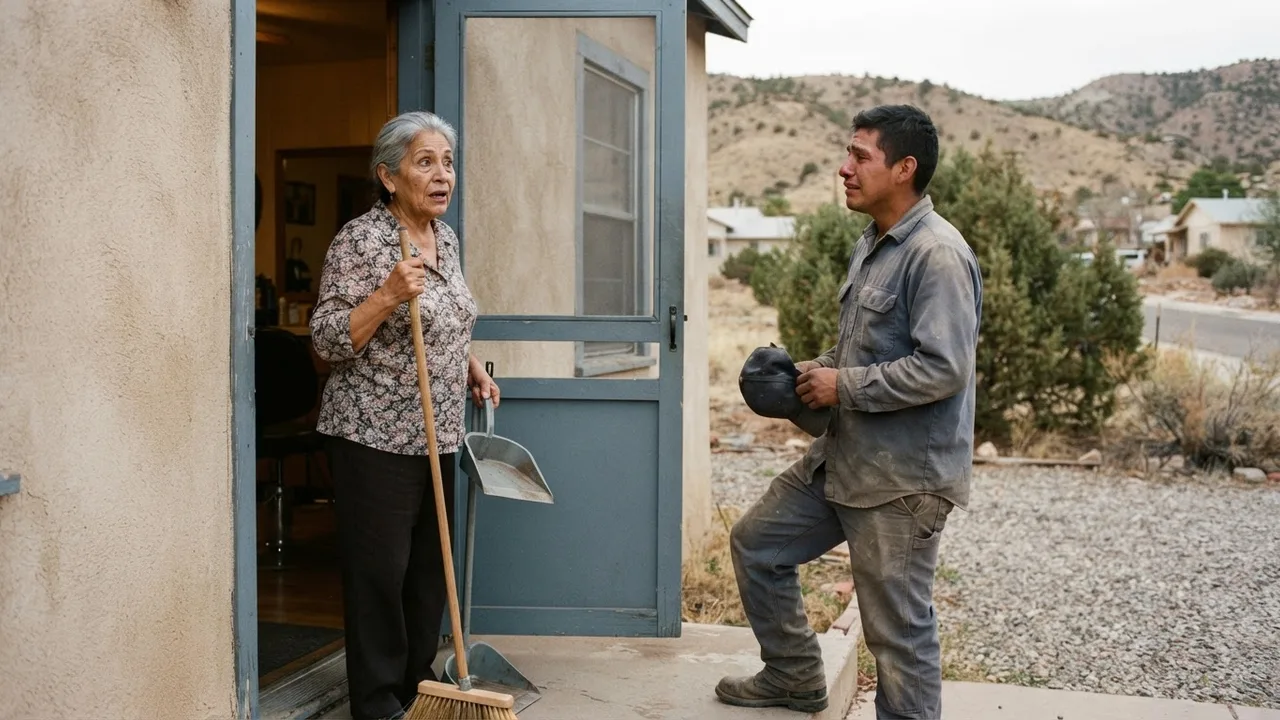
Adrian came back on a Saturday, after my last client, a woman named Mrs. Archuleta who tipped in quarters. I was sweeping around the chair when someone knocked at the screen door. It was him, with his hat in his hands.
"Ma'am, could I sit down a minute?"
"It's the chair or the stool."
He took the stool. He had the same worn tool belt on and didn't seem to know what to do with his hands.
"I think you knew my father, Efraín Talamantes. Before I was born. He was nineteen and he roofed on this street after the hail."
"That name means nothing to me."
He took a breath. "You called him Sparrow."
I remembered a skinny boy in a truck. I did not believe the young man in front of me. A roofer who had quoted me $13,800 three weeks ago wanted something, and I had been cut open once by a kind word.
"Anyone could have heard that somewhere. Who told you?"
"He did. He said you'd hand the pot over the gate and say, 'Eat, Sparrow, and go before my husband sees. He'd say we can't feed the whole street.'"
I sat down in my own chair. Nobody alive knew those words but me and that boy. Ernesto had said them in our kitchen, and I had carried them out the gate every night in my own mouth.
"Is he outside?"
"No, ma'am. He died in February, on a job site, his heart. He told me before. He said find the hair lady on Yucca Street who called me Sparrow and tell her I made it."
I didn't say anything. The sink dripped. Out on the street Mrs. Archuleta's car started and pulled away.
"I looked in March," he said. "Salons on Yucca Street, and there's nothing, because you take appointments by phone. Then your post came up in August with the street and the front-room salon. I booked the quote to see. When you said since '94, I was nearly sure, and I couldn't say it and be wrong. My mother remembered he'd said 'Luz' once. It took me three weeks to clear a free day with my crew." He looked at the floor. "I'd like my crew to do your roof on the twenty-fourth. You pay materials only. Sorry. I know that's a lot to ask you to take."
"You told me yourself you lost two jobs."
"Yes, ma'am."
"Then I'm not taking charity from a boy who's short."
"He always meant to come up. He said it every Christmas and he never did. I can't let that be the last word on it."
I looked at my own hands. They had held that pot every night for three months and I had never once told anyone.
"Materials, $4,600, I pay. Wages for your three men, $720, I pay. I'll take your own day, and that's all I'll take."
"Ma'am—"
"That's my price, mijo."
He put out his hand. His palm was rough like Ernesto's, and I shook it. That night I wrote the check at the kitchen table, and I wrote it twice before my hand would hold still.
I called Natalia the next day. "A roofer from Las Cruces will do it on the twenty-fourth, for materials and wages. I'll explain in person."
"Explain what? Mom—"
"In person, mija."
On the Monday I told Rochelle the date and told Ofelia over the fence. Ofelia only said, "Ay, thank God," and went on pulling her dead geraniums.
The twenty-fourth came in cold and windy, with the dumpster at the curb by dawn. Shingles came down off the roof like hail, and four men walked the ridge in the half-dark. Adrian was up there in his father's belt. I waited out in the yard with a thermos and watched.
Natalia pulled up mid-morning after four hours on the road, keys in her fist, still in her hoodie.
"Mom, listen. You said you'd explain."
"After they eat."
Ofelia came across the yard in her slippers with a foil tray of breakfast burritos for the crew. She stopped beside me and pressed a folded fifty into my hand.
"First payment, muchacha."
I would have refused it a month before. I put it in my smock pocket and said thank you.
At the picnic table, with the men eating on the porch steps and the wind pulling at the foil, I told Natalia. The boy in the truck, the winter her father was laid off, the stew in the blue pot, the grocery money I'd hidden from him, the extra Sunday clients I worked every week to make it up. I told her that the roofer on the ridge was that boy's son.
She didn't say anything for a long time.
"You lied to Dad."
"I did."
"For months. And you wouldn't take $2,500 from your own daughter, but you'll take a roof from a stranger's son."
"I turned you down because the loan came with the house attached." I held the thermos so I wouldn't fidget. "And my pride was as much to blame as your condition. I'll own that."
"Mom."
"I want to ask you for something that isn't money. After the holidays I'll come up one week a month and keep the kids on your night shifts."
Her face went. She pulled her hair knot tighter and then let it fall.
"I wanted you close for me," she said. "I'm drowning. Esteban's gone half the week and I'm at the hospital all night, and I'm so tired I forget what I said to Mateo." She wiped her face with her sleeve. "I already told the kids Grandma was moving up. Now I have to tell them you're not. That's what it costs me."
"I know it is."
She stood and went to the shed, came back with the push broom, and swept nails off the driveway for the rest of the afternoon, up and down, in the cold.
Late in the day, with the new shingles dark and even on the south side, Adrian came down the ladder with an envelope. He held it out.
"I put the shingles on my account, ma'am. This is your $4,600."
Natalia had stopped sweeping. I took the envelope, folded it once, and tucked it back into his shirt pocket, flat under the flap.
"Your father paid for that stew already," I said. "He made it. Bring your mother up for a pot of it before Christmas."
"Yes, ma'am." His voice cracked on it. He turned to hide his face and went back up the ladder.
At dusk Rochelle walked over from her house, three blocks, in her good coat with the readers up in her hair. She stood at the curb a long time looking at the new ridge line.
"That'll renew. Send me the invoice and photos tonight."
The trucks drove off with the dumpster. Natalia hugged me hard at the car and said she'd call from Socorro. Ofelia's porch light came on. I was alone in the empty yard with the broom she'd leaned against the fence.
Afterward I sat on my back step by the gate. I had paid out $5,320 and had $2,780 left, no truck, and a daughter who had dropped the listing and the apartment. Adrian had gone home with his father's errand done. Efraín had made it, and I had learned it eight months after he died, too late to tell him I was glad.
The blue pot sat on the stove behind me, dented, ready.
In the last light a row of sparrows settled along the new ridge cap, one after another, and the corner shingle that had ticked all summer was silent.

Comments