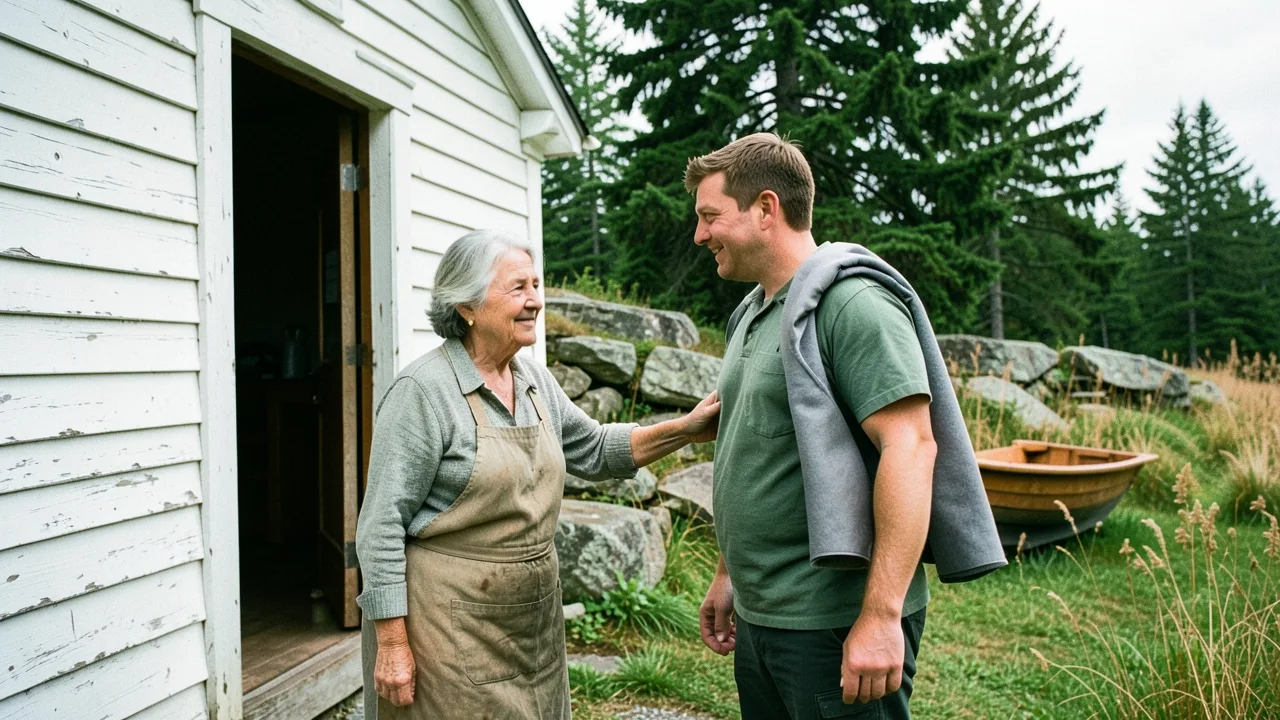
The credit union gave me until October 15 to come up with $3,540, and the only thing I owned worth that much was the skiff my husband named after me.
Roxanne Pelkey said the number twice across her desk, as if the second time might land softer. She wore her navy cardigan. A cup of tea went cold at her elbow beside a photo of two boys in hockey gear.
"Two payments behind, Hilary. That's $2,360. September's comes due on the twenty-fifth, so by October 15 we need $3,540, or the account goes to collections and we start a notice of default."
"I know what it says."
"I hear you." She turned the paper toward me anyway. "What's in checking?"
"Nineteen hundred."
"Is there family who could help? Your son?"
The branch was on Main Street, five minutes from my house, and I would be nodding to this woman at the post office for the rest of my life. I looked at the framed hockey boys instead of at her.
"The loan paid for Garrick's treatment," I said. "All sixty-eight thousand of it. Reid thinks insurance covered it. He doesn't know."
Roxanne wrote something small on her pad. "The draw period ended in June. That's why the payment jumped."
"I noticed."
Two days earlier, Reid had come down from Bangor for Sunday supper with six mackerel in a bread bag, caught off the Belfast footbridge. He laid them in my sink like a cat bringing a gift.
"Ma, I'm saying it one more time. Sell the place. Rent something near me. Heat one room instead of eleven."
"Hand me the cornmeal."
"But never the skiff. The skiff comes to me. Dad built that cradle for it."
"Nobody's selling the skiff." I dredged the fish and laid them in the pan, and the fat spat. "Nobody's selling anything."
"You don't even like mackerel," he said. "You never eat it."
"I got paid in mackerel once." I don't know why I said it. "A whole bucket, for three Saturdays restitching a lobsterman's winter cover at Hatch's. His little girl slept in the truck under my coat the whole time."
Reid stopped with the cornmeal in his hand. "You never told me that."
"There was nothing to tell." I turned the fish.
On Wednesday I posted in the Midcoast boaters group: winter covers and repairs, taking all work, *Hilary Spofford, Spofford Canvas, started at Hatch's sail loft in 1996.* Then I went out to the barn and cut canvas for the one cover I had on the books, because the work was the one part of the trouble I knew how to do.
The Belfast boatyard that used to send me a dozen covers a winter had been sold in the spring to people who used a shop in Portland. Nobody had called me about that, either.
On a Thursday afternoon a woman walked into the barn while I was setting a seam on a half-finished cover. She was broad-shouldered, with a dark braid and a black fleece vest with a co-op's name stitched on the chest. She held her phone up in a waterproof case and photographed my cutting table before she said hello.
"Fourteen covers," she said. "Tell me what thread."
"Bonded polyester. Heavy."
"Stitches per inch?"
"Six. Eight at the corners where it chafes."
She got down close and photographed the corner. Then the hem, then the back of the hem. She asked about the acrylic, where I bought it, what I charged to reinforce a stanchion hole, and whether I'd drop the price on volume. I answered the sewing questions at length. She asked three where one would do, and I had met her kind before. She wanted my numbers to carry to the Portland shop and set against theirs.
Out the open barn door the Hil sat on her cradle in the dooryard, white in the thin sun.
"How long have you been sewing?" she asked.
"Since Hatch's."
She looked at me a beat too long. Then she slid the phone into her vest. "I'll be in touch."
I didn't expect to hear from her. I went back to the seam.
The rain came in the next week's blow and kept on. That Saturday a skinny kid in orange bib pants stood dripping in my barn door, a cut thumb taped with electrical tape and a wad of damp bills in his fist.
"Ma'am, I'm sorry, ma'am. Jory Tibbetts. From Searsport. They say you're the best on the bay, and my dodger blew out Wednesday, and I got to haul Monday or I lose the bait and my uncle's patience, and I only got sixty dollars."
"Show me."
He had it in a trash bag. The stitching had let go along the whole windward edge. A dodger like that wanted a good $380 of cloth, and I had exactly that much on the rack, bought for a paying customer's cover.
"Sixty won't buy the thread," I said.
His face dropped. "No, ma'am. I figured."
"Put your money away." I took the bag. "Come Monday at five and it'll be on the boat."
"Ma'am, I can't—"
"Go home, Jory."
I cut the new dodger that afternoon and sewed until the rain quit against the roof. Then I started the paying cover from scratch on whatever scraps I had left, the $380 of cloth I had no money to replace already gone into Jory's dodger, and I was still at the machine after 2 a.m., my eyes burning, so the real job wouldn't slip. I made coffee at one and didn't drink it.
That was the kindness I couldn't afford. I knew it going to bed, and I'd have done it again.
On the Friday of the twenty-fifth I missed the September payment, as I had known I would. I put an ad on the board at the feed store for the skiff. A man from Lincolnville came on the first Saturday of October with a trailer and $4,200 in cash.
"Good boat," he said, running his hand along the gunwale.
"My husband built her."
He had her strapped down and gone up the road before noon. I stood in the dooryard looking at what was left, the cradle Garrick had cut and pegged himself, empty as a bed.
Reid's truck came up the drive that afternoon. He had said he'd help me put up the storm windows, and he got out with his father's old Carhartt on and his Lions cap pulled down. He stopped halfway across the yard.
"Where's the Hil?"
"I sold her."
"You what?"
"This morning. A man from Lincolnville."
"Why?"
I had the speech ready in my head, the loan and the three payments and the number, and it wouldn't come. I'd sworn Garrick's boy would never carry any of it. "It's done, Reid."
"That was Dad's." His voice went polite, which was worse than shouting. "You knew I wanted it."
"I know."
He put up two windows without talking and left before the potatoes were done. The texts I sent that night sat unanswered, and the next weekend he didn't come, or the one after.
On Monday I paid the credit union the $3,540 in a cashier's check. Roxanne stamped it and didn't say a word, and I was grateful. That left no winter work booked and $1,180 due every month after.
On a Wednesday, late in the afternoon, the same woman in the black vest came back alone. The sun was low through the open barn door and lay across the empty cradle.
I was braced for her. "The price is the price. Seven hundred a cover. I'm not coming down."
"I know," she said. "The board voted on September 24. They want all fourteen at your price."
I put the shears down. "All fourteen."
"I'm Tamsin Marston." She waited a moment. "My father was Ansel Marston."
The name meant nothing. I had mended a hundred covers in my years at Hatch's, and every one of them had an owner who shook my hand.
"You told him to pay you in mackerel," she said. "Winter of 2001. The *Tamsin Rae*. I was the kid asleep in the truck under your coat."
Then I saw the loft steps in November light, and a five-gallon bucket sitting on them the next August, silver and still wet, and no man anywhere near it. And a little girl with a dark braid, wrapped in my brown loft coat, with her boots sticking out.
"That was you?"
"That was me."
Something hot went up the back of my neck. "You read my post. You saw 'Hatch's' and felt sorry for me."
"Hilary—"
"I don't take work out of pity. I gave that cover away. I won't be paid twice for it."
"The board never heard a word about my father." She said it hard. "I came in September as a buyer. I photographed your seams and took the pictures to them, because I promised I'd only send them work I could show. They voted on stitches." She pulled the braid over her shoulder. "My father drove to Belfast in 2012 to thank you. Hatch's was closed and nobody knew a Hilary Coombs. He died in February, a heart attack, before he found you."
I sat down on the stool by the machine. The thread spool was still turning a little where I'd let go of it.
"Where did the skiff go?" Tamsin said. "I saw it in September."
"Sold. Eleven days ago."
"If I'd told you who I was—"
"You'd have been a stranger with a story," I said, "and I'd have sold it anyway."
She nodded slowly, like someone taking a hit she'd figured on. I would have cried if she had asked me anything else.
"Come back on the twenty-fourth," I said. "I'll have an answer."
That left ten days. I spent the first few of them sewing and telling myself no. The work was good work and the money was real, and every time I laid the two next to a bucket of mackerel on a loft step, it came out looking like charity.
Then I called Reid. It rang out. I called again from the barn on a Wednesday night, and he picked up.
"Ma."
"Come Saturday morning. Nine o'clock. To the barn, not the house."
"Is something wrong?"
"Yes," I said. "That's why."
He came at nine in his father's Carhartt. Tamsin pulled in behind him a few minutes after, with a clipboard and a roll of drawings tucked under her arm, the boat list in her vest. The first co-op pattern was already chalked on the canvas across my cutting table.
I didn't offer anyone coffee. I took the credit union envelope out of my apron pocket and laid it on the canvas between us.
"Read that."
Reid looked at me and then at Tamsin. He took off his cap, which he never does indoors, and unfolded the letter. His lips moved at the numbers. He went back to the top and went through it again.
"Sixty-eight thousand," he said.
"Your father's treatment. Insurance paid part. This paid the rest. I drew it in 2023 and 2024." My voice cracked and I made it keep going. "The payment jumped this summer. I missed three. I sold the Hil to catch up, and that's why she's gone."
"You told me insurance handled it."
"I did. You'd have quit your apprenticeship to send me money. Your father would have done it, and you're his son. I wasn't going to let you."
"Ma." He sat down on the upturned bucket by the table. "I've spent three weekends telling myself you sold Dad's boat because you were done grieving. That you wanted him out of the yard."
"I know. I watched you think it."
"I liked being right about it." He rubbed his thumb along the cap's sweatband. "It was easier than this. Giving it up costs me something."
Tamsin stood very still with the clipboard against her chest.
"There's more," I said. "This is Tamsin Marston. In 2001 I mended her father's winter cover at Hatch's for three Saturdays. The mackerel I told you about, that was him. She was the girl in the truck."
Reid looked at her. "You're the one."
"I'm the one," Tamsin said.
He put the cap back on and took it off again. "How many covers?"
"Fourteen," I said. "Tenants Harbor."
"Each one needs fitting on the boat before it's sewn off. That's an hour's drive down and an hour back." He looked at the pattern. "I'll do it. Every Saturday through December."
"You've got overtime on Saturdays at the shop."
"I know what I've got."
That was all he said about it. Tamsin let out a breath and came forward and took an envelope from inside her vest. It was soft at the corners, with *From Ansel* written across it in a woman's slanting hand.
"My mother sent this. It's two thousand dollars."
I looked at it a long moment. Then I put my hand over hers and pushed it back.
"Your father paid me."
"In mackerel," Tamsin said, and her mouth twisted. She put the envelope away.
I took the pen and signed the co-op's order, and she laid the $2,800 materials deposit on the canvas, a check I could bank by noon. I folded it into my apron over the thimble.
"We sold his boat in June," Tamsin said to Reid, as if he'd asked. "Me and my mother. I drive past it in Rockland. It's still got the name on the stern."
"That's rough," Reid said.
"Yeah."
Nobody made a speech. Reid got up, found the measuring tape on its nail by the door, and ran it out along the first pattern, reading me the edge of it in a low voice while I chalked. Tamsin held the clipboard and called out boat lengths, and the three of us worked down the table.
He stayed to supper that night. We ate leftover haddock chowder, and he put the Carhartt on the hook where it had always hung.
The Saturday the first cover came off my machine, it was gray and still, with the last of the boats coming out of the water all along the coast. I had rolled it and tied it with sail twine. Reid backed his truck up to the barn and came around the side of the house with it on his shoulder.
He stopped at the cradle in the dooryard. Then he laid the cover across it, snug against Garrick's pegged oak, and stood there with one hand on the rolled canvas before he went to put the tailgate down.
Comments