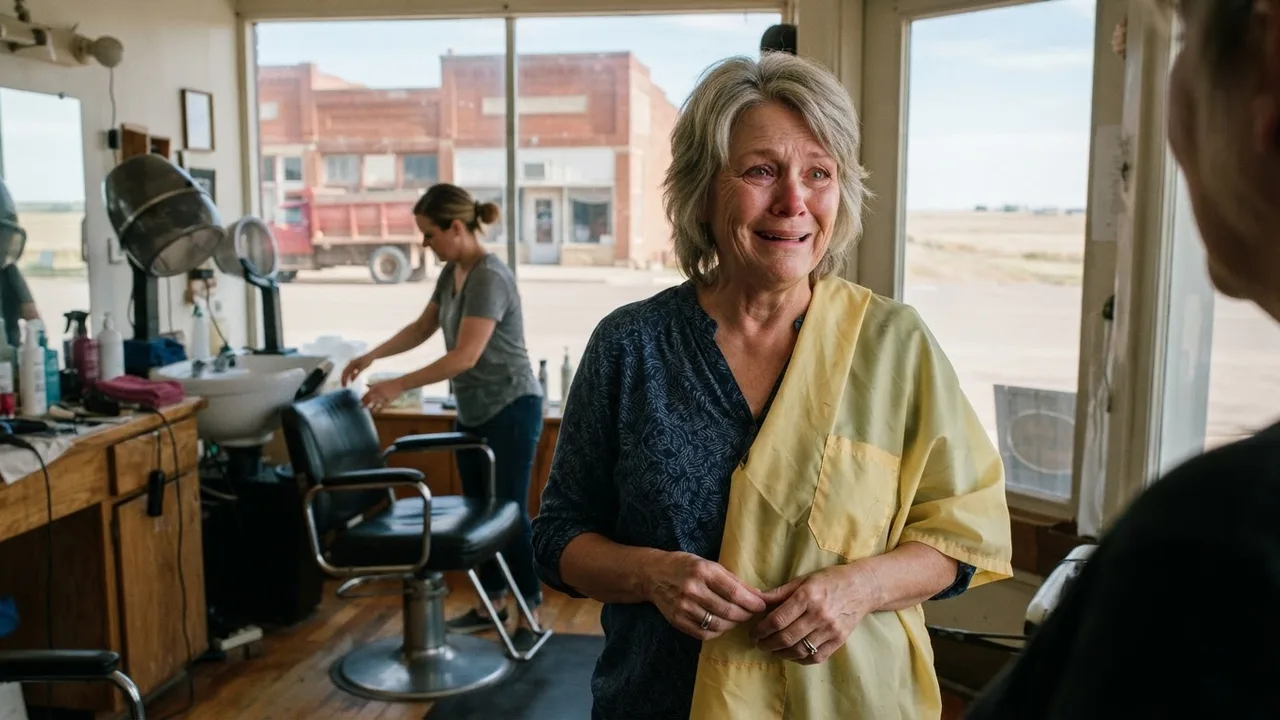
My son-in-law stood in my shop with his hard hat under his arm and told me I could be there when my first grandchild came, but only if I closed my chair for two weeks.
Two weeks closed was about seventeen hundred dollars I would not make. Rent of six hundred fifty was due the first of the month, and I had nineteen hundred put by.
"Brooke's due November 4, ma'am," Nolan said.
"Nolan, I've told you not to call me ma'am."
"Yes, ma'am." He turned the hard hat a little in his hands, and a grain truck went by on Highway 2 and rattled my front window. "She wants you there. She won't ask. She said it plain, though. Two weeks, or don't come."
I had a comb in my hand. I put it in the jar of blue sanitizer, mostly so my hand would have something to do.
"Did she say why two?"
He took his time with it. Nolan always did, like every word might be live. "She said two days and back to the chair is what you did when Dad was dying."
That was the first I knew of the baby, and the first I'd heard in five years what my daughter thought of me. I heard it from a lineman in a fire-resistant shirt, standing next to my appointment book.
"Well," I said. "Then I'll come."
"She doesn't know I'm here."
"I figured."
After he left I sat down in my own chair, which I almost never do, and looked at the book. I lay awake that night too, doing the sum on the back of an envelope, and it came out the same each time I did it.
On Thursday I set Arlene Voss's hair, same as every Thursday. She is eighty-four, and she holds her vinyl purse in her lap under the dryer like somebody might come for it. I told her about the baby while I wound her last rod, only half listening to myself, because the other half was still working out how a woman closes a one-chair shop.
"Well, it's about time," Arlene said. "Somebody in that family had to do something." She went under the hood, and the old dryer in the corner started its roar. She hollered over it. "This thing is older than the courthouse!"
"I bought it when Pfeiffer's closed."
"Pfeiffer's. Two blocks off the square." She said it like she was correcting a date. "What was it doing there?"
"Holding up a little girl, mostly." I don't know why I said it. "She sat under it every afternoon after school, because her mother had the next chair. The mother was new in town with talk behind her, and nobody would rent her a chair. So I told Mrs. Pfeiffer to put her in and take it out of my pay if a dime went missing."
Arlene looked at me from under the hood. "I'll tell you what, that was either kind or foolish, girl."
"Probably both."
"What became of the child?"
"I can't tell you her name. I called her Astronaut. I'd bring the hood down over her head and count her down from ten."
The timer went off. Arlene said the baby could do worse than Arlene, and we were back to the baby.
I put a notice in a Nebraska stylists' group on the first of the month, under my own name and the shop's. I asked for a licensed stylist to cover November 2 to 14. It drew one reply, a woman in North Platte who wanted two hundred fifty dollars a day. I did not answer her.
On the tenth Arlene sat down in my chair and did not take off her cardigan. She said her son in Denver had cut back what he sent, and she could only come every other week now.
"What does that do to your set?" I asked.
"It does what you'd think." Her chin was up. "Nobody's asking you for anything, Darcy."
I opened the book and wrote PAID beside her name, down through Christmas. Fifteen sets at twenty-eight dollars. I did it with the pen going hard enough to dent the page underneath.
"What is that?" Arlene said.
"Prepaying. I give a discount."
"I kept the county's books for years, girl. I know a gift when I see it in a ledger."
"Then you know better than to argue with a ledger."
She sat there with her tissue out of her sleeve and not used. When I took her to the sink, she said nothing at all, and that was how I knew. The money was four hundred twenty dollars out of the nineteen hundred meant to carry me through the two weeks I would be gone.
A week after that, in the middle of a slow afternoon, a woman came in without an appointment. She was tall and lean, dressed all in black, with one ear lined in earrings and a haircut sharp enough to cut paper. She did not look at me first. She read the license on my wall, eyed the sink, tipped the sanitizer jar to the light, and looked over the chair as if she meant to buy it.
I had a letter in the drawer from the chain salon in Kearney, the second one, offering to buy my client list. I knew a scout when I saw one.
"Just a trim," she said. She sat. "How many clients do you see a week?"
"Enough."
"You taking a vacation?" She was looking at the old dryer. She walked over while I was draping her and ran a hand along the hood, and I said it was older than the courthouse, and she said she could believe it.
"My daughter's having a baby," I said. That was all I gave her, and I thought it was plenty.
She said little the rest of the way. When I rang up twenty-two dollars, she put a fifty on the counter and was through the door before I could make change. I stood there holding two tens and a five and three ones like a fool, and then I put them in the coffee can for her next time.
I had phoned Nolan on Monday to say I'd come on November 1 even if it meant closing. On Thursday night Brooke called me.
I was in my kitchen with a plate of eggs going cold. I knew her voice before she said her name, and I sat down.
"Mom. It's Brooke."
"Well," I said. "Hello."
"Nolan told me what you said. Don't close the shop for me." Her voice dropped the way it did when she was hurt, low and exact. "You wouldn't close it for Dad."
"Brooke, there's something about that last month that you—"
I stopped. I had a promise in my mouth, and I had made it at a bedside, to a man who could barely hold my hand.
"That I what?" Brooke said.
"Nothing. It's complicated."
"It's not complicated. If this is how it's going to be, don't bother."
The stove clock said a minute and a half when I put the phone down. I did not eat the eggs. I did not sleep, either, and I thought I had paid for a door that was now shut a second time.
The first of October was a Thursday, and I was counting the till with the blinds half down when somebody knocked on the glass. It was a quarter past six. I knew the black coat before I opened up.
"I saw your post," she said.
"I thought you were from the chain in Kearney."
"I'm not." She stood on the mat with her hands in her pockets. "I drove up that day to see you. I lost my nerve."
"I can't pay what a stylist from away would want," I said. "I'm sorry you came all this way."
"I'm Hallie. Jeannie Brandvold's girl. From Pfeiffer's."
I did remember a Jeannie. Then I tried to put a surname to her and got nothing. "I knew a Jeannie," I said. "I'm sorry. I don't know you."
She walked past me to the corner and set her hand on the hood of the old dryer.
"You called me Astronaut. You'd bring this down over my head and count me down from ten, and I'd sit under it till Mom was done."
I had to put the cash drawer down. I remembered a small girl with a missing front tooth and her knees pulled up to her chin, and the way her eyes got wide on *four, three*. I did not remember her face. Somewhere in me, though, a hood was coming down.
"Astronaut," I said.
"I heard you tell Mrs. Pfeiffer to take it out of your pay." She said it fast, each piece worn smooth from being said to a windshield all the way up from Grand Island. "Mom left owing you a hundred and twenty dollars. She was ashamed of it till she died. She told me that story my whole life. There are three women with chairs in my shop in Grand Island because of what you said that day. I'll work your chair November 2 to 14 for nothing. I'll sleep wherever you put me."
"No."
"Mrs. Lundgren—"
"Nobody works that chair but me." My voice came out rougher than I meant. "I won't take two weeks of another woman's book when I can't pay for it. And I didn't stand for your mother to be paid back."
"It isn't paying back." She looked at me straight. "I'll be here the eighth at nine to learn your book. If you send me home, I'll go."
She went out. I stood in my own shop under the half-lowered blinds, holding twenty-eight dollars of somebody else's change in my head, and I did not lock up for some time.
On Monday I taped a sign in the window that said CLOSED NOV 2 to 14. I phoned Nolan, and he said, "Yes, ma'am," and that he would tell Brooke.
On the eighth Hallie was on my step at five of nine with a thermos and a Casey's bag. She did not ask whether I'd changed my mind. She went to the appointment book and began to read it page by page. After she finished she took the broom from the closet and went over the floor, which I had mopped Wednesday night.
Arlene came at ten, as she does, and took her place under the dryer with her vinyl purse on her knees. She looked Hallie up and down and said, "Well, you're taller than the last one."
"I'm the only one," Hallie said.
"Hm."
The door opened at half past ten. Brooke stood there in a long gray cardigan over her maternity top, with her arms folded across the baby. She had her father's height and his straight back. She looked at the CLOSED sign on the glass, then at me.
"Nolan said you taped it up Monday. I took my day off," she said. "He didn't want me to drive. I came to tell you in person not to close this shop for me."
"I'm not closing it."
"Of course not."
I walked to the window and picked at the corner of the tape until it came away. The paper tore down one side and I peeled the rest off the glass. "Hallie's going to work my chair. I'm coming November first, for the two weeks. You can put me wherever you put me."
Brooke looked at Hallie, who went on sweeping, and then back at me. "Why now? You couldn't for Dad."
That was the question. Under the hood Arlene sat with her chin raised. Hallie's broom went back and forth over the same patch.
"Well," I said. "In 2016 your father mortgaged the land. When he got sick, the bank called the note. The shop was the only money coming in. It paid the house and his insurance through that last month, and that's why I kept the chair open. The land sold for just enough to clear the loan and bury him. He made me promise you would never know he'd lost the place."
My voice shook on the last of it, and I let it. I had kept it for five years, and it was the last thing he had ever asked of me.
Arlene reached up and switched off the dryer. The roar wound down, and she stayed where she was, both hands clamped on her purse, not looking at anyone.
Brooke put a hand on the back of the shampoo chair, and then she sat down in it, heavily, like the baby had taken her legs.
"I told Nolan for five years that you picked hair over Dad." She said it to the floor. "Now I have to go home and tell him I was wrong." She stopped. "And then I have to be angry at Dad instead. I don't know how to do that."
I did not go to her. I did not know that she wanted me to.
"I'm not going to say thank you," Brooke said.
"I didn't ask you to."
She sat there a minute longer. Then she got up with a hand on the arm of the chair. "The crib's in the guest room, so you'll be on the pullout. It's not good. You'll want a pillow of your own."
"I'll bring one."
She turned to Hallie. "How do you mean to handle Arlene's set? It has to be done tight."
Hallie leaned the broom against the sink. "I'll learn it."
"She'd better," Arlene said.
Brooke nodded once, short and businesslike, and went out. I watched her cross the square to her car with one hand on the small of her back. The harvest trucks were running on Highway 2 and the whole street hummed with them.
I took my house key off my ring and held it out to Hallie. "North edge of town, a mile from here. Second bedroom's made up. Eat what's in the icebox."
"I can get a motel."
"You'll take the key." I opened the till and put two twenties and a ten into her hand. "That's your gas, and I'll hear nothing about it."
She looked at the bills for a second. "A joke about my lease payments would be easy right now."
"Skip it."
"Okay," she said, and put the money in her pocket.
Arlene was setting her purse straight. "Well, girl?" she said to me. "Are you going to stand in the doorway all morning?"
I was already in it. I had my smock folded over one arm and the crumpled CLOSED sign in my fist. Hallie stepped to my chair, found the pedal with her boot, and pumped it until the seat rose to her height, which it had not done for anyone in twenty-six years.
Comments