The man from Savannah set a box of donuts on my counter and told me my window, the one I'd stood behind for thirty-one years, would close for good on October ninth.
"I want to be transparent," Terrence Mabry said. He had his sleeves rolled once and his laptop bag still on his shoulder, as if he might have to leave fast. "Your customers move to the Brunswick branch. Severance is twenty weeks' pay. And I'll look at placements."
At the next window Jasmine stood with a stack of twenties in her hand and did not count them.
I did the arithmetic instead, because arithmetic is what I do when I can't do anything else. Six hundred twelve dollars a month on the forty-one thousand Lamar's last year had cost us. The loan ran to 2031. My Social Security would not carry it once I added the taxes and the insurance on a house I'd lived in since before Hunter could ride a bike. Without this paycheck I'd be sleeping in my son's spare room in Marietta, and he did not know a word of it.
"Thank you for telling us in person, Terrence," I said, and I took a glazed donut so he'd have something to report.
Jasmine made it to the break room before she cried. I took her a paper towel and the rest of the box and sat with her until the lobby doors opened at nine.
That night I called Hunter. I stood at my kitchen sink with the light off so I wouldn't have to look at the loan statement on the refrigerator.
"Mama?" he said. He only says it that way when he means it. "What's wrong?"
"The branch is closing in October. The customers go to Brunswick."
"Okay. Okay, we'll figure this out."
"There's nothing to figure," I said. "It'll all be fine."
---
The paper ran a piece on the closing the Thursday of the following week, with my picture at the window and my butterscotch jar on the ledge. I hated the picture. Half of Darien stopped to tell me it was a good one.
The Monday after, we shut the doors at five and took the framed photographs of the shrimp fleet down off the lobby wall. Jasmine unhooked the *Miss Charlene* and set her on the counter, face down, like she was putting a child to sleep.
"They told me the closest openings might be Savannah," she said. "I'd have to leave at six. Who gets Micah from pre-K, Miss Rhetta? My mama works till four-thirty. Who?"
"Hand me the next one."
"I'm asking you a real question."
"And I'm telling you we'll take down forty frames before anybody answers it." I held out my hands. "Hon, hand me the next one."
She did. Behind each frame the wall had a bare nail hole and a clean rectangle where the sun had never reached. Jasmine reached into the jar on my ledge, unwrapped a butterscotch, and turned the cellophane over in her fingers.
"How long has this jar even been here?"
"Since 1995." I lifted down a picture of the fleet at Blessing of the Boats. "I put one on top of my own car payment once, for a skinny boy in white rubber boots whose out-of-state check got held. Three hundred forty dollars and a butterscotch. I told him that was his interest."
"Did he pay you back?"
"He went off on a boat. I never saw him again." I handed her the next frame. "Mind the glass on that one."
---
The Tuesday after the first of August, a week after somebody planted a Commercial Property For Sale sign out on our bank lot, a heavyset man in a faded cap stood in the lobby for a long time, studying the ceiling.
He had a gray-shot beard and a sunburned neck and grease worked into his shirt cuffs. He walked the length of the pale rectangles on the wall like he was measuring them. He did not take a deposit slip. When he finally came to my window he stood a little sideways, as if he favored one ear.
"Ma'am, how long have you been here?"
"Thirty-one years, hon. Can I help you with an account?"
"No, ma'am." He turned his cap in his hands. "When's the branch close? Your last day, I mean."
"October ninth. If you're the one with the sign, the number's on it."
He nodded for a while. Then he took a butterscotch out of my jar and put it in his shirt pocket, and he thanked me and walked out. I watched his truck back out of the lot, and I thought about what a building like ours would sell for, and who would tear out the vault.
"He didn't buy anything," Jasmine said.
"Buyers don't. They look."
---
A week after that, Terrence called me into the back office. He had a folder this time and no donuts.
"Rhetta, I'll be transparent. There's one full-time teller position at Brunswick, and by seniority it's yours." He slid the paper across. "Eighteen miles. Same benefits. I'd like you to take it."
I looked at the paper. It meant six hundred twelve dollars a month, safe for five more years. It was the one sure way I had of keeping my house.
I thought of Jasmine's sneakers under the counter and the picture of Micah clipped behind her badge.
"Give it to Jasmine," I said.
"Rhetta."
"She has a four-year-old and a mama who works till four-thirty. I've got a house and a head for numbers." I pushed the paper back. "And don't tell her I turned it down first. Tell her it's hers."
He rubbed his jaw. "That's not how I'd planned to place the staff."
"I know it isn't."
"The next thing I have for you is nothing. I want you to hear me say that."
"I've heard it."
He sat a moment, then picked up his pen. "All right. I'll tell her this afternoon, and I won't say a word about you."
That afternoon Jasmine ran across the lobby, grabbed me, and cried into my cardigan. I patted her back and told her to mind her cash drawer.
---
Hunter drove down the first Saturday of September with a folder of listing printouts and his phone in his hand. He had a sunburn on his neck from driving with the window down. In the folder were pictures of the spare room Brianne had painted yellow.
He spread them on my kitchen table next to the salt shaker.
"It's a good room, Mama. It gets the morning sun."
"It's a pretty yellow."
"The market's good right now. If we list by Christmas you'd clear enough to be comfortable." He was talking louder and cheerier with every sentence, which is how his father got when he was scared. "Hey, wait. Why didn't the bank move you to Brunswick? Eighteen miles. You told me customers go there."
My tongue went dry. "They had nothing."
"Nothing? After all that time?"
"Hunter. Nothing."
"Then there's no reason to sit here," he said. "Mama, the house is too much for one person. You're sixty-six."
"I know how old I am."
I got up and ran water over a cup that was already clean.
"I'm not trying to take anything from you," he said behind me.
"Then don't put my kitchen on a printout." I came back, stacked the pictures, and handed them to him. "I'm not listing it. I'm not leaving."
"You won't even tell me what you owe on it."
"It's mine to know."
He pushed his chair back so hard it knocked the wall. We said things then that I'm not going to put on a page. Sunday morning he was packed and gone, a day ahead of his plan, and the yellow room's pictures were still lying where he'd dropped them on the counter. I sat up that night with the loan statement under the porch light and never once turned the page.
---
On the ninth of October I counted down my drawer for the last time. It came out to the penny. Jasmine hugged me in the empty lobby and I walked home with the butterscotch jar against my ribs, half a mile toward the water, with the first cool air coming off the marsh.
The next morning I was on the porch with a cup of coffee when a truck pulled up at my curb. The heavyset man from the lobby got out and took off his cap.
"Miss Rhetta? I'm Levi Strother, ma'am."
"Hon, if it's the bank lot, the sign has the number to call."
"I'm not buying anything, ma'am." He climbed my steps slowly, with the care of a man whose knees had done their time. He took a butterscotch from his shirt pocket, still in its wrapper, and laid it on my porch rail. "I came to pay back the interest."
"Everybody who came to my window got a butterscotch."
"You put this one on top of three hundred and forty dollars out of your own pocketbook." He looked at the rail, not at me. "You told me it was my interest. Said at your window the interest runs the other way."
I set my coffee down. I had told that to nobody but Jasmine, and only in passing, back in July.
"That boy was skinny as a cattail," I said. "He had red hair."
"Yes, ma'am. It was red once." He rubbed his sunburned head. "White rubber boots. A check from a bank in Florida that you couldn't cash for seven days, and a landlord putting me out that Friday. Then the boat went to the Gulf and I went with it."
I sat down in my porch chair. My knees decided it.
"I spent your money on gear and a used truck," Levi said. "I let it sit, all this time. I told it every Thanksgiving, the bank lady and the candy, and figured you were long gone. The bank changed its name twice. My Aunt Willadean up here sent me the paper in July. 'Isn't this your bank lady?' She asked at church which house was yours, and I came to your window to be sure."
"And you took a butterscotch."
"It was the jar." He almost smiled. "I waited till today so I wouldn't pull you off that window early."
He took an envelope out of his back pocket. "Three hundred forty."
"Put it away."
"Ma'am—"
"Put it away. I'm not a woman who wants it back."
"I know it. That's why I have something else." He kept hold of the envelope and looked at it. "I own Strother Marine Engine in Brunswick, diesel work, mostly shrimp boats. My office manager gave notice for the end of September. She's my ex-wife, and she's moving to Mobile to be near our girl. I need the front office run. Tuesday through Thursday, nineteen dollars an hour. Books, billing, and the shrimpers who owe me."
"I don't take pity work."
"It isn't pity. My books are a shoebox. The boats owe me twenty-three thousand dollars and I can't make myself ask men I've worked beside." He turned his cap over. "I need somebody who can say no to a man kindly."
I looked at the butterscotch on my rail. Down the street a screen door banged.
"I'll think on it," I said.
"Yes, ma'am." He went down the steps and left the candy where it lay.
---
I phoned Hunter on the Sunday. I told him a man in Brunswick had offered me a job keeping his books and asked him to come down the next Saturday. He said he'd be there.
He came into the shop yard in his company polo with his jaw set and his phone held like a clipboard. The shrimp boat tied at the dock was waiting on an engine, and the wind off the water flapped the tarp on her deck. Levi stood by the shop door with his cap in his hands.
"Mama, I'm just going to say it. A man you hardly know, offering you work, and you won't even let me look at his books? That's somebody taking advantage."
"Hunter, hush a minute." I walked out on the planks where the wind pulled my cardigan and made him follow me. "I'm going to tell you two things, and I want Levi to hear them, because they're his too."
"Mama."
"In 1996 this man was nineteen and broke. The bank had a hold on his check and his landlord was putting him out. I gave him three hundred forty dollars out of my pocketbook, and it was my car payment."
Hunter's mouth opened. Levi looked at his boots.
"I paid it late and told your daddy I'd miscounted the checkbook. It's the only lie I ever told him about money. He died believing it."
"Why are you telling me?"
"Because the second thing is worse." I made myself keep looking at him. "The bank did have a job for me. In Brunswick, full time. I gave it to Jasmine, who has a four-year-old. I told you there was nothing."
"You sat at that table," he said, and his voice broke in the middle, "and told me there was nothing."
"There was something and I gave it away. I'd rather owe a man a hard week's work than owe my son a room."
The wind worked at the tarp. Hunter turned and watched the water for a good while.
"I painted that room yellow because you said once you liked yellow," he said. "Brianne's getting a sewing room out of it now. That's fine. That's what I get." He wiped his face with his wrist. "You could've told me, Mama."
"I know it."
I turned to Levi. "Here's how it goes. Tuesday through Thursday. Nineteen dollars an hour, like you said. Two weeks' trial, for both of us. And the books get done my way."
"Yes, ma'am."
I ran it in my head, severance and Social Security and three days a week at nineteen. It came out tight, and it held.
Levi took the envelope from his pocket again. I put it back in his hand and folded his fingers over it.
"Keep that in your cash drawer," I said. "Some boy's check is going to get held."
"Yes, ma'am," Levi said again, quieter.
"I'll be calling every Thursday night," Hunter told him, "to hear about these shrimpers."
"Yes, sir."
Nobody said anything more. Hunter put his hand under my elbow and we walked up to the shop, and he held the door while I went in ahead of him.
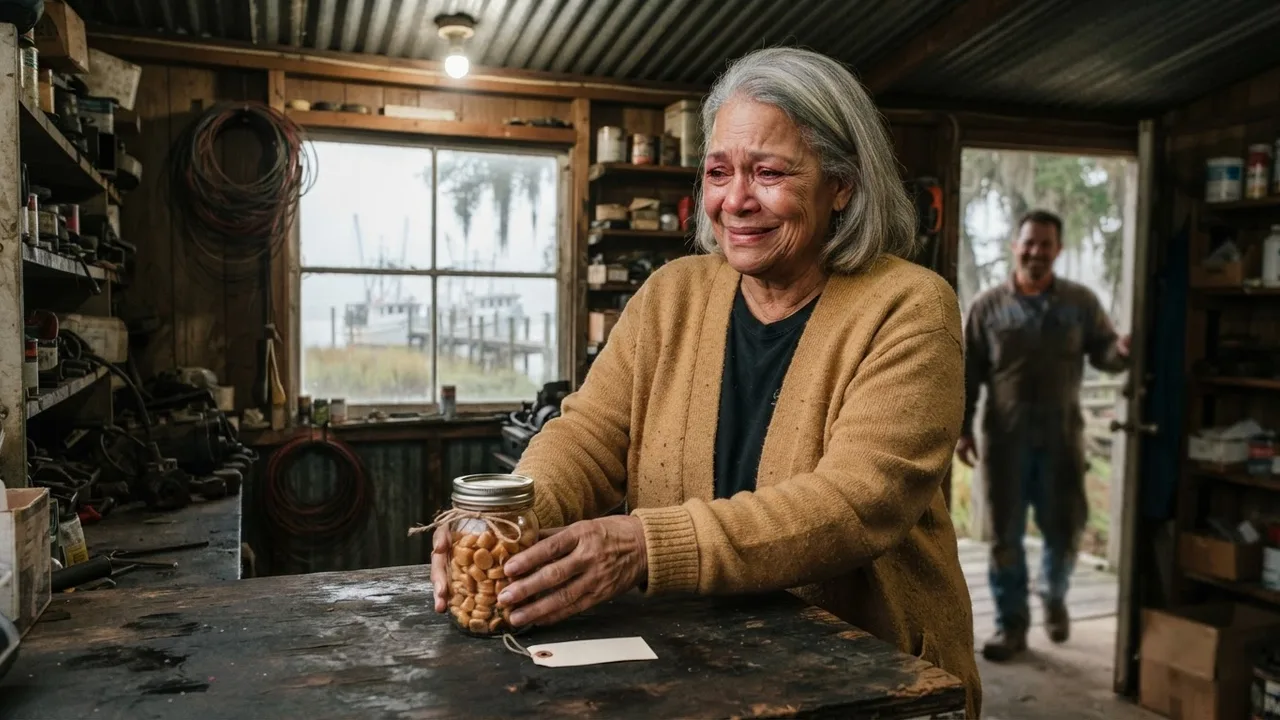
The front office had a metal desk, a calendar from a parts supplier, and a counter black with thumbprints. On the counter sat a shoebox of invoices, its lid gone soft. I took the butterscotch jar out of my bag, wiped the glass with my sleeve, and set it down beside the box, the way the donut box once sat on mine.
Comments