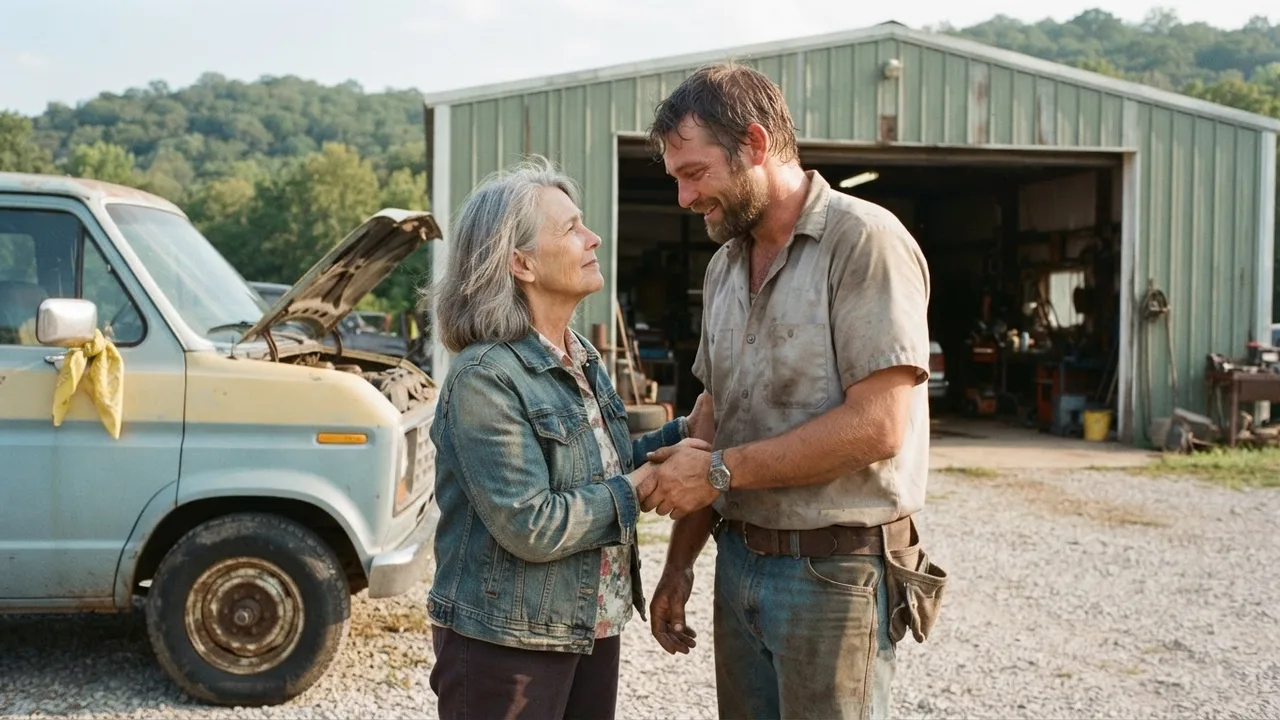
The engine in my grooming van died on Route 95 north of town with a wet goldendoodle in the tub, and I watched the tow truck haul off the only living I had at sixty-six. I had $3,100 in the bank and about sixty regular dogs on my books. Two days later Lonnie Gaither told me what a new engine would cost.
He did it the way he does everything, from the side. I sat in the folding chair in his office with my reading glasses swinging on their cord, and he talked about the dry summer.
"Corn out past Hartville's burning up standing," he said. "Dale Pruitt says he'll cut it for silage and call it a year. Creek behind my place is just rocks."
"Lonnie."
"The rod went through the block, Ruby."
He wrote it on the back of an invoice so I could see it. A used engine, $2,900. Labor, $2,500. Both bays were full of farm trucks until late October, because harvest pays his light bill all winter.
"I've got thirty-one hundred," I said.
"I know you do." He pushed the pencil behind his ear. "I'm sorry."
The next morning I sat at my kitchen table and phoned my regulars one by one. I said the van was down and I couldn't say when it would be up. Within the week eleven of them had booked with the new groomer in Cabool. Eleven dogs I had clipped for years, and August's appointments, about $3,800 of them, went with them.
On Thursday, the twenty-seventh, my son turned forty-one.
I made his supper the way I had since he was small: chicken and dumplings, green beans cooked down with bacon, and a yellow cake with chocolate icing. Travis came in from the co-op still in his work shirt, his truck keys in his fist, and he kept them there through the whole meal. He's lean and sunburned, with climbing scars up both forearms, and he teases until he's scared. Then he goes quiet and starts quoting numbers.
I set the cake down and he lit the candles himself, as he does every year.
"Forty-one," he said. "The year Mom missed my ninth birthday for a poodle, I thought I'd never get to forty-one."
He's told it at every Thanksgiving I can remember. I let it go by, same as always.
For a moment I wasn't in my kitchen. I was in a Springfield waiting room at two in the morning, with a skinny boy who wasn't mine, and a yellow bandana with ducks on it going around the neck of a dog with a leg gone. Then Travis blew out the candles with his mouth set hard, and I came back.
"Mom," he said. "I'll pay the whole fifty-four hundred."
I put down the knife.
"If you'll sell the route by spring. Lonnie puts in the engine, you work till then, and you're done. I can't stop picturing you alone on the shoulder of Route 95. Every time my phone rings on a job, I think it's that."
"No."
"Mom."
"I won't sell my last working years for an engine, Travis. I'm sixty-six, not dead."
He stood. He looked at the cake with the candles still smoking and went out to his truck, and I sat there and understood that I had just watched somebody leave a birthday supper before the cake. It was the one I'd missed, turned around. He didn't call me for two weeks.
On Tuesday, the first of September, I posted the van for sale in the Wright County buy-and-sell group, as is, $2,500, with a photo of the door. *Ruby's Clip & Dip — Every Dog Leaves in a Bandana.* I figured I'd do small dogs in my garage and make do.
Then, that Saturday, there was the man in the lot.
I had gone out to Lonnie's to pull my tools out of the van. The lot behind the shop is gravel, and the van sat at the back with its hood propped like a mouth. A big, heavy man in a canvas jacket and a shop cap was standing by it with his hands in his pockets. The fellow who had messaged me about the post, I figured. A parts picker out of Springfield, here to lowball me for the tub and dryer.
He didn't ask. He got down on his back in the gravel and slid under the van, and I heard him grunt.
"How long you been grooming?" he said from under there.
"Long enough." I said it to his boots.
"How long's that lettering been on the door?"
"What's it to you?"
He slid out and sat up. His beard was going gray. He looked at the door, at the words, a long time, and then at me, and I didn't like how he looked at me. Like he was checking me against something.
"Since before you could shave," I said. "You want the tub or not?"
"I'll call you," he said, and he got in a pickup and left. He didn't call.
On Thursday the tenth, the phone rang at suppertime. It was Mavis Teel, eighty-four years old, a retired school cook who has carried her poodle Pepper everywhere for thirteen years.
"Ruby, I'm so sorry to bother you." She was crying. "His mats. They've pulled his skin raw, I can see it, and I can't drive to Springfield, and I know you don't have your van, I know—"
"Put the kettle on," I said. "I'm coming."
I took my clippers in a grocery sack and drove my old Buick over to Elm Street. Pepper lay on Mavis's kitchen table on a bath towel, shaking. I had to knee-walk around him on the linoleum for two hours, easing the blades under mats as hard as felt. Mavis hooked her cane on a chair back and fed me anyway, a slice of pound cake on a saucer, apologizing the whole time. When I finished, he was a shorn little gray thing with pink skin and nothing hurting him. I tied a red bandana on him.
Mavis pressed three twenties and a five into my hand.
"Sixty-five dollars," she said. "Please, Ruby."
I knew she lived on Social Security, and I knew what sixty-five dollars was to me this month. I folded her fingers back over it.
"Pepper's a good sir," I said. "He doesn't owe me."
When I lifted him down off the table, something in my lower back let go like a snapped rope. I held on to the table edge with Pepper against my chest until Mavis took him from me. I didn't sleep that night or the next. For ten days I couldn't lift a dog, and that was the end of my garage plan.
On Tuesday evening, the fifteenth, I was on the porch with a heating pad against my spine when a pickup came up my gravel road. The man from Lonnie's lot got out and stopped at the foot of my steps.
"The tub and dryer aren't for sale separately," I said.
"Ma'am, that's not why I'm here." He took off his cap. "My name's Shane Rusk. Did you have a shop on Main Street in 1994?"
"Sixteen years, yes. And I've tied a bandana on every dog for thirty-eight."
He came up one step. He took a square of cloth out of his jacket and laid it on my porch rail, smoothing it with his thumb, which was creased with black.
"You told me nobody leaves Ruby's without a bandana," he said. "And that dogs don't count their legs."
I looked at his broad, graying face and could not find the boy in it. The boy I half remembered had been skinny as a rake.
"I don't know you," I said.
"His name was Tater."
I sat down. The porch swing took me, and I didn't remember choosing it.
"My mother saw your post," he said. "Patsy Rusk, over in Mansfield. She knew the slogan, and she knew the name from that night. She texted me a picture, and I wasn't sure till I saw the van. The post only had your number and where it sat, so I called Lonnie." He turned the cap in his hands. "I've got a diesel shop in Marshfield. Rusk Diesel. A girl, Josie, half the week. Ma'am, a salvage yard's holding a used engine for me at twenty-six hundred, dealer price. I'll put it in myself. Parts and labor, no charge."
"No."
"Ma'am—"
"I won't take an engine and two days of a working man's hands for one night I spent in a chair. You've got a girl and a shop to keep."
He didn't argue. He nodded slowly, like a man who'd checked a thing and found it wouldn't turn. He went down the steps and stopped at the bottom.
"I've had that in my toolbox drawer thirty-two years, ma'am. I'm not taking it back to Marshfield."
He left Lonnie's card on the rail with a phone number penned on the back, and then his taillights went down the gravel.
That night I couldn't lie flat. I sat in my kitchen with the bandana in my lap. It had been washed so many times the ducks were only outlines, and one corner was hemmed by hand where it had frayed, small crooked stitches, a boy's or his mother's. Someone had kept it all those years in a drawer with the wrenches. And I had sent him off as though the night had cost me nothing worth naming.
I thought of Travis at my table with his keys in his fist, and the cake. I had told him what his birthday was worth without telling him anything at all. I had just done the same to a man on my porch, decided alone what a night was worth.
I phoned Shane at seven the next morning, Wednesday.
"The engine's mine to pay for," I said. "Every dollar of the twenty-six hundred. That's near all I have, and I'd rather it went there than sat in the bank while I sat on the porch."
"Ma'am, the price is nothing to me—"
"Your hands I'll take." I cut him off. "I won't pretend I can pay for those, and I'll tell you plain, I don't like owing a man. That's what it costs me, so let me pay what I can."
The line was silent a good while. I heard a truck go by on his end.
"Yes, ma'am," he said.
Then I called Lonnie, who started in on the dry weather.
"I need a bay," I said.
"Ruby, I've got Dale Pruitt's grain truck in one and the Hartley boys' flatbed in the other. You know what harvest—"
"I'm not asking you to bump a farmer. Shane Rusk's got an engine, and he'll put it in with his own hands. The money for it is on me. I need a lift after you lock up and a morning to finish."
"Shane Rusk called me about that." He was quiet. "I told him where you live."
"I know you did. I'm not mad." I took a breath. "I never asked you for a thing in twenty years, Lonnie. Not a favor, not credit, nothing. I'm asking now, and I'm hating every word."
He let out a long breath.
"That's my Friday night," he said. "And Dale's truck won't come out of the second bay till Saturday noon if I give you that lift, and Dale will grumble about it from here to Christmas, and I'll eat it. I might lose him a week, Ruby." He cleared his throat. "Hank would have my hide if I didn't. After closing on the eighteenth, and the morning of the nineteenth. Second lift. You'll bring coffee."
"I'll bring coffee," I said.
On Thursday I phoned Travis for the first time in three weeks.
"Meet me at Lonnie's Saturday at ten," I said.
"Why?"
"Because I'm asking."
He said, "Okay," like it cost him a tooth.
Saturday the second bay was loud with a working morning, a radio going and Dale Pruitt's grain truck in the first bay with its hood up. My van sat over the lift with a new engine in her, Shane and Lonnie on either side finishing hookups. I stood with a thermos and my back held stiff.
Travis came in at ten, his keys in his hand. He saw the man under his mother's van and stopped.
"Who's paying for this?"
"I am," I said. "Come here."
He came. Lonnie stopped turning his wrench, and Shane stood up with a rag. Four of us in a garage, and not a one of them would look away.
"Your ninth birthday wasn't a poodle," I said. "It was a ten-year-old boy alone in a waiting room in Springfield with a dog missing its back leg. His mother couldn't be reached. I drove them seventy miles and sat with him till she came, and I got home after four in the morning. I chose him over you, Travis. You had your daddy and a cake. I never could make it sound right, so I let the poodle stand." I nodded at Shane. "That's him."
Shane turned the rag in his hands.
"My mother still talks about the dog lady," he said.
Travis looked at him a long time and then at me. He didn't say anything. The radio played a song about a truck.
"I've told that poodle story at every Thanksgiving for thirty years," he said finally. "I'll have to quit." He rubbed his thumb across the keys. "I was never mad about a supper, Mom. I was scared. I was nine and you didn't come home, and Dad said you were fine, and I didn't believe him. I've been scared of you out on that road ever since."
"I know that now."
"The selling business." He shook his head. "Forget I said it. Just call me first when something breaks. Not Lonnie. Me."
"I'll call you first."
He went to the bench, picked up the work light, and held it low under the engine for Shane, the way he must hold one up a pole. Shane said, "Little left," and he moved it.
I took the envelope from my coat and held it out. Twenty-six hundred dollars in twenties and fifties, from the bank that morning. Shane looked at it and put up a hand.
"The money's for the part," I said. "I owe you for your hands. And your girl's dog gets groomed free for as long as I can hold clippers."
He took the envelope. "His name's Moose," he said. "He's a lot of dog."
"Good," I said. "I like a lot of dog."
Lonnie climbed into the cab, and the van turned over once, twice, and then the engine caught and held, running low and steady in the bay.
I drove home that afternoon past the spot on Route 95 where it had died. The empty tub rattled behind me, and Shane's faded yellow bandana hung knotted on my rearview mirror, swinging a little at every curve.
Comments