The Custer County Chief said my granddaughter, Avery, would leave for Air Force basic training on October 27, and that was how I found out, because my son had not spoken to me in seven years.
I cut it out with the kitchen scissors, folded it in four and put it in my purse next to the furnace man's estimate. Six hundred forty dollars, before the cold.
In September of 2019 Lance stood in my kitchen, with Avery, eleven, waiting in his truck, and asked if the two of them could winter in my basement. His marriage had ended. I said no, and I told him why in dollars: he still owed me four thousand from two loans, and a grown man had to stand on his own.
"All right, Mom," he said, very politely. He had not said another word to me since. At my husband's funeral he stood at the back of the church and was gone before the last hymn.
That Saturday I sat at my kitchen table with a card from the Dollar General rack and argued with myself about money. I live on Social Security and what the farm families pay me to keep their books. What I had set aside for the furnace was in an envelope in the flour canister.
I settled on two hundred dollars. The long and short of it was that a girl going off to the Air Force ought to have something in her pocket from her grandmother, furnace or no furnace.
I wrote the card and came to the last line. Through the front room I could see the porch, and the green cast-iron frog by the door with the paint chipped off its nose. I wrote, *Whenever you're home, key's under the frog. You don't knock here.*
I had first said those words the winter I was twenty, to a skinny boy named Monty, who slept on my back porch after the town decided he was a thief. His little brother, a kid whose name I never learned, sat on my back step every afternoon eating a bologna sandwich with too much mustard. He would not come in.
The same frog sat beside that step. I put the card and the two hundred in an envelope and wrote my return address in the corner. Then I licked it and walked it to the post office.
---
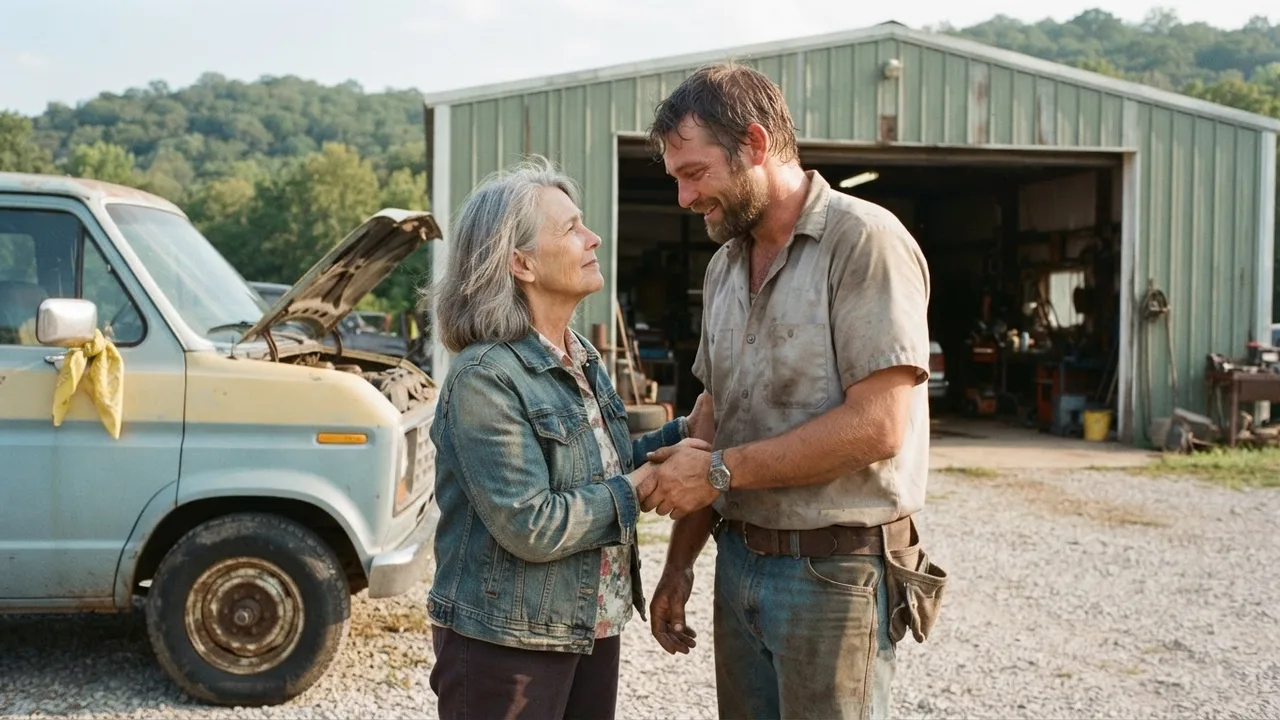
A week later I drove out Highway 2 to the east edge of town, to the metal building with KUCERA WELDING & REPAIR on the sign. The clipping was in my purse. I had pressed my slacks.
Lance was under his hood, running a bead on a trailer hitch. A young man in a grinding apron stood by the bench with a coffee can of washers, and he looked at me and then at the floor.
I waited for the bead to finish. It took a while.
"Lance."
He lifted the hood. His forearms were pocked with burn scars I had never seen. "Mom."
"I read in the Chief that Avery's leaving. I wondered if there's to be a send-off. I'd like to come."
He took off a glove and folded his arms. "There's a supper. It's at a friend's place out north. It isn't mine to invite you to, and I wouldn't if it were."
The hired man picked a washer out of the can and put it back.
"You taught me to keep accounts," Lance said. "I'm keeping one."
My face went hot, and I stood there with my purse in both hands. I had asked my son for something in front of a stranger and been told no, and I had not known until then how much I'd hoped.
"Well," I said. "That's the long and short of it."
I walked to the car without hurrying. In the mirror the hood came down and the arc lit up blue.
---
Five days later, on a Thursday, a man knocked on my front door with a banker's box on his hip. He was lean and weathered, with a gray mustache and a feed-store jacket worn white at the cuffs. He took off his cap and held it in both hands.
"Mrs. Kucera? I hear you keep books."
"Who sent you?"
"Nobody sent me. I had your address."
I thought of the co-op manager at once. He had been handing my name to every farmer who couldn't pay since the day I retired, because I was cheap and he knew it. I let the man in anyway, because he was already looking down at the frog.
"That frog," he said. "How long have you had it?"
"It was my grandmother's. Why?"
"Well, now." He turned his cap a little in his hands. "It's got a good face on it."
Over my oilcloth he lifted the lid. Three years of receipts: feed, vet, diesel from the Cenex, hay twine, every one of them loose. His operating loan came up for renewal at the bank on October 15, and the banker wanted them in order.
"It's a mess," he said. "I know it's a mess."
"Six hundred dollars," I said. "I'll see what's in here before I tell you yes."
"Pay's another matter," he said, and got out of the kitchen before I could ask what he meant. On the porch he looked at the frog again for as long as it takes to read a line. Then he put on his cap and went down the steps.
---
On Monday he came back for his answer, cap in his hands again. He stood on my porch and would not come in until I told him to.
"I'll say it plain," he said. "I can't pay you before December. That's when my hay checks come. I won't have a dollar sooner, and I'd sooner you knew."
I had been counting on that six hundred. It was most of the furnace.
"Books by the fifteenth," I said. "Money when you have it."
"Well, now. You're sure?"
"I said so, didn't I?"
He nodded as if that were a harder thing to take than a no. When his pickup was gone I called the furnace man, who had penciled me in for the next week.
"It'll have to wait," I said.
"Marcy, it's near October. First hard frost, you'll wish you hadn't."
"I know what I'll wish."
For the next three weeks I worked beside the sink-side window in my coat with the furnace off, because the old thing rattled if I ran it and I wouldn't trust it. I sorted his receipts into piles on the floor and ran the columns till past midnight, most nights. My feet went numb in my slippers. I did not mind the work. It was the one place my head stayed out of my own business.
---
On Saturday, October 10, somebody knocked at my door, and it was Avery.
She was tall, with a dark-blond braid down her back and dog hair on her clinic fleece. She looked me straight in the eye. I had not seen her up close since she was eleven, and I held onto the door.
"Grandma," she said, like a word she was trying out. "Can I come in?"
She sat down across from my stack of ledgers and would not take coffee. She laid an envelope between us, the one I had mailed, and the two hundred dollars was inside it.
"I can't take it," she said. "It feels like taking sides."
"It was a gift."
"I know. And I won't ask you to the supper, Grandma. That's Dad's to do, and he won't." She turned the envelope over. "I showed your card to somebody. He said he knew a Marcy once."
"Who?"
"I can't say." She met my eye. "I was eleven that winter. We lived in somebody else's spare room."
I could not answer. She stayed twenty minutes by the clock on the stove, and we talked about the clinic and the boots she had worn since tenth grade, and neither of us said what we were thinking.
At the door she stopped and looked at the frog. She said nothing at all. Then she went down the steps with her braid swinging, and I stood there and understood that I would not be at the supper.
---
I finished his books at ten past one on the morning of the fifteenth, in my coat, and never went to bed. At seven he came into my kitchen and took the books in both hands.
"They're in order," I said. "I'd have had him audited otherwise."
He did not smile. He took an envelope from his jacket and put it on the table. "Six hundred. I sold the calves early on Tuesday at the sale barn, so I'd have it."
I counted it. Then he laid a second envelope beside it.
"That's five hundred more. For the nights."
I pushed it back across the oilcloth. "I agreed to a price."
"Well, now." He held it a moment and then let it go. "Is the key still under that frog?"
I looked at him. "Who wants to know?"
"Key's under the frog," he said. "You don't knock here."
The kitchen went cold, and it was not the furnace. "Those words were on a card to my granddaughter. Anybody who read it could say them back."
"Yes, ma'am. Avery showed me the card at my place, helping with the horses. I copied the address off the envelope. Nobody at the co-op sent me."
"Then you're a man who read my mail and is playing on it."
"No." He turned his cap over. "I'm Monty Ahrens's little brother. I'm the kid on your back step. Bologna, too much mustard."
"Monty's brother was a little boy. He never told me his name."
"Arvid," he said. "You never asked, and I never said."
I looked for a boy in the gray mustache and the cracked hands, and I could not find him. He sat still and let me look.
"There was an orange coil on that space heater," he said. "You took it off your own bedroom floor. And you walked to the co-op in January. Monty said your car money went on his boots."
I put my pencil down. The boy on the step had eaten his sandwich in both hands, too, as if it might be taken back. That was how this man held his cap.
"You wouldn't come in," I said.
"No, ma'am. Not once."
I sat down. He told it plainly, in order: Avery's card, the ninth of September, his drive here, the frog on my porch. He had wanted to see what kind of woman I had become before he said anything, so he had asked me for books he truly needed.
"And what did you see?" I said.
"A woman at her table at seven in the morning, in her coat." He looked at the floor. "Well, now. There's more. In October of 2019 I said those words to your son. He worked for me part-time, hauling hay. He had nowhere for that girl. They had my spare room until April."
My hand was on my glasses chain, and I had not felt it move there. *Some rancher out north.* I had never asked whose place it was.
"For seven years," he said, "I thought Lance's mother was a hard woman."
"I was." I pulled my cardigan shut at the neck.
"I didn't know it was you. I want you to know that."
"Whose porch?" I said. "Yours?"
"Mine. Saturday the twenty-fourth, at dusk, Avery's supper. I'm asking you myself. And I'll tell Lance whose words they were first, if you'll let me."
"You will not."
He waited.
"I gave a boy the town called a thief my back porch," I said. "I turned my own son away from a basement. If he learns that, it's the worst thing anyone could say about me, and it is true. You will not say it."
"All right." He put on his cap. "And the supper?"
I did not answer. I picked up the six hundred, took it to the telephone on the wall and dialed the furnace man.
"Tomorrow," I said. "Yes, tomorrow. I have the cash."
Arvid let himself out. I heard his boots on the porch, a pause by the frog, and then the pickup.
---
The furnace man came at eight on Friday and was in the basement for an hour. When the heat ticked on in the registers I stood over one in my stocking feet and felt it on my ankles.
I paid him the six hundred forty with a check-sized stack of bills on the counter: Arvid's six hundred, plus forty of the two hundred Avery had handed back. I wrote it in the ledger in pencil, the date and the amount and *furnace*. The ledger had a hundred sixty dollars left in it for Avery, and I looked at that line for some time.
Then I called Arvid's number.
"I'll come," I said. "I'll bring kolaches. I'll tell Lance myself, and you'll keep out of it."
"Well, now," he said, and was quiet. "Yes, ma'am."
---
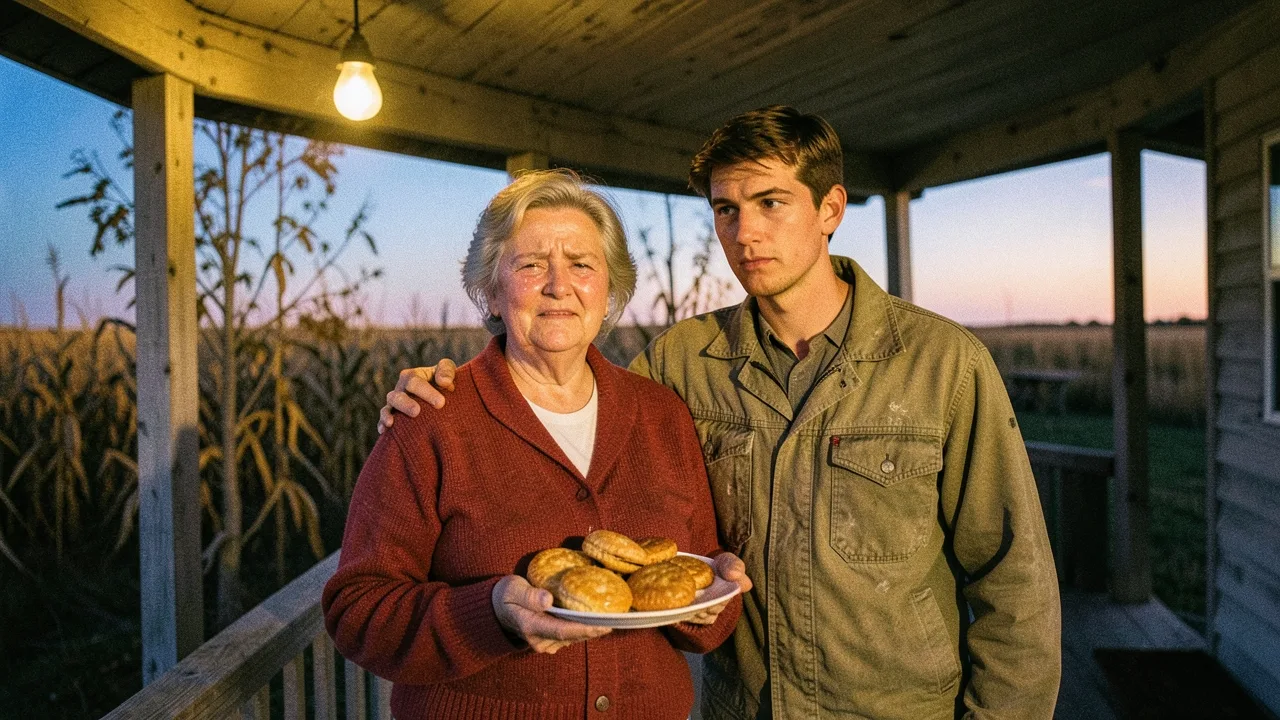
On the twenty-fourth I drove out past Merna with a pan of apricot kolaches on the seat. A cold wind came off the pasture, and the cottonwoods along the fence line had gone to bare sticks. Arvid's long covered porch was strung with bulbs, and supper tables stood out in the yard.
Lance met me at the bottom of the steps with his arms folded. He had on a clean gray work shirt.
"Who asked you?"
"I did," Arvid said from the porch. "It's my porch."
I held the pan. "Lance, I'd like five minutes. At the far end. Avery can hear it."
He looked at his daughter, who had come to the rail in her good boots, and at Arvid. Then he walked ahead of me down the boards. Avery and Arvid followed and stood a few steps off.
"The winter I was twenty," I said, "there was a boy in this town nobody would take. Sixteen. He'd been caught taking money out of the sale barn café till, and he was sleeping in a stock trailer. I put a cot and my own space heater on my back porch. I told him the key was under the frog and he didn't have to knock."
Lance did not move.
"His little brother came every afternoon and ate bologna on my step. He wouldn't come in. I never knew his name." I looked down the porch. "The man whose porch we're standing on was that little brother."
"Mom."
"You came to me in 2019 and I gave you numbers," I said. "I was wrong. I knew it by Christmas, and I let seven years go because I couldn't say so."
His jaw worked. "You'd do that for a boy who stole," he said, "and not for your own son?"
I did not look away. "Yes. That's the truth of it."
Wind rattled the bulbs. Avery had her hand over her mouth.
"Christmas Eve that year," I said, "I drove the Merna road. I looked for your pickup in every yard. I turned back when the snow started."
Lance looked down the porch at the iron frog by Arvid's door. It was gray, plain, a little rust at the ears.
"That's where you got those words," he said to Arvid.
"Where'd you think I got them."
Lance unfolded his arms. He stood there a good while, working the cuff of his shirt between his thumb and finger.
"Seven years," he said. "I've been the son whose mother said no while a stranger said yes. I liked how simple that was." His voice cracked on the last word, and he cleared it. "Now I don't know what I am."
"I don't either," I said.
He nodded, slowly. Then he jerked his head toward the yard. "Sit down and eat, Mom. Avery made the pie."
I walked back beside him. Nobody said a word. Arvid went ahead and pulled out a chair, and Avery took the kolaches out of my hands.
Later, when the plates were cleared, she came over with a pencil. "I don't have any paper."
I took the clipping out of my purse and turned it over. She wrote on the back, her letters round, and handed it back to me: her name and a street, Lackland Air Force Base, a box number.
I did not look at it until I was at the car. Lance had walked me down the steps, and he stood with his hand on the roof of the Buick.
"Is that frog still on your porch?" he said. "The key still under it?"
"Yes."
He nodded. He did not say he'd come, and I didn't ask. He tapped the roof twice and went back up toward the lights.
I drove home on the Merna road in the dark. The clipping lay on the seat beside me, Avery's photograph on one side and her Lackland address in round pencil on the other, and every few miles I put my hand on it.
Comments