Mama's house on Cooper Street was sold, closing December 27, and after that she'd live with my brother two hundred miles away in Tucson, and I'd be the only Trujillo left in Silver City.
I had been packing it a box at a time after my shifts at the pharmacy, which sits half a mile from her front door. Towels. Canning jars. A drawer of church bulletins she wouldn't let me throw out.
Thanksgiving was the three of us, same as every year since Daddy died: Mama, me, and Nieves Apodaca from across the street, who brought her own tortillas because she didn't trust mine. Ristras hung red on the porch posts. Mama had her Christmas cards stacked on the sideboard already, each one signed in her careful cafeteria-list hand, *Lupe Varela Trujillo*, the way she had signed everything my whole life.
After pie, she dragged the ornament box to the dining table and began sorting it into two piles, Tucson and stay.
She passed me a glass bell with her bent little fingers, the ones that curl in at the last joint. Gabe has them too. We call them Mama's hands. Mine are square, Daddy's, good for counting pills and not much else.
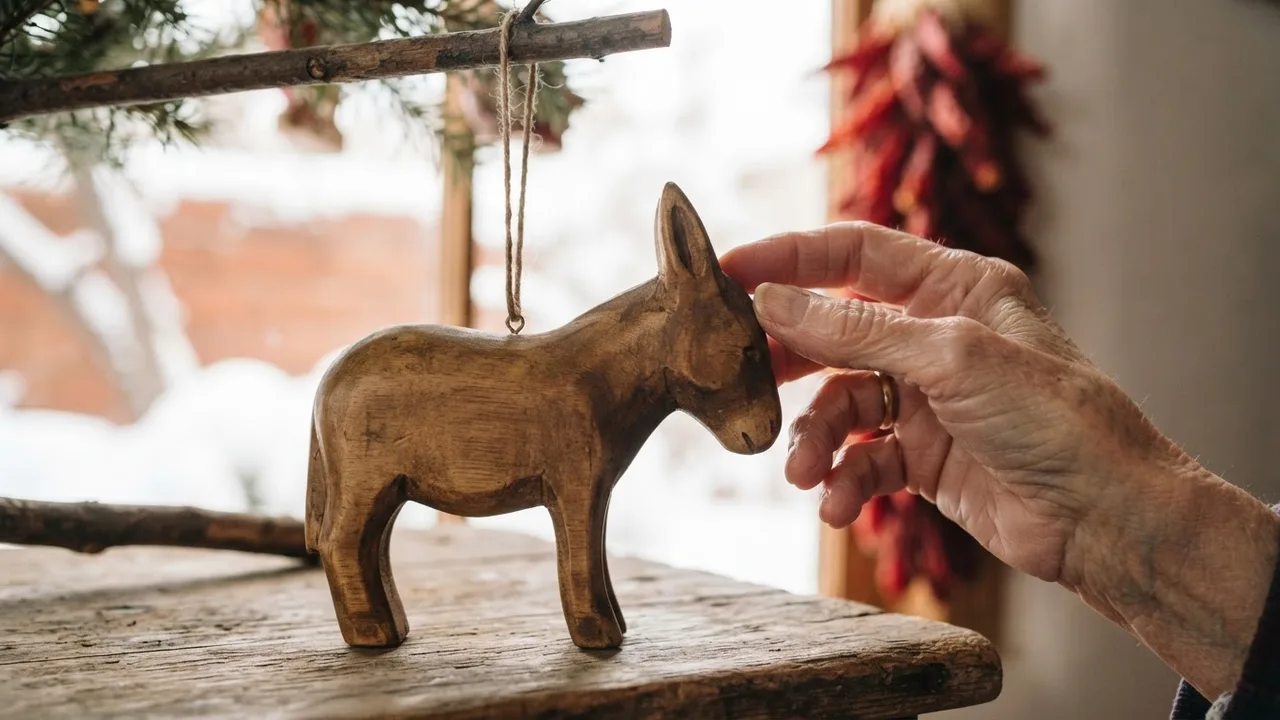
Then she lifted out the burro. It was palm-sized, carved from pine, its ears worn pale from sixty Christmases of being hung and unhung.
"Jimmy's burro comes with me," she said.
She stopped. The tissue paper crackled in her hand.
"Gabriel's," she said. "I said Gabriel's."
Across the table Nieves put down her fork and looked at her plate. Nobody said a word about it. Mama reached for the coffeepot and asked who wanted more.
I took the burro from the pile and turned it over. There was the J burned into its belly, the one Daddy always said stood for Jesús, "because the burro carried Him."
There had never been a Jimmy in our family. I'd have known. I count things for a living.
Two days later I crossed Cooper Street with the leftover pie under foil. Nieves sat in her folding chair on the porch with a blanket over her knees and her white braid pinned up, watching the street the way she has since 1962.
"La doctora," she said. "You bring me pie, you want something."
"Nieves, who's Jimmy?"
"Ay, no."
"Thursday, Mama called the burro Jimmy's. You put your fork down."
She pulled the blanket higher. Down the block somebody's radio played a ranchera, thin in the cold.
"When your family moved in, the spring I'm talking about, that little boy answered to Jimmy," she said. "For months. Then your mama came over and asked me to call him Gabriel. Not to ask why. So I never did."
"Never? Not once, in all that time?"
"A promise is a promise, mija." She looked at me then, and she looked her age. "Don't make me the one who talks. And don't come asking again."
She handed back the pie, and then the plate it was on, and she didn't say a word about Thursday coffee. I walked home with the plate in both hands, and the foil rattled the whole way.
A week later was the tamalada, the first Saturday of December, and Mama's kitchen smelled of pork simmering in red chile. Dana had driven over from Tucson to help. She stood at the sink in her quilted vest, soaking corn husks and rearranging my mother's cabinets as she went.
Mama took Daddy's wedding band off the chain at her neck and hung it from a cabinet knob so it wouldn't catch in the masa. She'd done it every year. She went to the table to spread, and the radio covered her.
I didn't plan it. The loupe lives in my vest pocket, the one I use at work to read the imprints on pills, and it was in my hand before I thought. I held the ring up to the light over the stove.
Inside, worn but plain, the letters ran: *A.T. y G.V. 16-6-62.*
I read it. I did the arithmetic. Then I did it again with my lips moving, which Gabe says I do.
"Appraising the gold?" Dana said at my shoulder.
"Dana, they were married in sixty-two."
"They were married in fifty-nine. I clapped at your toast."
"It says sixty-two. And Mama called the burro Jimmy's, and Nieves says Gabe answered to Jimmy when they came here." I told her all of it, low, with my back to my mother. The cake in the parish hall, 1959 in blue frosting. My toast.
Dana took her glasses off their beaded cord and put them back on.
"Okay, here's the thing," she said. "She moves into my house in three weeks. Do not put this on Gabe."
"It's his name, Dana."
"It's *my* guest room," she said, and went back to the husks.
I hung the ring on its knob. I spread masa until my arms ached, and never once looked at my mother's face.
The next Saturday Gabe backed the rented trailer up to the garage and climbed down in his canvas jacket with his cap pulled low. No hug. He walked past the water heater to the stack of boxes and picked up one end of Mama's old dresser.
"Dana told me," he said. "That night. Said you've been digging."
"I've been asking."
"Same thing, Doctora."
We lifted. The dresser went up the ramp, and I stood in the cold with my hands empty.
"Gabe, what's your earliest memory?"
"What?"
"The very first thing you remember."
He didn't want to answer. I watched it cross his face and watched him answer anyway, because he's honest. "A long drive in a green pickup. Dad singing. I was on the seat next to him, and it was dark, and he sang the whole way."
"Where were you going?"
"Here, I guess." He took off his cap and put it back on. "Stop. Dad was my dad. I don't know what you think you've got, but Mama's got two weeks in this house, and you are not going to upset her."
"I'm not trying to take anything—"
"You're not taking it. You're poking at it." He latched the trailer gate with a bang. "I'm not staying for supper."
I stood on the driveway until his taillights turned toward Pinos Altos Street, and then toward the highway. It was the first time in our lives he'd left angry. He didn't call when he got home. I know, because I held the phone until midnight.
Five days later, on the Thursday night before Christmas week, I let myself into Mama's kitchen late. Half the cabinets stood empty. She sat at the table in her robe with a mug of milk and the last roll of packing tape.
"You should be home," she said.
"Mama, I need to say something, and I need you to let me finish."
I laid it out. The burro at Thanksgiving. Nieves on her porch, with the pie plate coming back to me. The ring on its knob, and what I'd read inside it with the loupe.
"I stood up in the parish hall and toasted a year that was a story," I said. "Nieves won't have me for coffee. Dana told me not to put it on Gabe, and Gabe drove home without speaking to me. That's what not knowing has cost me. I don't know what it's cost him."
"Nieves is old," Mama said. "She remembers wrong."
"She remembers a little boy who answered to Jimmy."
"Ya. Enough." She got up and opened a tin and put biscochitos on a saucer, and set it in front of me. I didn't touch it. She sat back down and turned her mug a few times in her hands.
"Your brother was Jimmy before," she said. "Your father gave him his name when we married. That is all of it that's mine to give."
"Mama—"
"Mija, please." Her bent fingers pressed the tape roll. "He's taking me into his house. Don't take his name from him at Christmas. Let it rest."
"I won't let him find it out from a box in his garage after you're gone."
She looked at the saucer and said nothing. I said goodnight and kissed the top of her set hair, and it smelled of hairspray, the way it always has.
I drove home through the cold with my theory. Daddy had worked at the steel mill in Pueblo for years before the wedding. A woman. A baby. Daddy gave him his name when they married. I thought I knew what my mother had been protecting, and I thought it was herself, and I hated how sorry I felt for her.
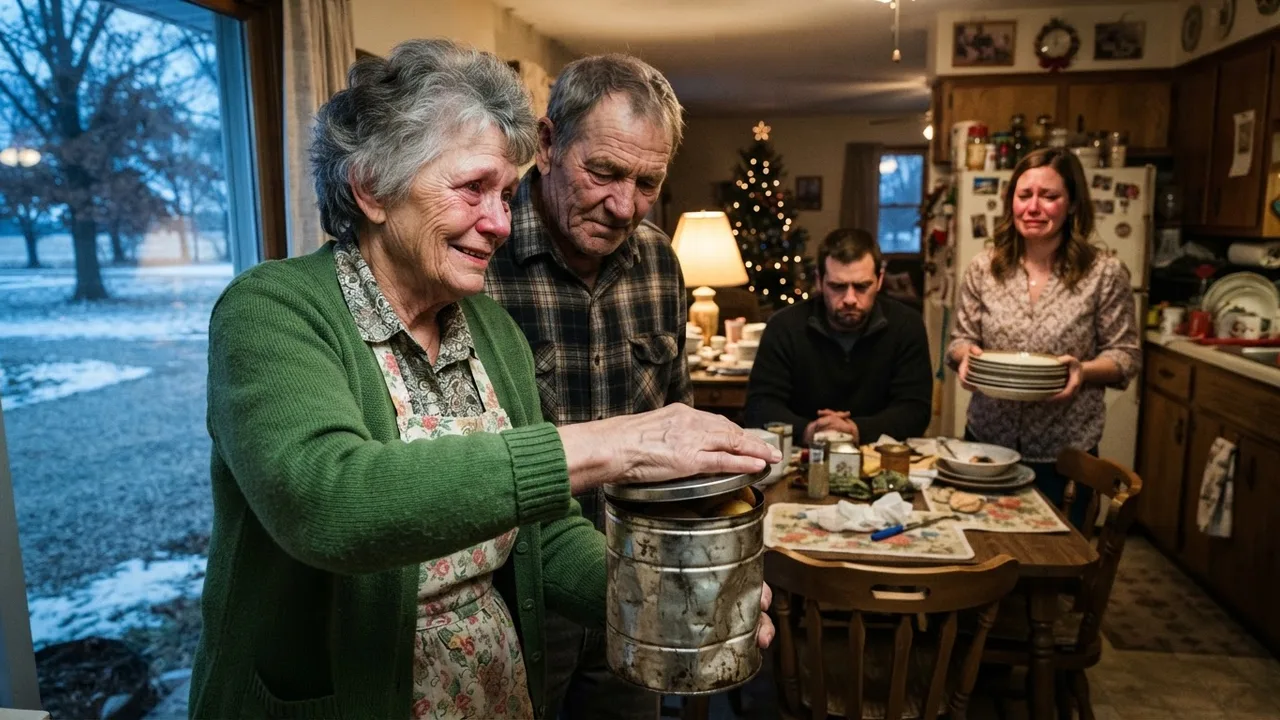
Christmas Eve, the last tree in that house stood in the front room, and the burro hung on it where it had always hung, low on the left. Gabe and Dana had driven in that afternoon. He was polite to me, which was worse than angry. Dana and I had set the luminarias along the walk, sand and candles in paper sacks, and lit them in the dusk. Cold orange light came through the front window.
Gabe stood by the sofa, drying his hands on a dish towel. Dana was beside the doorway. Mama stood apart, near the tree, in her good cardigan.
I lifted the burro off its branch and put it in my brother's hand, J side up.
"Before you were Gabriel, you were Jimmy," I said. "Daddy gave you his name when he married Mama, in 1962. I don't know who she was in Pueblo, but Mama took you as hers and never once let either of us feel a difference. I wanted you to hear it in this house, from me, not from a box in your garage someday."
His jaw set. The towel went still in his other hand.
"I told you to leave it," he said.
Dana crossed the room and took the dish towel out of his hands. She didn't say a word for him. She just stood beside him.
"Mija." Mama laid her hand along the back of the sofa. "There was no woman in Pueblo. It was me."
I looked at her hand. Then I looked at Gabe's, closed around the burro, with the little finger bent in at the last joint, the same as hers.
It was all there, and had been for years. It came out of me piece by piece, as if I were counting.
"G.V. on Daddy's ring. You still sign Varela. Jimmy Varela." I turned to my brother. "You were born James Varela, Gabe. You're Mama's. You were always Mama's."
Mama didn't correct me.
"His father was a boy who enlisted," she said. "He never wrote back. Not once. Your father made that burro the first Christmas, Gabriel, and he said, 'This is for my Jimmy.' I said 1959 so nobody in Silver City would count." She looked at him, finally. "Sixty-three years you had a mother who did everything in order. Now you have me."
Gabe set his hand on the sofa back beside hers. Same fingers, side by side. "Mama's hands," he said, and it came out rough.
Nobody moved. A luminaria sputtered on the walk.
"I've told my grandkids my whole life I got Dad's eyes," he said. He turned to me, slowly. "You could've let me drive her home and never said a word."
"I couldn't."
He nodded once. He didn't smile.
"He chose you," Mama said. "Every day, Gabriel, he chose you."
My brother turned the burro over in his palm, J facing out, and hung it back on the low left branch. Dana put her hand on his back.
We went out in one car, Gabe's truck, Mama in the front seat between the two of them. Down the walk to midnight Mass he kept her arm in his, and up the church steps he didn't let go until the door. He said almost nothing to me, and I said almost nothing to him, and we both knew it was the quietest we had ever been.
I went back for the lights. I stood in the doorway a moment with my coat on. The burro hung in the glow of the luminarias through the window, its J turned out to the room for the first time, and I switched off the lamp.
Comments