Mama's house on Pecan Road was sold, the closing was December 30, and I had seven weeks to haul a lifetime of her things to the curb without losing one she'd want to keep.
Clem had found the buyers, a young couple with a baby coming, and he had a spare room ready in Pooler with a new quilt on the bed. All I had to do was empty closets on my days off. I'd carried Route 2 out of the Ashby post office for twenty-nine years, Mama's mailbox sat on it, and I believed there wasn't a drawer in that house I couldn't have described blind.
The cedar chest in the back bedroom was the last thing we'd put off. On a gray Sunday, with the pecan trees dropping their last husks onto the carport roof, I knelt and lifted out two quilts and a bag of Daddy's neckties.
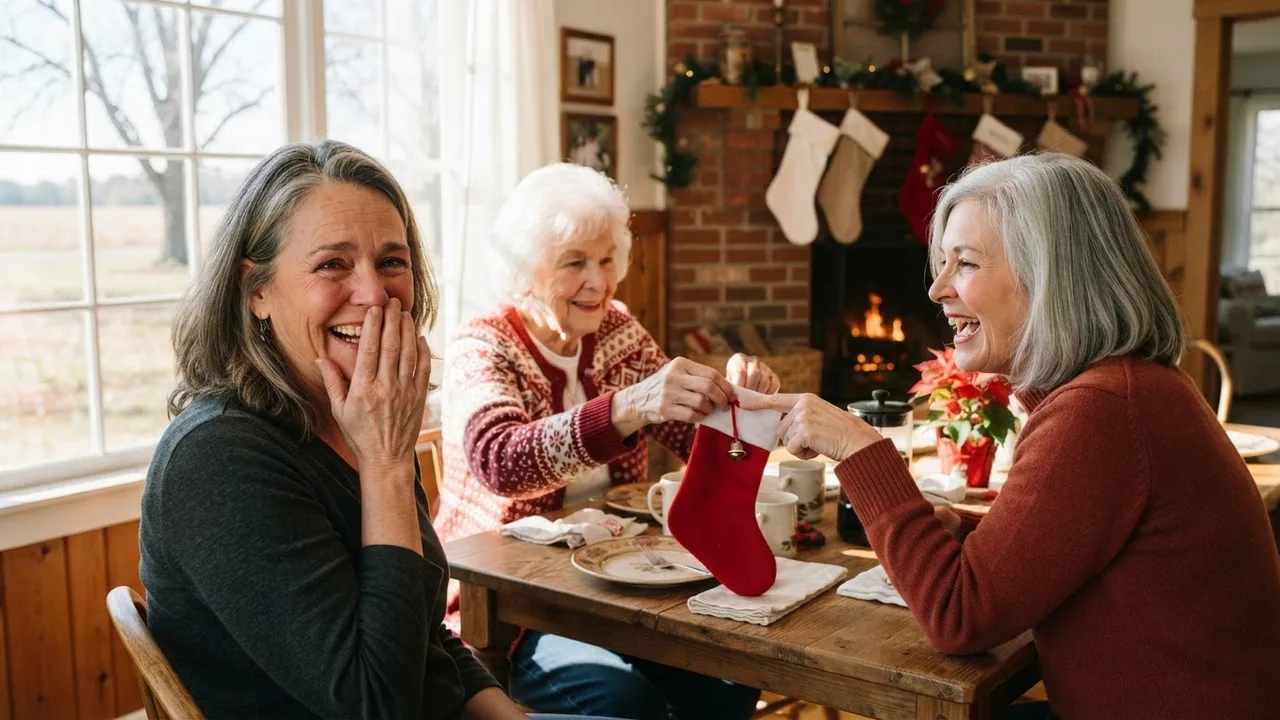
Under Mama's wedding dress lay a bundle of tissue gone the color of butter. Inside was a child's Christmas stocking, red felt, small as my two hands. White chain stitch spelled DOVIE, the loops uneven, and a brass bell was sewn to the toe. It gave a thin ting when I turned it over.
"Mama? Who's Dovie?"
She stood in the doorway with a dish towel. I watched the color leave her face from the forehead down.
"Nobody."
"It's got a name on it."
"Put it in the giveaway box, Marybeth." She folded the towel in half, then in half again, and went back to the kitchen. The faucet ran a long time.
Nobody in our family had ever been called Dovie. In the living room, four stockings hung from the brick mantel over five nails, as they had every Christmas of my life: Opal, Earl, Clem, Marybeth. Daddy always said the fifth nail was for luck.
I put a set of casserole dishes in the giveaway box and the stocking in my coat pocket.
That night my phone rang, as it did every evening around bedtime, though Mama didn't ask about my day. "Has that box gone to the church?"
"Not yet, Mama."
"Then burn the little red one. Don't put it in with the rest."
I stood in my kitchen on Oak Street with my coat on the hook by the door, the pocket sagging, and said neither yes nor no. "Well," Mama said. "Goodnight."
The next Sunday Clem and I were taping boxes in the garage, him in his dealership cap, me with the tape gun, when I took the stocking out and told him how Mama had looked.
"Probably some doll's," he said. "Some church-bazaar thing."
"Her face went white, Clem. She called me that night to tell me to burn it."
He pulled his reading glasses down off his head and put them on, which is what he does with a contract. "Sis, listen. The buyers close on the thirtieth. They've got a rate lock, they won't wait on us. If Mama gets upset and backs out, that's one hundred sixty-eight thousand dollars of her care money walking down Pecan Road."
"I'm not asking to stop the sale."
"You're asking her about it. Leave it be."
A box flap lifted in the draft from the open garage door, and I pressed it down with my elbow.
"Somebody named Dovie, and Mama's scared of her."
"You don't want her to go." He tore off a strip of tape with a screech. "You want her four miles from your door the rest of her life. That's selfish, Marybeth."
"That's not it."
"Put it in the box."
I didn't. He set the tape gun on the dryer and said he had a dealer call to get ahead of. I was in the back bedroom with the door shut when I heard his car start, a day before he'd planned to leave, and Mama stood on the porch afterward saying only, "He said he'd telephone."
Nearly two weeks later, on a Saturday, I carried a bag of shelled pecans to Inez Blalock on Church Street, as I did every November, and asked over her kitchen counter whether she'd ever known a Dovie.
Inez was tall and stooped in her housedress and pearl clip earrings, one hand always on the counter. "Dovie. No, honey, never a one. Now there was a Dovie Ruth in Cordele, kin to the Spiveys, but that's no help."
"No, ma'am."
"Your mama sang alto beside me in the choir, you know, I was nineteen and she was sixteen, and that October she went to her aunt's in Macon. 'An aunt in Macon,' they said. Came back that spring thin as a rail and quit the choir." She gave a small laugh. "Nobody asked, in those days."
I stood with my hand on the pecan bag. Inez's glasses swung toward me, and her face changed.
"Oh. Oh, Marybeth. You don't tell Opal I said a word."
I never had to. The next evening Mama's call didn't come, nor the one after, and she went nine days without her voice reaching me. She skipped our Sunday dinner, which she'd never done, and when I knocked at Church Street with a sweet potato pie, the curtain moved and the door stayed shut.
The second Saturday in December I was stacking tubs of Christmas mail into my truck on the loading dock when Tammy leaned out the back door. "There's a lady up front with a card. She says it's for your mama."
The woman who came around the side of the building was slim, with a silver bob and a quilted vest over a Christmas sweater. She held her purse in front of her with both hands.
"I don't want to be any trouble, but are you Mrs. Tolliver's daughter?" She laughed a little. "My mother sent Opal Tolliver on Pecan Road a card every year since 1960. The last one she mailed was in 2023."
"All right."
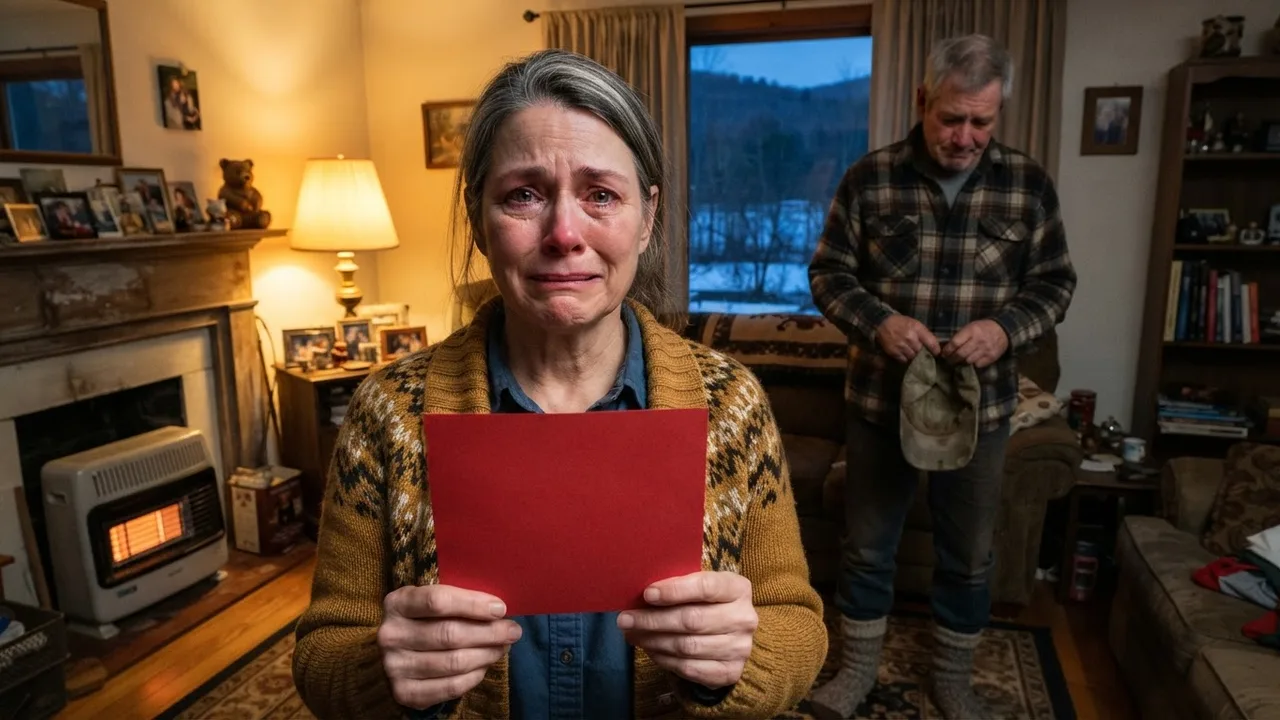
"She died a year ago October. I found this one in her desk, stamped, never mailed." She held out a red envelope with Mama's name in careful blue ink. "I drove out Thursday and saw the SOLD sign and all the boxes, and I lost my nerve."
I looked at her hands. They were small and quick, turning the envelope over as though it might open itself.
"I'm Glenda Dovie Pickett," she said. "The girl who had me named me Dovie."
The dock seemed to tilt under my boots. I took her number on the back of a delivery slip and told her Mama was moving, and that I would ask her.
I ran Route 2 ninety minutes late that day. Dwight, my supervisor, wrote it on a form, the first mark against me in twenty-nine years, and I lay awake in my brick house on Oak Street until four.
Five days later I carried groceries from the Piggly Wiggly out to Pecan Road. Before supper I stood at the mantel and lifted down my own stocking. Mama had stitched ours the Christmases we were born, and the MARYBETH ran uphill in loops that curled backward, the same as the loops in DOVIE.
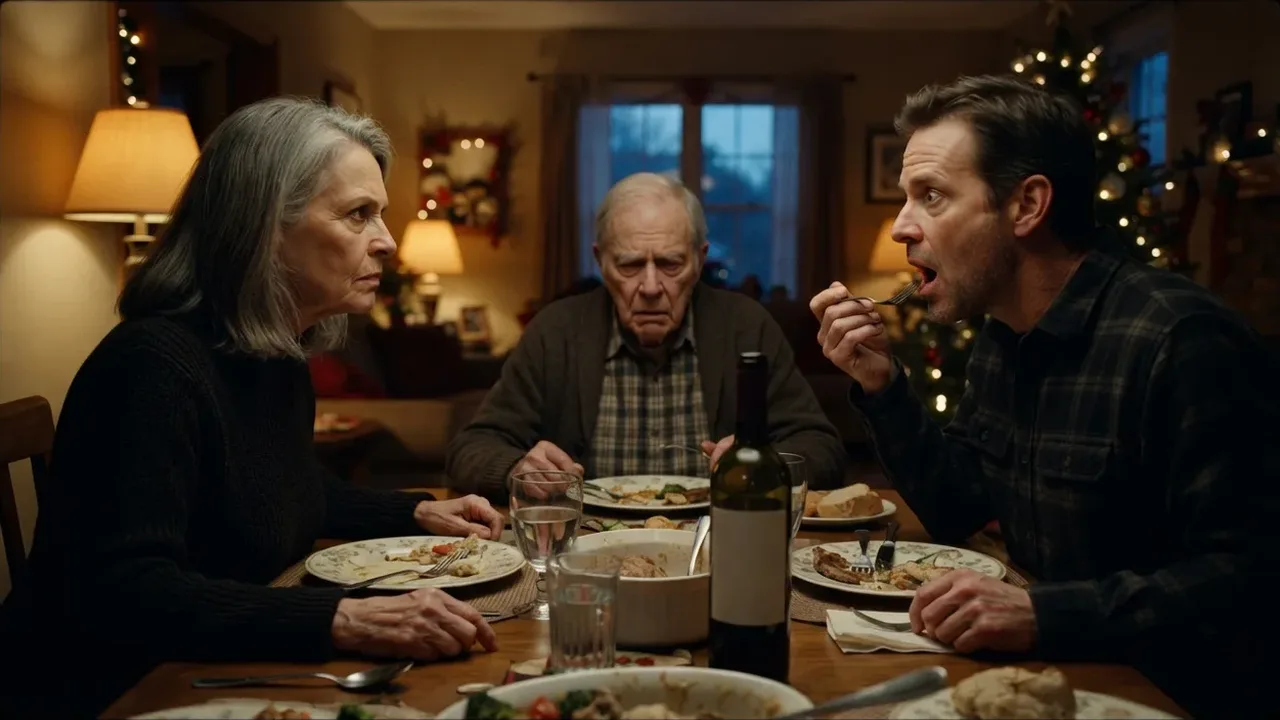
We ate pork chops among half-packed boxes. Afterward, with the dishes done and the kitchen light humming, I laid the stocking on the table.
Mama looked at it. Her hands, always folding something, stopped.
"I told you to burn that."
"I know what you told me." My voice shook, and I let it. "A woman named Glenda Dovie Pickett came to the post office with a card for you."
"Loyce Pickett was a good woman." She patted the table once. "We had an agreement, and I gave her my word."
"I put those cards in your box with my own hands twenty-seven Decembers, Mama. You were waiting at the road every time I came by, and you let me think it was a church friend."
"It was a friend."
She picked a crumb off the cloth and carried it to the sink. I stayed in my chair.
"It's cost me Clem's good word. It cost me nine days of you not calling."
"Inez telephoned me. You be gentle with Inez." She smoothed a wrinkle in the tablecloth that wasn't there. "It's finished, Marybeth. Let me go to Savannah with my house in order."
"Is she yours?"
The refrigerator hummed. Mama stared at the red felt and not at me.
"Don't you bring that woman to this house."
"You didn't say she wasn't."
Mama stood, gathered the dish towel, and said she was tired. Her hand went toward the red felt and stopped an inch short, and I picked it up and put it in my cardigan pocket.
I sat behind the wheel at the end of her drive with the engine off. A Valdosta card with no return address, every December from my first year on the route through 2023, and Mama waiting at the road that one week. The December I carried nothing, she'd asked me twice if I was sure. Inez's winter of 1959, Glenda's middle name, the backward loops, and a mother who could say "that woman" but not once "she's not mine."
I was fifty-seven years old, and I had a sister.
I called Glenda that Saturday and said I believed Opal was her mother. She laughed, a small startled sound, and then was quiet so long I thought the call had dropped. "I'd be so glad to come," she said, when I asked her to Christmas dinner at one o'clock.
On Mama's porch the next day I told her. She watched a pickup go by on Pecan Road. "Do what you're going to do," she said.
Clem arrived on Monday with his suitcase and his list. I told him only that there would be a guest at dinner, and he said, "Mama know?" and I said, "She knows."
On Christmas Day the house smelled of ham and cloves. Mama sat in her chair by the mantel in her good blue cardigan with a tissue up the sleeve, and Clem carried in the extra leaf for the table without looking at me.
Glenda came to the door at one o'clock with a dish of sweet potatoes under foil and the red envelope in her purse. Mama looked at her once and then at the carpet.
Before the blessing, I took the stocking from my cardigan pocket and hung it on the empty fifth nail, beside the other four. The bell gave its little ting.
"Clem, this is Glenda Pickett," I said. "She was born in Macon in January 1960. Mama named her Dovie."
Clem stood so fast his chair scraped. "No. Not today, Marybeth. Not in front of company, not at Mama's last Christmas in this house."
Glenda crossed the room and held the card out to Mama, her small hands steady. Mama kept hers in her lap.
I didn't make her speak. "Mama, you stood at the road every December for twenty-seven years. You don't have to wait at the road anymore. She's at your table."
Mama took the card. She read it in her chair, got up, and went to the mantel. She lifted the stocking off the nail and held it against her cardigan.
"Dovie," she said.
Nobody moved. Out the window a mockingbird worked at the last pecans.
"I was seventeen. Loyce held that baby first, and I promised I'd never come knocking, but I'd open the door if the girl came." Her mouth shook. "Your daddy knew. He said it was mine to tell. I couldn't make myself smaller in your eyes." She looked at Glenda and not at us. "Sixty-six years I haven't said that name out loud."
Clem was still on his feet, his cap in his fist. "Fifty-nine years I thought I was your first, Mama. I don't know what I am now."
"You're my boy," Mama said.
"Clem," I said. "I'm not taking anything from you. She still goes home with you on the thirtieth."
He stared at me a long moment. Then he went into the kitchen and came back carrying a ladder-back chair, and he set it at Mama's right, in Daddy's old place, and pulled it out for Glenda.
Later I dried while Mama washed, her quick hands working through the good china.
"You took it out of my hands," she said quietly.
"I know."
She handed me a plate and didn't say she was glad.
The sale closed on the thirtieth. That afternoon Clem's trunk was packed to the lid and Mama stood by the car in her coat.
"Write down that woman's number," she said. "Glenda's. And send her my Pooler address." She fastened her top button. "I'll mail the card this year."
Clem shook my hand, then pulled me into a hug that was stiff at the shoulders. "Call me Sunday, Sis."
It was less than he used to give me and more than I'd feared. Mama held me at the car door a long time and said nothing I'd have to hear her take back.
At the curb, the last giveaway boxes sat stacked beside her empty mailbox. Through the window of Clem's car as it pulled away, the little red stocking rode on Mama's lap, its brass bell catching the light.
Comments