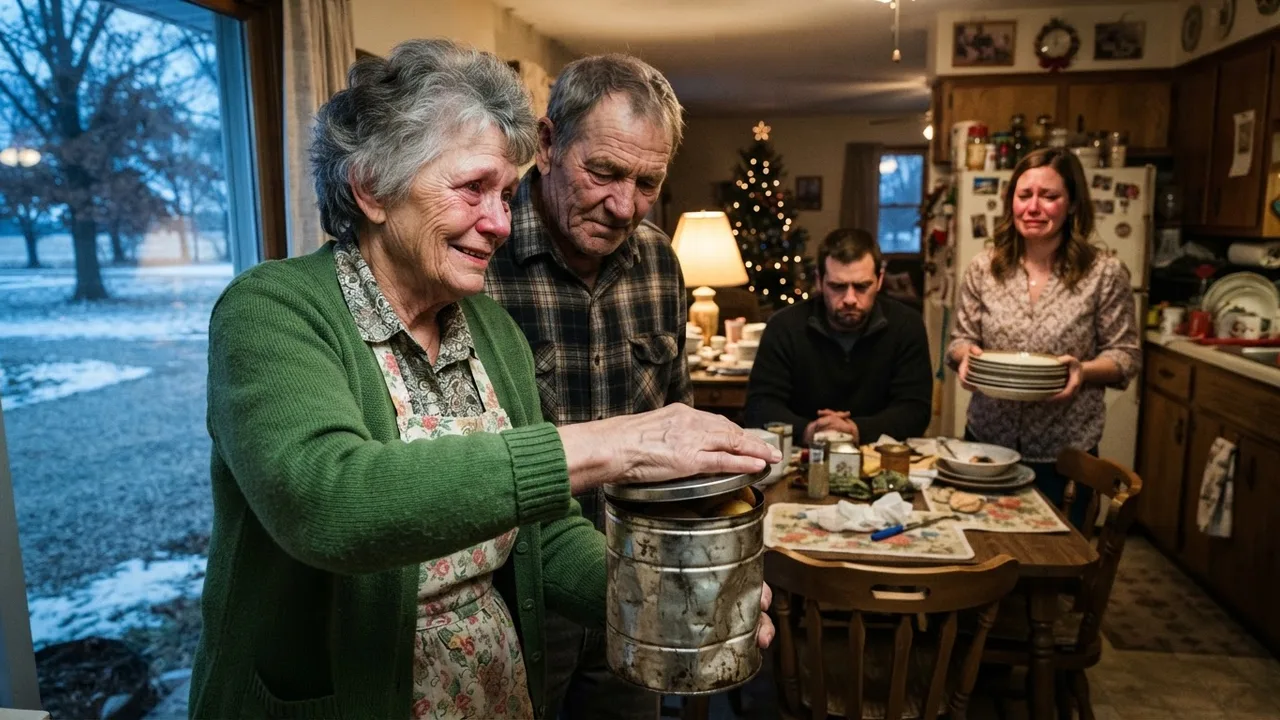
On the first Saturday in December I went down to the basement freezer for my roof money, and the coffee can marked BEEF SOUP BONES was four thousand dollars lighter than I'd left it.
I counted twice with the lid propped on my shoulder. Three thousand four hundred. The log clipped inside the freezer lid said seven thousand four hundred for the first of December, in my own handwriting, and the roofer wanted forty-five hundred on Monday.
As I let the lid down I saw a hard red crumb stuck to the rubber gasket, dark as a broken crayon. I had wiped that gasket with bleach water on the first, the way I have every month since my cafeteria days, and I had logged it clean. I don't throw out what I can't account for. I picked the crumb off and carried it upstairs, my right knee complaining on every step, and set it in a jar lid on the kitchen windowsill.
Then I called my son.
"Brad, somebody's been in your father's can. It's short, and I—"
"Ma. Who else has a key?"
I hadn't told him the amount. "Four thousand," I said.
"Harold's got a key."
"Harold fixed my sump pump Wednesday and left me a note about pie."
"He knew exactly where that can was. I'm just saying."
I looked at the jar lid. I could have said that my own son had stood alone down there for twenty minutes four days ago, with his overtime cut, and come up holding his father's level. I said, "I'll sort it out," and he told me to lock my doors, and I hung up with my thumb shaking on the screen.
That night I went back over the week like a delivery sheet. Brad on Tuesday, after his father's deer stand, asking if he could keep Marv's wooden level, and me saying of course. Harold on Wednesday, the note on the counter in his square capitals, his truck whining down my gravel the week before, while he waved it off as nothing. Tara on Friday, in her old gray sweatshirt, with a green balsam candle for me, carrying the Christmas tubs up from the basement so my knee could rest while I frosted sugar cookies. She'd teased me about the labels on my spice jars and hauled my trash can to the curb on her way out.
I lay awake listening to the furnace and hated that I had pictured Harold on my basement stairs, and then my own son.
On Monday I told the roofer I'd be short on the deposit. He said he'd hold my March slot until the end of the day Wednesday, and after that it went to the next name on his list.
Brad was at my kitchen table Wednesday noon with his reading glasses pushed up on his head, which told me he'd rehearsed. He hadn't taken his coat off.
"Harold paid the garage thirty-nine hundred dollars cash yesterday," he said. "For a rebuilt transmission. Three days after your money goes missing, he's flush."
"Who told you that?"
"Half the parts counter. Ma, I'll cover your deposit. Forty-five hundred, out of my truck fund. You sign today. You just take his key back."
I thought of his overtime and kept it to myself. "I'll ask Harold first."
"Ask him what? Ma, I don't want to watch you get hurt."
"I'll ask him, Brad."
Harold came into the church kitchen that evening through the back door, cap in his big chapped hands, to carry the roasters for the Wednesday supper. The pie he was owed sat in its box on the counter. I had scalloped potatoes and ham for sixty going, and I told myself to wait, and then I didn't.
"Harold, where did thirty-nine hundred dollars in cash come from?"
He went stiff as a fence post. The hearing aid whistled once in his left ear.
"I didn't take your money, Edith."
"I didn't say you did."
"You asked." He put his cap back on, indoors, which I had never seen him do. "I'd not come Christmas Eve where I'm not trusted."
The back door shut behind him. His truck started in the lot and pulled out onto the road, and I stood with a ladle in my hand until a woman at the pass asked if the potatoes were ready.
I served the line. Afterward I called Brad from the parking lot and said no.
"Ma, you'd pick him over—"
"I won't trade a man's key for money. Keep your truck fund."
The roofer, when I called him, said that since I hadn't signed by close of business, my March slot had gone to a woman on Pine Street. The next opening was May. At home I dragged the step stool into the bedroom and stapled a blue tarp over the stain on the ceiling, the one the size of a coffee can, and went to bed under it.
At the St. Paul's holiday bazaar that Saturday I worked the cookie table, as I have since Marv was alive. Two women I'd fed at funeral lunches for twenty years came up and took my hand between theirs.
"At our age, hon," one said, patting it, "we all want to believe."
I hadn't said a word about money to anybody at church. Brad had. He was standing by the coffee urn with a Styrofoam cup, and when I came over he lowered his voice.
"I'm just saying, Ma. Put that last thirty-four hundred in an account with my name on it. So it's safe. Before that man gets the rest."
"I'll keep my own money, thank you."
I walked the long way around the hall, past the quilts and the raffle table, with my face hot, until I came out at Tara's booth by the cookie table.
"Edie, you look like you've been chewing tinfoil," Tara said. She held out a jar of dark red candle. "Brand-new batch. Nobody's even seen this one yet, you're my first. Take it, it's yours."
"I'm paying."
"Edie, it's a gift."
"I'm paying, Tara. Today I'm not taking one thing from anybody."
She laughed and rang it up. "Eighteen dollars, then. Labeled and logged, just how you like." She squeezed my arm over the table. "Don't listen to him. He's scared, that's all."
The label on the jar said *poured 12/4/25*.
That evening I set the candle on the windowsill beside the jar lid. The red was the same red. I picked up the crumb and warmed it in my palm until it gave off a smell, faint and sweet, and I held the candle's jar under my nose and smelled cloves, and the same cloves in my hand.
I got out the freezer log and read the line for December first again. The coffee went cold beside me.
I told nobody. A crumb and a candle are not what you hand a man about his wife. I wanted to see her across my own flour first, with nobody else in the room.
The Monday before Christmas, Tara came to help make the kolaches for Christmas Eve, as she has every year. She came in the back door with a bag of powdered sugar and a kiss for my cheek, wearing the gray sweatshirt again. We had the dough half kneaded and flour to our elbows when I washed my hands and said, "Sit a minute."
I set the jar lid beside the red candle on the counter.
"I wipe that freezer the first day of every month," I said. "I wiped it December first and wrote it in my log. That crumb was on the gasket on the sixth. Your red. You poured it on the fourth, the jar says so, and nobody bought one until the bazaar. You were in my basement on the fifth."
Tara laughed, a short one. "Half the county has my candles, Edie. You bought one yourself."
"On the thirteenth. Not before."
Her hand went to the cuff of her sweatshirt. I saw small old spots of red on the gray. She pulled the sleeve down over her knuckles.
"Brad was down there too, you know."
I didn't answer her.
"And you handed a man you've known eleven months a key to your house. Brad's the one getting looks?" She was talking with her hands again, and then she stopped. "You don't know what twenty-nine percent does to a person."
I let that sit on the counter with the rest. She came around it, softer.
"Edie. If you let this go, nobody has to know anything. Harold'll come back on his own. You'll see. It'll be a good Christmas."
"It cost me Harold," I said. "It cost me my roof until May, and I sleep under a tarp. It cost me my name at the coffee table, with my own son telling church women I'm a fool."
"Don't."
"Tell Brad before Christmas Eve, Tara, or I will."
I noticed I hadn't called her hon. She took her coat off the chair. The door shut, and the dough sat in the bowl, half made, rising for nobody.
Next morning I drove six miles north on gravel with a pie on the seat. Harold was in the barn door with a pitchfork in his hand, and he leaned it against the frame when he saw me.
"I asked you wrong," I said. "I'm sorry I doubted you."
"I'd guess you had cause. I looked bad." He took off his cap and held it. "The transmission went. I sold Dad's two shotguns to a dealer in Waterloo for forty-one hundred. Paid the garage thirty-nine. I didn't want to come to you short, Edith."
"Harold, I'm short. I've got a tarp over my bed."
He looked at me a long time. "Tarp," he said. "I'd guess we make a pair."
"Come Christmas Eve. After church."
"I'd guess I can."
"I'm going to tell Brad about the shotguns."
His jaw worked. "Tell him," he said. "They were only guns."
I got back from the candlelight service at St. Paul's on Christmas Eve with the first dry snow ticking on my coat. Harold's truck was already in my gravel drive, and he stood beside it in his chore coat with his cap in his hands. Brad and Tara pulled in behind me a minute later. Brad got out angry.
"Ma, on Christmas Eve? With him here?"
I stood in front of my door with the porch light on my back. "Nobody comes in to my table until this is said."
"Ma—"
"Harold sold his father's two shotguns in Waterloo to fix his truck. That's the thirty-nine hundred dollars."
Harold didn't move. Snow gathered on his shoulders.
"On the sixth I found a hard red crumb on my freezer gasket," I said. "I'd wiped it clean on the first and written it down. It's from Tara's red candle. She poured those on the fourth, and nobody had one until the bazaar. She was in my basement on the fifth."
"Half this town has those candles," Brad said.
Tara said nothing. Brad turned and looked at her, and she looked at the gravel, and I watched my son see it.
"Tara," he said.
"I won't call anybody," I said. "I won't say a word at church. I would rather lose four thousand dollars than my son. But I will not set a plate in front of a lie on Christmas Eve. And Tara knows what twenty-nine percent means a good deal better than I do."
"Twenty-nine percent of what?" Brad said.
Tara's hand went to her cuff, and then she let it fall.
"A card," she said. "A year ago, for the wax and the jars and the booth fees. I had the statements sent to work. The fall fairs never earned it back." She breathed in the cold. "I took four thousand out of your mother's can on the fifth, while I was carrying the tubs. I paid the card off on the eighth. And I let you blame Harold."
Brad's mouth opened. Nothing came out of it.
"It's cost me the one thing I built myself," Tara said. "I'll close it. And it's cost me you. I knew I'd lost that the minute I did it."
Brad stood a long time. The snow settled on his quarter-zip, on the stitching of his name. Then he went to his truck and came back with the checkbook for the savings he and Tara shared. He wrote on the hood under the porch light, pressing hard, tore the check off, and held it out.
"That's four thousand. That's my truck fund, Ma." His voice cracked on it. "I'd write it twice before I'd say again what I said about you."
I folded the check into my cardigan pocket. He turned to Harold.
"I'll tell the women at St. Paul's myself," he said. "That I was wrong, and that I said it in front of people."
"I'd guess that'll take some doing," Harold said.
"It will."
I held out my hand for the house key. Brad worked it off his ring and put it in my palm. He didn't look at me. I took Harold's arm and we went in.
I'd hung up my coat and put the ham in the oven when the door opened behind us. Tara hung her camel coat on the hook and went to the china cabinet. She set out the good plates, one at every place, and Harold's next to mine, with her hands shaking on the stack. I did not tell her where anything went. She knew.
Supper was quieter than other years, but everybody was at it. Brad carved the ham. Harold ate three kolaches and told the one joke he has, about the elevator and the ear of corn, and Brad laughed a beat late. Down the hall, the tarp over my bed sagged a little where the stain was.
When the plates were cleared I went down to the freezer, favoring my knee, and brought up the can. I put the three thousand four hundred in a bank envelope with Brad's check. Then I washed the can at the sink, filled it with kolaches, and put it in Harold's big hands. I pressed the lid down with both thumbs until it caught.
Comments