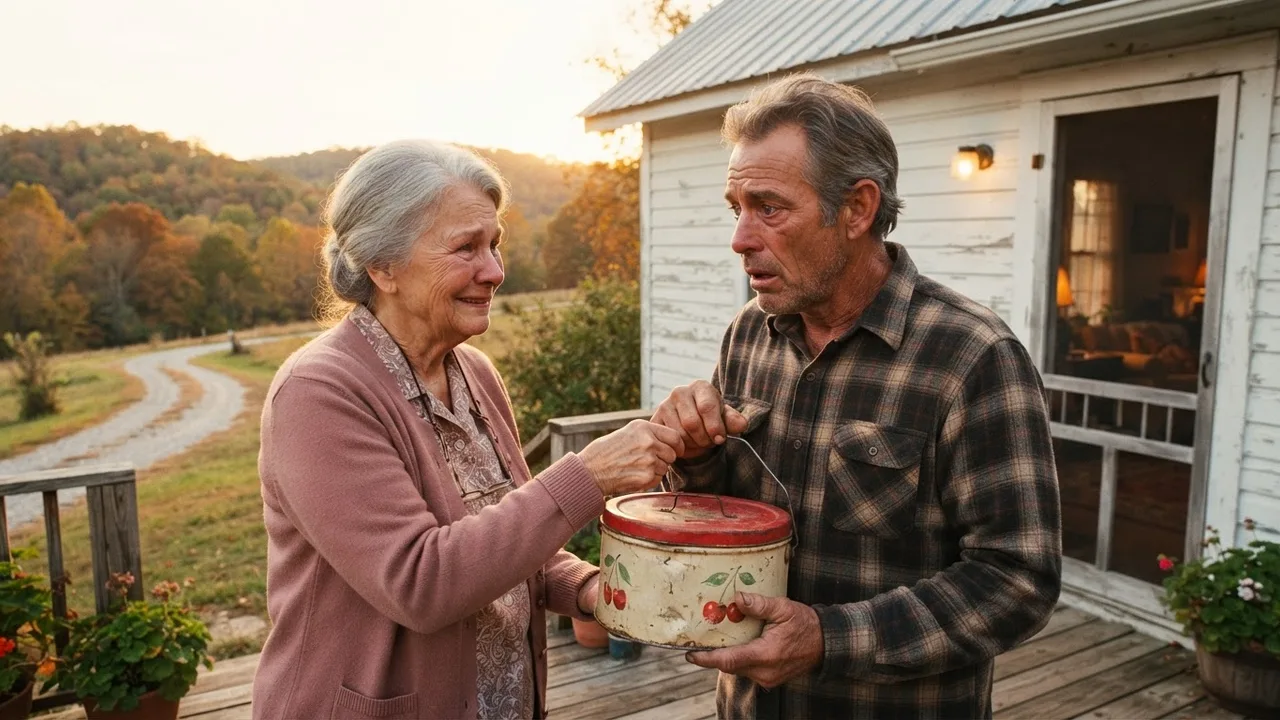
Mama's house on Spurlock Road had twenty-six days left in our family, and at one of the last Sunday dinners in it she asked who was going to carry Hoyt's cake in the tin carrier now.
She said it while she wrapped cornbread in foil, her hands going the way they always went. Then they stopped.
"Hoyt's cake?" I said.
"Did I say Hoyt?" She tore off another sheet of foil. "These boxes have me mixed up. Have some more beans."
I had already had two helpings. I looked past her at the sideboard, where a cardboard box sat open with the carrier in it. It was Aunt Ila's round tin, dented on one side, the cherries painted on it gone pale, the lid still red. Ila had carried her ribbon cake to the county fair in it the year she won. Her photograph stood on the piano with that ribbon pinned to her dress, the pretty sister who died at twenty-one. Beside the window stood the one straight cane-seat chair nobody ever sat in.
I knew exactly one Hoyt. Hoyt Fennell had been in my class since kindergarten, and he had unloaded produce at my kitchen door every Tuesday for eleven years.
"Mama, what cake?"
"The beans'll go to waste," she said, and carried the pot to the stove.
On Tuesday, Hoyt backed his truck to the loading dock at Ava Elementary like he always did, and I stood at the top of the steps with my clipboard and a hairnet on. He handed up the lettuce, then the case of apples, then the invoice. The pencil was behind his ear.
"Hoyt," I said, with a joke ready in my mouth, "somebody bake you cakes?"
He didn't answer. He took the pencil down and looked at it.
"Every October seventeenth," he said. "My birthday. Black-walnut jam cake under burnt-sugar icing, on my porch before daylight, in a tin carrier with cherries on it. I set the empty on my swing and by evening it's gone."
My clipboard was in my hand. I couldn't have told you what was on it.
"I was adopted," he said. "Mama told me when I was ten. Dot said, 'Somebody who loves you sends it. Don't you lie in wait. Just eat it and say thank you.' So I never have. I'll be fifty-three on the seventeenth."
"Hoyt." My mouth had gone dry. "I think it's my mother."
He looked at me a long time. A forklift beeped somewhere behind the gym.
"Don't you dangle this, Jodie. Find out or don't say it."
"I'll find out."
He signed the invoice and handed it up without one joke. Forty-seven years we had known each other, and I had never seen him not have one.
The first Saturday in October Kirby pulled in at the farmhouse with the empty trailer, and I carried a plate of Mama's chicken and dumplings across town to Velma Odom. She lived two blocks off the square in a small brick house. She met me at the door in her quilted housecoat with her lipstick on and her cane hooked over one arm.
"Honey, sit. I was just thinking about the summer of the big hail, because that's the summer before your mama and me started together."
"Nineteen seventy-nine," I said.
"Well, now, you know it. She could've had the high school kitchen, more money, and she went to the superintendent and asked for the elementary by name." Velma tapped the table. "The fall the Fennell boy started, same as you. She set back a plate for him for years, with the Fennells so hard up. And once I asked her why, and she said, 'I'm keeping a promise.'"
I pushed a dumpling around the plate.
"I always told people she went in there for me," I said.
"Well, honey, she did too." Velma tilted her head. "Why are you asking?"
I thought of her alto in the Baptist choir, and of half of Ava standing in the pews beside her.
"Sorting boxes," I said. "Eat while it's hot."
That Sunday I caught Kirby in the garage after dinner, where he was stacking boxes against the wall with his cap pushed back, and I told him everything: the slip, Hoyt's porch, Velma's kitchen table.
"Jo." He set down a box. "She's seventy-nine and leaving the only home she's ever had. Ask her once she's settled in Tulsa."
"After Friday week there's no house to ask in."
"Then it'll keep."
"It's been keeping fifty years, Kirby."
He went short and bossy, the way he did. "You always have to be the one who knows what's in everything. Every drawer, every box." He picked the box back up. "I'll finish the packing myself. Don't come up till Thursday."
"That's four of the last days I've got in that house."
"Then you'll spend them at home," he said, and went back to stacking.
I drove home with the radio off. Kirby had never in my life told me not to come to Mama's.
On Thursday his truck was gone, and so was the trailer. The kitchen was half packed, cups wrapped in newspaper and lined along the counter, the table bare except for a sugar bowl. Mama stood at the sink in her cardigan with a tissue showing at the cuff, wrapping a gravy boat.
"Have a roll," she said. "They're yesterday's but they're good."
"Mama, Hoyt Fennell has found your cake on his porch every October seventeenth of his life. He never once lay in wait to see who left it."
Her hands slowed on the newspaper.
"Velma told me about nineteen seventy-nine," I said. "The high school kitchen. The plate you set back. The promise."
"Velma talks."
"I've told everybody you went into that kitchen for me." My voice cracked on it and I let it. "I went into it because I thought it was where you loved me best. And I've stood across a loading dock from that man every Tuesday for eleven years, not knowing he mattered to this family."
She set the gravy boat down. For a while there was no sound at all; even the refrigerator stood unplugged and propped open to air out.
"I bake the cake," she said. "I won't tell you I don't."
"For who?"
"It's a promise, Jodie. To somebody who's been gone fifty-one years. It was the only thing that person ever asked of me, and it isn't mine to tell." She looked at me. Her eyes were wet, and she hadn't moved to wipe them. "Let it go to Tulsa with me. Please."
"Mama."
"I mean it." She sagged against the counter, and I saw how small she was. "I'm tired. Take that box by the door, the one marked Jodie."
She went into the dining room to the sideboard box, lifted the dented carrier out and set it on top of the one by the door. She had written my name on the flap in her slanting hand.
I carried it out to the car myself.
That night I put the carrier on my own kitchen table in Ava and sat down in front of it with my reading glasses on the cord.
Burnt-sugar icing scorches. I have cooked icings for thirty years, and I know a hand that hasn't practiced will turn it bitter or grainy in the pan. Hoyt had said burnt-sugar icing, every year, ribbon-cake perfect. Mama had told us all my life that she never could make Ila's cake.
Somebody had made it for fifty-one years.
The family said Ila spent 1973 at a shirt factory in Springfield and came home before Thanksgiving. Hoyt would be fifty-three on October 17. That put his birth in October of that same year, and the only person Mama had lost fifty-one years ago was Ila.
I got up and looked at the dark window. I thought about the photograph on the piano, the ribbon, the girl we always said died with nothing behind her.
I called Hoyt the next morning and told him there was a place for him at Mama's Sunday dinner.
"Is it her?" he said.
"I'd rather you hear it at the table than from me on a phone. Wear a good shirt."
"Jodie."
"I won't dangle it, Hoyt. I promise."
Then I called Mama. She came on the line out of breath, with newspaper crackling behind her.
"I asked Hoyt Fennell to dinner Sunday," I said.
She said nothing. I heard foil tearing.
"He'll want to know somebody's glad he came," I said.
"You've done what you've done," she said, and hung up gently.
On Saturday I made the cake. The first icing scorched and I poured it out, and the whole kitchen smelled like a burned penny. The second came off the stove the color of dark amber and set smooth over the black-walnut layers. Kirby was back from Tulsa by then, and he didn't call me.
Hoyt came up the porch steps at Mama's in a pressed white shirt with his big hands empty. Kirby stood at the dining room window with his arms crossed. Mama met Hoyt at the door, and I watched her look at him as if she had never seen him before.
"Come in out of the wind," she said.
She served him first, ham and green beans and the yeast rolls, and she put two on his plate without being told. She said almost nothing while we ate. The packing boxes crowded the walls, and Ila's photograph watched from the piano.
When the plates were cleared, I brought the carrier in from the kitchen, set it on the table in front of Hoyt and lifted the red lid.
Black-walnut jam cake under burnt-sugar icing.
"Aunt Ila's cake," I said. "Took me two tries. Mama's been making it fifty-one years and telling us she never could."
Hoyt didn't touch it. His hands were still on the table.
"Jo," Kirby said. "Not today."
I answered my mother, not him.
"You kept your word so well that he ate at your school every day and at your table never. Friday strangers get the keys to the house Ila grew up in. Let him sit at her table once while it's still ours. If you won't say it, Mama, I will."
Mama stood with the dish towel in her fist. She folded it once and set it down on the table beside the cake.
"Hoyt," she said. "Your mother was my sister, Ila."
Nobody moved.
"She was nineteen. Our parents were strict church people, so they were told she'd gone to a shirt factory in Springfield. I drove up Sundays." She kept her eyes on him. "She picked Dot because Dot was her Sunday school teacher. She came home that November, and two years later she was dying. She said, 'He'll have a mother. Just see he eats.' That's every word she asked of me in her life."
"Ma'am," Hoyt said.
"I've broken it on a Sunday with the dishes still out." Her voice shook once and held. "I'll answer to her for that. Your father was a boy who went into the Navy and never knew, and his name I'll keep."
Hoyt breathed out. He looked down at the cake.
"Dot told me to eat it and say thank you," he said. "I never knew who to say it to." He lifted his eyes. "Thank you, Ardith."
My mother put her hand over her mouth.
Kirby had not turned from the window the whole time. Now he crossed the room, picked up the straight cane chair that had stood by the window all his life, and carried it to the table.
"That was Ila's," he said, and set it down at Hoyt's elbow. "Sit."
Hoyt moved over into it.
"I wanted her to leave here easy," Kirby said to me, quietly. "That was mine to want. It wasn't mine to decide. I'll carry that to Tulsa."
"I know you will," I said, and my throat hurt.
Mama took the knife from the sideboard and cut the cake.
There was coffee in the good cups, the last ones not yet wrapped. Hoyt ate his slice slowly with his shoulders down, sitting in Ila's chair under Ila's photograph. Mama sat across from him and told him small things, one at a time: that Ila's laugh came out of her in a snort and she hated it, that the blue ribbon was pinned to her dress the whole afternoon and she wouldn't take it off for supper, that she had picked Dot and nobody else.
"Two rolls," Hoyt said suddenly. "You always gave me two rolls."
"You were skinny," Mama said. "You were a skinny little thing."
He laughed, and then he had to put his fork down.
I thought about the story I had told for forty-seven years, that Mama went into that kitchen for me, and I let it go. Part of why I went in there was gone with it, and the picture of Ila on the piano had turned over like a card. She wasn't a girl who died with nothing behind her. He was sitting at the table, eating her cake with a bent fork.
Kirby wouldn't quite look at me yet, but he refilled my coffee without asking.
When the light went long across the floor, Hoyt stood and pushed in his chair. Mama picked the carrier up from the table and held it a moment against her cardigan.
"It was your mother's," she said. "It's yours to carry now."
I cut what was left of the cake, wrapped it in wax paper and laid it into the carrier, and Mama pressed the red lid down over it. Hoyt held it by the wire handle. He nodded to each of us in turn and walked out the front door of the Spurlock house in the last of the daylight, the cherries on the tin showing in the sun, with five days left on the house and nobody left to set a cake on a porch swing before dawn.
Comments