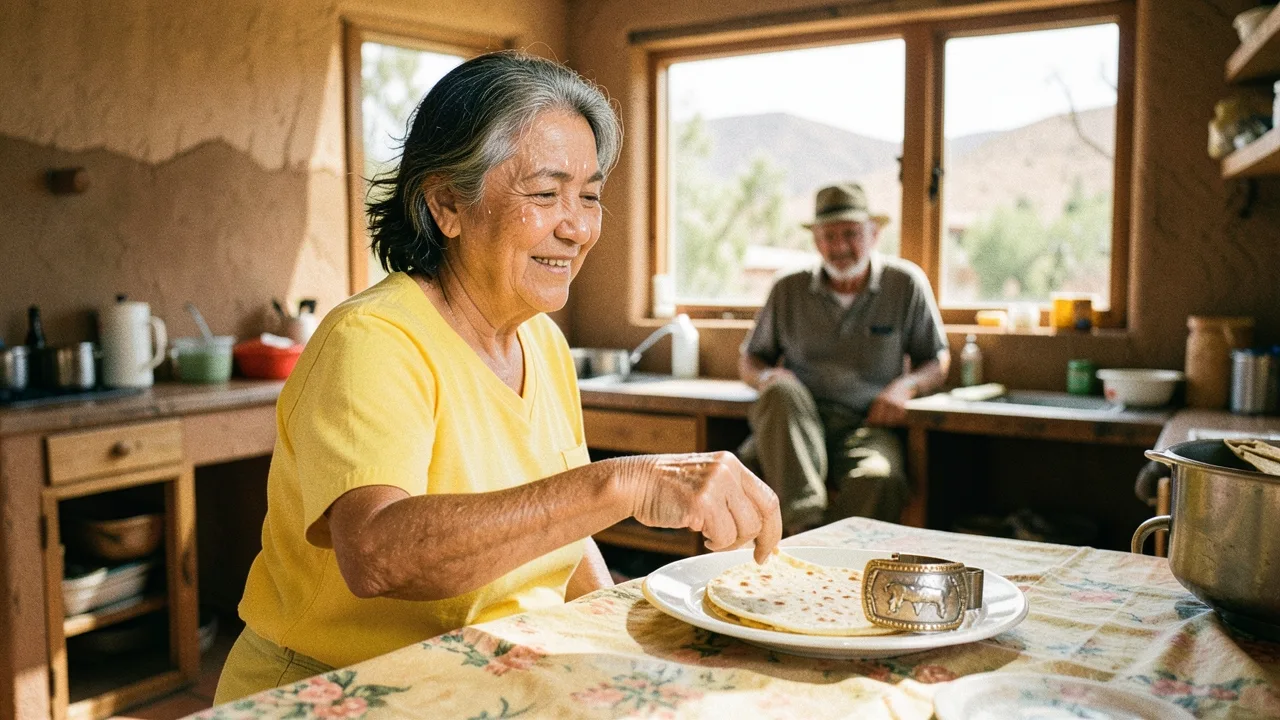
My father's silver roping buckle was the one thing I asked for when Mama sold the house on Bernard Street, and I had until the closing on October 30 to make my brother agree.
I didn't think it would take that long. Esteban had always let me have the small things.
That Sunday we ate at the kitchen table with boxes stacked to the window. Mama wouldn't eat anywhere else until the closing. The comal sat wrapped in a dish towel on the stove, the biscochito cutters were in a shoebox, and the red chile ristra still hung on its nail by the pantry. Outside, the roasters in front of the grocery had been turning their drums all week, and the whole town smelled of scorched green chile.
She had made red enchiladas with a fried egg on top, the way Daddy liked them. His buckle hung by the kitchen door on its own nail, where it had hung for forty years: silver and gold, a steer and a rope cut into it, from the 1961 Socorro County Fair team roping.
"I'd like the buckle, Mama," I said. "When it's time."
"So would I." Esteban had driven down from Albuquerque and still wore a pressed work shirt. "I'm the son."
"Neither of you." Mama spooned chile over my plate. "That buckle's been Nacho's since—"
She stopped. The spoon stayed over the plate and a thread of chile dripped onto the oilcloth.
"Who's Nacho?" I said.
"Nobody. A boy your father knew. Eat."
She got up to warm tortillas she had already warmed. She stood at the stove with her back to us, and she did not sit down again.
Esteban laughed and mouthed *names crossed* at me. I didn't laugh. There was no Nacho in the Armijos, none among our cousins, none in the church directory, none in forty years of Christmas cards.
On Thursday I took Mama's Buick to Sedillo Tire & Brake on California Street, a mile from the house, for a brake job I'd been putting off. The Armijos had taken every car they owned there for as long as I could remember.
Mr. Sedillo wrote up the ticket at the counter with his faded feed-store cap pulled low. He was broad and slow and called me ma'am. "Six hundred forty, ma'am."
I was counting it out when a man in a work vest leaned in the bay door. "Hey, Nacho, you get to my truck today?"
"After lunch," Mr. Sedillo said.
My hand stopped on the bills. He saw me look at him, and he nodded toward the wooden bench just inside the bay door.
"Your daddy sat right there," he said. "Saturdays, from '94 till he got sick. Talking roping, mostly. He let me hold that buckle of his once, in '97."
"Did you know him before the shop?"
"No, ma'am. He just showed up and kept showing up."
"Showed up why?"
He looked at me a moment longer. Then he went quiet and turned to the next customer, and I stood there holding six hundred and forty dollars with nobody to hand it to.
I lay awake that night running Nacho through every Armijo I knew. I also ran through the man I'd liked for years without once asking him a question.
Two weeks later, on a Saturday, the Buick would not start. Mama called Sedillo's, the way she always did.
By noon the garage on Bernard Street was hot as a kiln, with the door up and the concrete giving back the sun. Mr. Sedillo clamped a jumper box to the battery while I held the flashlight, though there was nothing in that garage a flashlight could help.
"It's the battery," he said. "Your mother ought to sell me this car, ma'am. My granddaughter Ximena's sixteen and needs something that runs."
"I'll tell her."
He straightened and pulled off his cap to wipe his forehead with his wrist. Under it, swept back from his hairline, was a streak of white as clean as a feather.
It was my father's streak and Esteban's. In my own twenty-four years of school nursing I'd charted that same lock on brothers and sisters and never once on a stranger.
I couldn't make my mouth work for a second. "Were you always a Sedillo?"
He gave a short laugh at the odd question. "Frank Sedillo adopted me at three. He died in 2020. My mother never said much about my first father. Just that he was a good man who kept his word."
"That's a nice thing to say about a man," I said. It was all I could manage.
He settled the cap back, shut the hood, and drove off thinking I'd been making conversation. I stood in my mother's garage with the heat coming up through my shoes. I had never kept a thing from a person's face before, and it turned out I knew how.
The Saturday after, Esteban came down to pack, and I caught him in the driveway while he was loading boxes into his truck bed. I told him all of it: Nacho, the bench, the streak.
He kept his eyes on the box in his arms. "It's a nickname and a cowlick, Leti."
"It's not a cowlick. It's the same white as yours."
"Half of Socorro has gray in the front by sixty." His voice went measured and flat, the way it did when he meant to have the last word. "You go digging at Sedillo's and you'll shame Daddy in front of the whole town. I won't have it."
He set the box down and went inside. Through the screen I heard him tell Mama that I had some idea about Daddy and the Sedillo man, and that he wanted the buckle to put an end to it.
That evening she took it off its nail. She didn't look at me. She wiped the silver once with her apron and put it in Esteban's hand.
He left without saying goodbye. I stood in the driveway watching his taillights go up the road toward the interstate, seventy-five miles of dark to Albuquerque, and then I went back inside to the nail.
On Sunday I found her in the kitchen with newspaper and a stack of plates. The nail by the door was bare, with a pale square on the wall under it.
"Sit, Mama."
"I have the plates to do."
"Sit."
She sat. I laid it out the way I'd lay out a chart. Nacho was what the customers called Mr. Sedillo. Daddy sat on his bench every Saturday for years, and our family had taken its cars nowhere else for thirty-two years. And under the cap was a white streak I'd have known anywhere.
Mama folded and unfolded a sheet of newspaper.
"On Daddy's last day he asked for the boy," I said. "All afternoon. 'Where's the boy? Where's the boy?' I held his hand and said, 'There's no boy, Daddy, it's me.' And when the nurse came in, I told her he was confused."
Mama's hands went still.
"I've been ashamed of it for seventeen years," I said. "I thought I'd made it up out of my own head, that the one thing he wanted at the end was nothing."
She didn't speak for a long moment. A truck went by outside on Bernard Street.
"Your father was married before me," she said at last. "There was a baby. He made a promise to the mother and he kept his word."
*Kept his word.* They were the very words Mr. Sedillo had said his mother gave him about his first father.
"Is it Ignacio Sedillo?"
She looked at the pale square on the wall. She would not say yes and she would not say no, and her not saying was an answer.
"*Mija,* let it rest." Her voice dropped into Spanish. "That man had a father who loved him. Don't take that from him at sixty-three."
"Frank Sedillo has been gone since 2020, Mama."
She got up and went back to her plates.
That night I sat at my own table on Vista Drive with a cold cup of coffee and two choices, and neither was free. If I told it, I'd lose my picture of a father who never gave anything up, and my place as his eldest, and maybe Esteban's goodwill and Mama's forgiveness. If I kept it, I'd be one more keeper, and Daddy's last afternoon would stay wrong forever, and a man would go on not knowing whose bench that was.
I chose telling it. I wanted to do it with all of them in the room, at the last supper in the house.
Mama settled the Buick herself on the phone the following Sunday: $3,500, to Ignacio, who would come by the evening of the twenty-fifth for the keys. On Monday I called Esteban.
"Come to Mama's last supper," I said. "And bring the buckle."
"I'll come." He let that sit. "I'm not promising anything about the buckle."
"Then come without it."
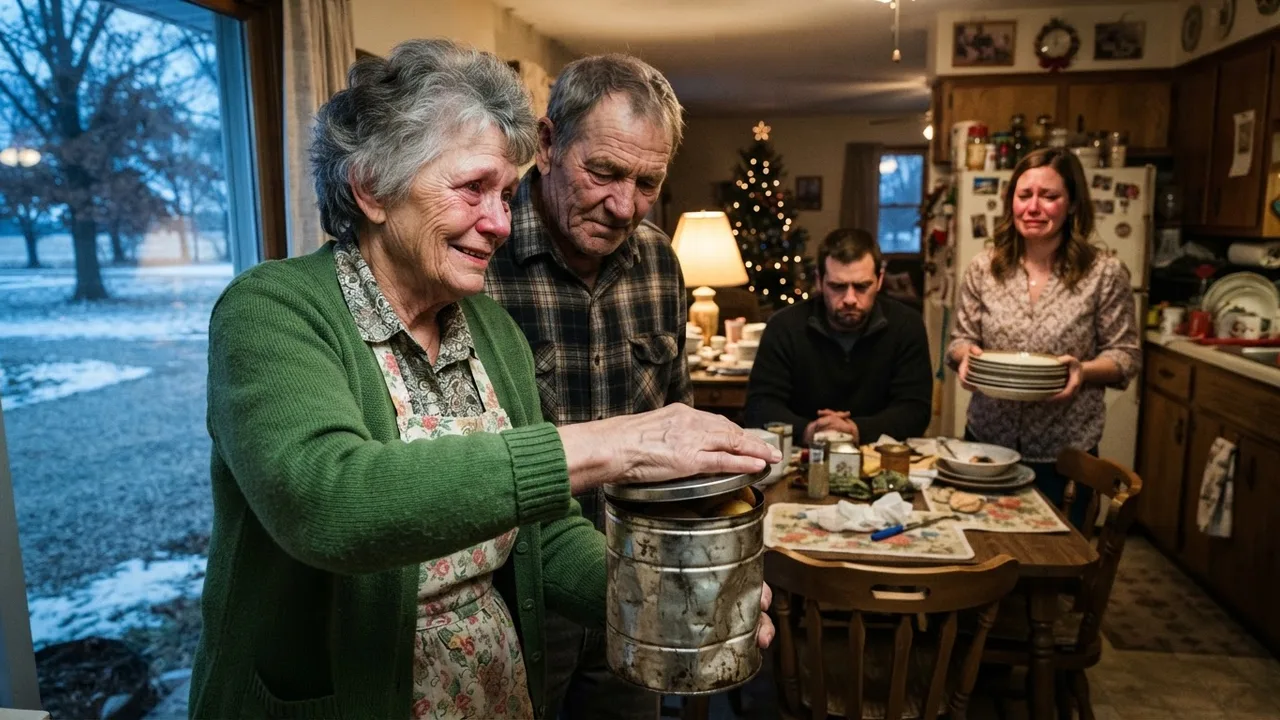
On the twenty-fifth I made the enchiladas myself, because Mama's hands had started to shake over the stove. By then the kitchen held three chairs, the table, and a little else. Esteban's truck was in the driveway when the knock came at five.
Ignacio stood on the step in a clean shirt and his feed-store cap, holding an envelope. I took him by the arm, as I never had.
"Stay for supper," I said.
"Ma'am, I only came for the keys."
"I know. Stay anyway." I went out to the garage and carried in the folding chair, the metal one with the cracked seat, and wedged it in at the corner of the table.
Mama's rule had held for fifty years, no caps at her table. He looked at her, and she looked at the oilcloth. He took off his cap and set it on his knee, and the white streak showed under the kitchen light.
Esteban looked at it, then at his plate.
We got through a few bites. I put my fork down.
"Ignacio. Your mother told you your first father was a good man who kept his word." My own voice sounded strange to me. "His name was Rubén Armijo. He kept his word forty-three years, and the last fifteen from that bench."
Ignacio set his fork on the rim of his plate, very carefully. Nobody moved.
"Leticia's upset," Mama said quickly. "She's been packing, she hasn't slept. *Mija,* you don't know what you're saying—"
"Daddy's last day, in hospice, he asked for the boy all afternoon." I kept my eyes on Mama. "I held his hand and said, 'There's no boy, Daddy, it's me.' Then I told the nurse he was confused. He wasn't confused. He was asking for you." I turned to Ignacio when I said that last part.
Mama made a sound I had never heard from her. She pressed the back of her hand to her mouth and took it away.
"He wasn't confused," she said. "He was asking me. I promised to keep it while Frank lived, and Frank's six years gone, and I kept it anyway." She was looking at no one. "In 1994 he wanted to tell you, Ignacio, and I said no. He told me to give you his buckle. I was proud I kept my word to your father. I didn't."
Nobody answered her. The refrigerator hummed. I looked across the table at Esteban and said nothing, because anything I said would have been pushing.
Esteban pushed back his chair and stood. He went out the door without a word, and I heard the truck door and then his boots on the porch boards. He came back in with the buckle in his fist, set it beside Ignacio's plate, and sat down again.
Ignacio picked it up. He turned it once under his thumb, the way he must have in 1997, and ran the thumb along the steer.
"I'd have liked to know whose bench that was," he said.
He did not get up from the chair.
Mama was crying, but she did what she knew how to do. She reached over with the spoon and put two enchiladas on his plate, then another spoon of chile, and pushed the tortillas toward him.
"Eat," she said.
He ate a bite. After a while he laid the envelope beside the Buick's keys. "Thirty-five hundred, ma'am. As we said."
"I don't want it." She pushed it back across the oilcloth. He pushed it again. She looked at it, and she gave up.
"Come to Albuquerque for Thanksgiving," she said. "Come to my apartment."
"I'll bring Ximena."
Later he went out to check the Buick's tires. I carried plates to the sink, and when I came out onto the porch Esteban was standing there with his hands in his pockets, looking at the roasters' glow down the street.
"Fifty-four years I was Daddy's only son," he said. "I guess I wasn't."
"No."
"I'm not going to pretend that doesn't cost me." He rubbed the back of his sunburned neck. Then he went in and I heard his voice at the table, easy again. "Hey, Ignacio. Did Ximena get the streak?"
"She did," Ignacio said. "Right up front."
I came back in with the basket and set the warm tortillas down in the middle of the table. The silver buckle lay beside Ignacio's plate and his cap sat on his knee in the folding chair, the one thing I had asked for. I passed him the tortillas.
Comments