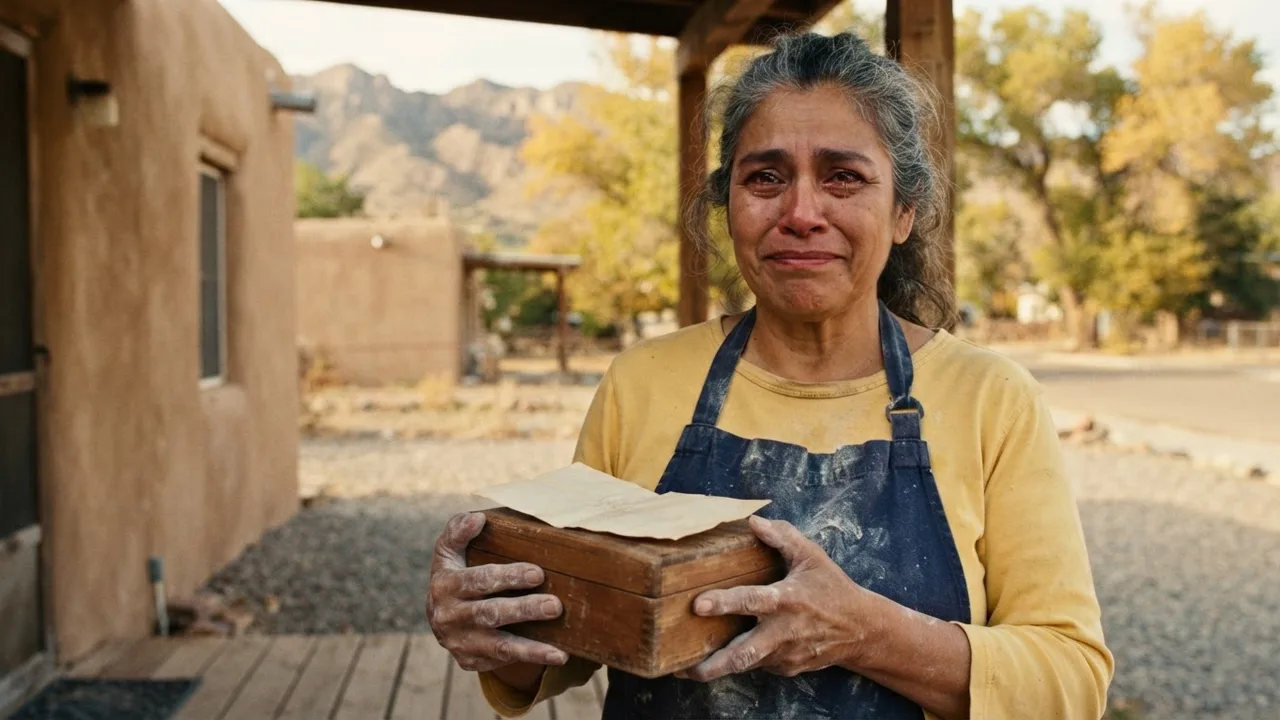
The new manager gave me until October 3 to stop making bread from scratch at Paloma Market No. 1, and after that, he said, he'd see whether a woman my age was still needed at all.
He said it at my bench at five in the morning, on his second day, with a tablet in one hand and my tray of conchas between us.
"Here's the thing, Juanita," Austin Feeney said. "The bakery's running four percent. District wants eleven by December 31."
I kept shaping. Twelve to a tray, and I counted them under my breath, the way I count everything.
Nineteen years I had opened that bakery at four in the morning. Bolillos and conchas every day, custom cakes on Saturdays, all of it on a long steel bench my Tía Altagracia had put in when she opened the first Paloma Market in 1961. She called me Palomita until the day she died.
What Austin Feeney did not know, and nobody on that floor knew, was that Tía left me 51 percent of Paloma Markets, all twenty-six stores. The certificate lay in a cedar box under my bed. I sat on the board as Juanita M. Bustamante and drove to Albuquerque four times a year in my good blouse.
My son Eliseo was sixteen when Tía died. I told him she'd left "a little money and some papers," because I wanted him to make his own way. And I kept it from the store because word in Socorro reaches Albuquerque, and a director filing papers about her own bakery would be talked about in every Paloma by Friday.
"Eleven percent," Austin said again. He turned the tablet so I could see the red number. "Scratch baking is a hobby the store pays for. It ends October 3. Frozen par-bake after that."
"The Saturday cakes ring at the service desk," I said. "Special orders. They aren't in your four percent."
He smiled, not unkindly. "The plan counts the bakery code and nothing else. Moving sales between departments is above anybody in this building. The report is the report."
He reached past me and lifted the custom cake book off its nail by the oven. I had kept that book there since before he could drive.
"I'll hold on to this," he said. His eyes went to the blue dove stitched on my bib. "Cute. A bird nobody remembers. After the changeover, I'll see whether a woman your age is still needed full-time. No offense."
He walked off, straightening a rack of bags as he went.
I stood there with flour in the creases of my knuckles. One signed page from a director would stop him cold. I also knew whose name would be on it.
I baked the last scratch bread on Saturday, October 3, and I did it slowly. Reyna came back to the bakery window at the end with her thermos, poured me a cup of her coffee, and said nothing, which for Reyna was a speech.
On Monday, Austin had me on twenty-four hours a week, noon to close. A trainee had my four o'clock opening and a frozen tray to open it with.
"Older folks just run slower," Austin told me up front, by the registers. "No offense."
I took my apron to the deli counter to say hello to Reyna. She was standing with a clipboard. At the top of the sheet, in her round handwriting, it said *Bustamante, J. — breaks.*
"He told me to log them," Reyna said. She had put her glasses on, the beaded chain swinging, and she looked at the clipboard instead of at me. "I'm a lead. I can't say no."
"I know you can't."
"I'll drive myself from now on." Her voice had gone quiet and formal, the way it does when she's frightened. "It makes more sense, with your hours."
Nine years of rides at 3:45 and one thermos between us on the bench seat of my '09 sedan, and it ended over a clipboard. I could have filed the review that night. I went home and made eggs and did not.
The Saturday after that, Dolores Archuleta came in at ten with her purse over her arm and her good coat on, though it was warm. I had made her thirtieth-anniversary cake in 2016. In the spring she had asked me for the fortieth, and I had written it in the book. Two tiers, lemon, sugar marigolds.
"Juanita." She smiled at me across the counter. "I'm here for my cake."
I opened my mouth, and Austin got there first.
"Ma'am, I'm sorry," he said, coming around the end of the case. "The bakery doesn't do custom work now. Juanita is just counter help. She shouldn't have promised you anything." He tapped the glass. "We have a frozen sheet cake, though. Happy to write whatever you like on it."
Dolores looked at me. I had made that woman's cake for nineteen years and had never once missed a date. Three women in the bread line had stopped talking.
She took the order slip out of her purse and laid it on the counter. She smoothed it once.
"I'll find someone else," she said. She did not say it unkindly, and that was worse.
Austin picked the slip up and looked at it. It was my handwriting. I watched him not read it.
A week and a half after that, on a Tuesday, he asked me up to the office stair and handed me an envelope.
"Voluntary separation," he said. "Six thousand two hundred dollars. Honestly, Juanita, at your age that's the best you'll see." He said it gently, like a man breaking news to a sick aunt. "My wife and I have a baby due in January, so I know how this feels from the other side. You can sign it in my office on October 27. Two o'clock. You'll need a witness."
"And if I don't sign?"
"Then we keep going the way we are. Twenty-four hours is a lot of hours for a bakery that doesn't exist."
I drove home the four minutes with the envelope on the seat beside me, where Reyna's thermos used to ride. I did not sleep much that week.
On Monday night I sat at my kitchen table with the carbon book of every cake slip I had written in twelve months, and a pencil, and a pot of Folgers I didn't need. I added the first column under my breath and then the second. I added them again, because I did not believe the first answer.
Thirty-one thousand four hundred dollars. All of it rung through the service counter, none of it in Austin's number.
There it was, plain as a bread tray. The plan I'd voted for in May, with my own hand in the air, would close a bakery that made money, and the next store's baker would lose her bench the way I was losing mine. If I said nothing, the only person I protected was a woman who didn't exist at that store anymore. She had been the Juanita who opened in the dark, and that Juanita was already gone.
I took the cedar box out from under my bed and lifted the certificate out of its tissue. Number 1, issued to Juanita Munguía Bustamante. Tía had signed it in blue ink, and her hand shook on the *M*.
If I spoke, I would not be plain Juanita again. Reyna would know I had kept her outside the truth. And I would have to tell Eliseo why I let him scrape through 2020 on a credit line when I had money sitting in banks that I'd never touched.
I wrote the director's review on a yellow pad in my best handwriting, signed it, and put the certificate beside it. Then I washed the coffee cup and went to bed and lay there listening to the refrigerator.
At two o'clock on Tuesday the door to the manager's office was shut. Reyna sat in the chair by the window with her hands in her cardigan sleeves. On the desk, Austin had set out the separation paper with a pen laid across it, the way you set a place at a table.
"Thanks for coming, Juanita. Reyna's here as witness." He clicked his pen. "If you'll sign at the bottom—"
"I won't."
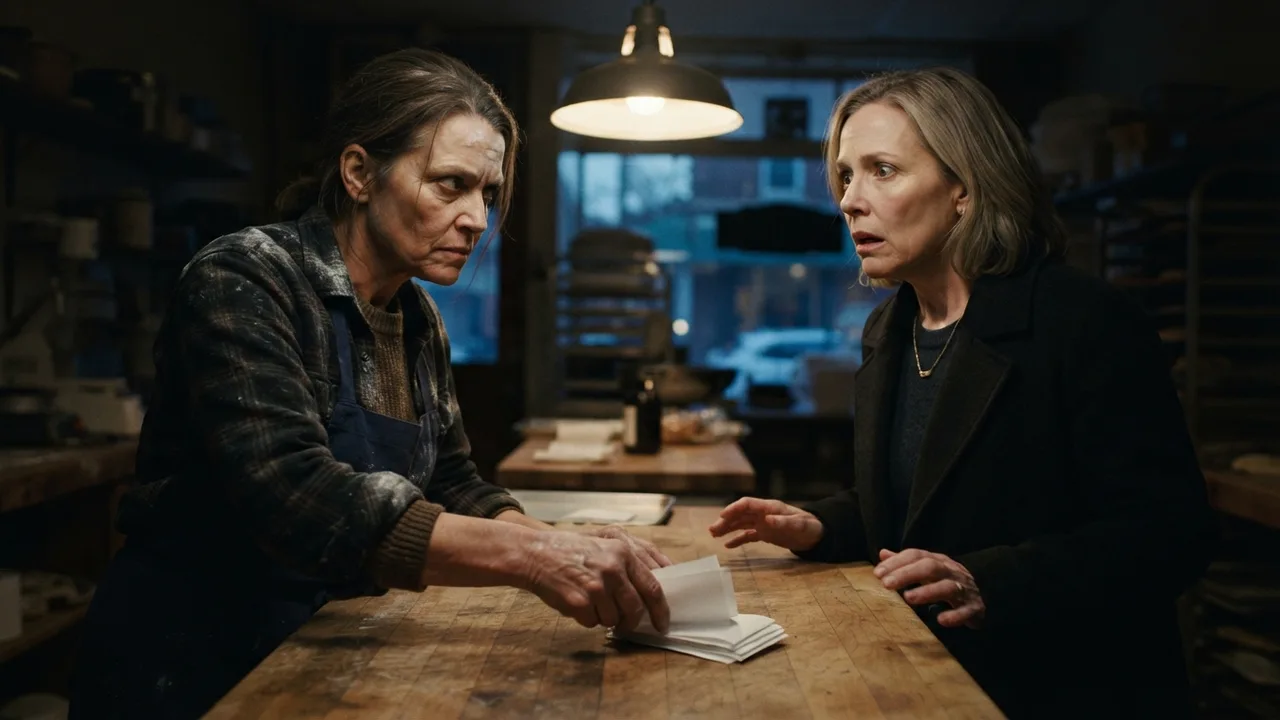
I laid the certificate on the desk beside his paper. Then the page from the yellow pad, copied clean. Then, last, the carbon book, set down square on top.
"As a director of Paloma Markets," I said, "I have filed a written review of this store's bakery figures under Section 4 of the plan, with special orders counted. I filed the original this morning with the corporate secretary in Albuquerque. That one is your copy. Every staffing action at this bakery stops until the board rules in November. And as the owner of fifty-one percent, I'll put the numbers in front of that board myself."
Reyna's glasses had slid down her nose. Nobody moved.
"Anybody can have an old paper with Munguía on it," Austin said.
"Open the plan on your tablet. Section 4."
His thumb scrolled, hunting. I said it before he found it.
"Any director may file a written review of the department figures of any store operating under this plan. Upon filing, all staffing actions under the plan at that store shall stop until the board has ruled on the review."
He stopped scrolling. "The last page lists five directors," I said.
He went to the last page. His lips moved, and then he read it aloud. "Juanita M. Bustamante."
He put the tablet down on the desk. I watched him pick it back up.
"Okay," he said. "Okay. But if you're on the board, you set my number. You voted for eleven percent. So you did this to yourself, and it changes nothing."
"I raised my hand in May," I said. "I did. A number is only as honest as what it counts, though, and a director can make it count."
I opened the carbon book to the last slip and read him the total. "Thirty-one thousand four hundred dollars in twelve months. Pull special orders on your own register report. Do it now, while we're all sitting here."
He did. I listened to his thumb on the glass and to the ice machine in the break room down the stair. Reyna's breathing sounded loud.
"Twelve point seven," Austin said at last. His voice was thin. "With the cakes in. Not four."
"Not four."
He sat back. He looked at the ceiling tile, then at the paper he had set out for me, then at his own hands.
"If this holds, I cut a bakery that was making money," he said. "And I put it in my first report to district under my own name. Walking it back means I'm off the trainer list." He did not apologize. He did not look at me while he said the rest. "I trusted the report."
"You had a baby coming and a number," I said. "I know. The number was wrong, and I helped write it."
Reyna had taken off her glasses. They hung on their chain against her cardigan, and without them her face looked younger and very tired.
"Nine years in your car," she said, "and you let me write down your breaks."
"Reyna—"
"May I be excused? I'd like to go back to my counter." She was already standing. She went down the stair, and I listened to each step until the door at the bottom swung shut.
That was the cost, and it landed right there, in a room that smelled of toner and cold coffee. I had thought I would feel lighter.
"Mrs. Bustamante," Austin said, the first time he had used it. "I'll want you at the bakery door Friday at four. I'll have some papers."
I picked up my certificate. The pen stayed where he had set it out for me.
On Friday he was standing outside the bakery door at four sharp, still dark, keys swinging on his lanyard, with the cake book under one arm. The lot lights buzzed. It was the first cool morning, and the whole town smelled of green chile roasting at the farmers' lot on Spring Street.
He held out the book. Then a letter, one page, signed.
"The separation offer's withdrawn," he said. "Full hours start next week. Scratch baking comes back to No. 1 while district re-runs the bakery with special orders counted, for the board."
I took the book and hung it on its nail. The nail was still there.
"I called Mrs. Archuleta myself," he said. "She's getting her cake. I told her it was my mistake." He rubbed the back of his neck. "My district manager took me off the regional trainer list for this year. I had to accept it. I'm not going to say it didn't sting."
"I won't say it should have," I said.
"No." He nodded. "Would you show the trainee the conchas? He's good with his hands. He's slow, but he's good."
"Slow is fine," I said. "Tell him to bring his own apron and be here at four."
Headlights swung into the lot. Reyna's Buick pulled into a space beside the deli entrance. She got out with her thermos in one hand, only one cup balanced on top, and walked past the bakery door.
"Morning, Mrs. Bustamante," she said.
"Morning, Reyna."
She kept walking. When I went in to the break room for my coffee, it went quiet and somebody's chair scraped. I took my coffee to the bench and drank it there.
On Saturday I lit the oven at four, left the trainee the rest of the tray, and drove the seventy-five miles up I-25 with a white Paloma bag on the seat beside me. The blue dove on it was stamped crooked. It was still warm when I came down Eliseo's block off Edith.
His new shop had three vans parked out front and a roll-up door standing open. He was at the counter in his work shirt with *Eliseo* stitched over the pocket, half-turned toward a phone that rang, and he let it ring.
"Ma. It's Saturday. You hate this drive."
"I brought bread." I set the bag on his counter. "Sit down, mijo. I have to tell you some things, and you won't like all of them."
I told him about the certificate in the cedar box, the fifty-one percent, the board in Albuquerque four times a year. I told him about 2020, when I could have written one check and let his shop breathe, and didn't. He listened with his scarred hands hanging between his knees. Out in the bay somebody dropped a wrench.
"Why?" he said. "Why, Ma?"
"Because Paloma is me." I had not said it out loud in my life. "Tía opened the first store in 1961, when I was two years old, and she named it for me. The dove on every sign is the Palomita she called me. It's on my apron. All through school in Socorro, I was the Paloma girl, and I never knew whether anybody saw me or the stores. I never found out what I'd earned for myself."
He didn't say anything.
"So I gave you a name that was on nothing," I said. "I wanted everything with your name on it to be yours."
"I would have liked to choose." His voice was hoarse. "For myself. What to do with it. Whether to take it."
"I know."
"I'm not there yet, Ma. I'm not going to say I am."
"I'm not asking you to."
He stood and walked around the counter. He opened the white bag, took out a bolillo, and tore it in half. He ate a piece standing up, looking at the door of the shop, and I watched his jaw work.
"Come up Sunday," he said. "Dinner. Not for the bread."
Out in the lot, he carried the bag to his van and set it on the seat. It sat there, still warm, stamped with the dove, under the door that read *Bustamante Heating & Air*.
Comments