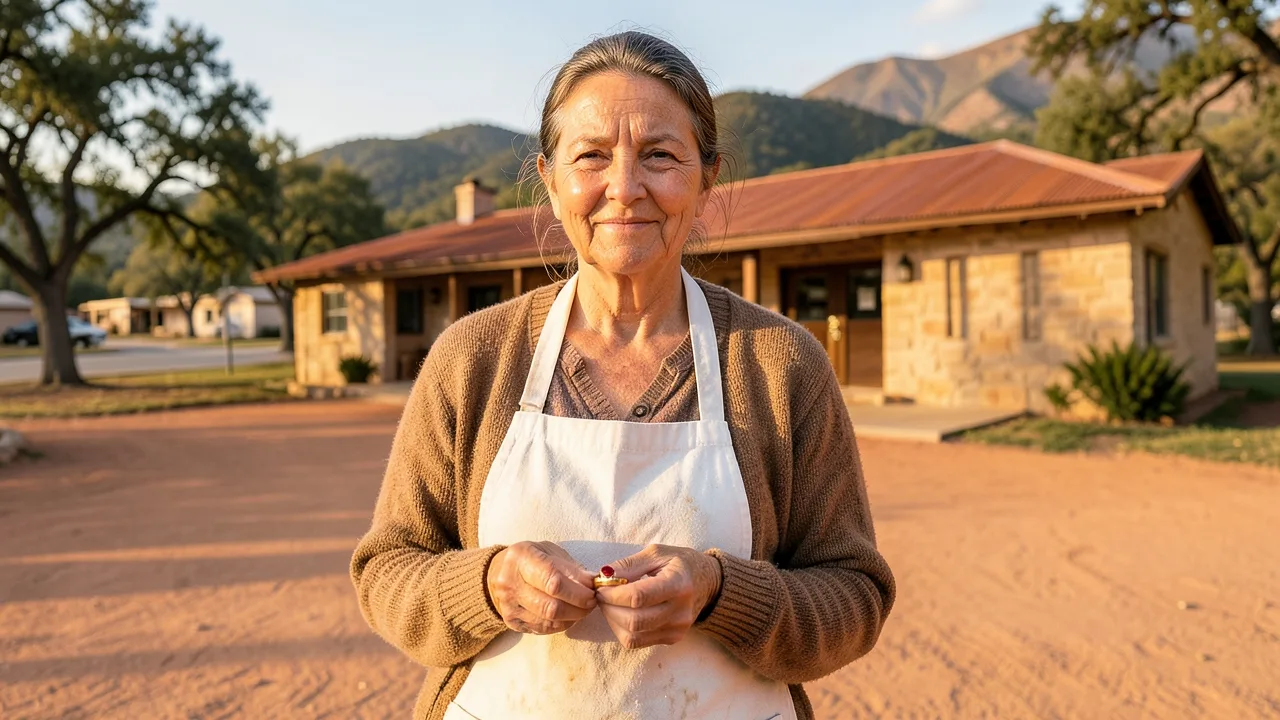
The new manager gave my Saturday clinic until October 17, which meant nineteen years of teaching Llano Springs kids to bowl for free had ten Saturdays left, and the ring in my apron pocket couldn't buy one more.
Nobody in town knew what that ring was. In April 1991, in Wichita, Kansas, I was Imogene Voight, thirty-one years old, and I won the Women's National Tenpin Championship. The league gave me a gold ring with a red stone, engraved AWTL 1991.
After that, everybody loved the champion. Sponsors called at suppertime. Strangers wanted my table at restaurants. My first husband married the title, and when my scores slid he left in 1998.
I came to Llano Springs in 2006 wanting to be liked once for myself, for my green chili and my patience with eight-year-olds. So the ring rode with my order pad and never on my hand. At six every morning I bowled alone on lane 16 before the center opened, and I still averaged a little over 200.
The Pro Night flyer had hung by the front desk since the end of July. *Beat Our House Pro. $10 a game. October 17.* Whoever beat Kent got lanes 15 and 16 free on Saturday mornings through May. I read it every day and I walked past it every day.
Kent told me about the clinic on a Saturday in August, standing behind lane 2 with his tablet against his chest and his weight back on his heels. Nine children were on the approach. Two parents sat on the bench with their coffee.
"Imogene, quick heads-up," he said. "No offense, but the Junior Strike Academy takes lanes one and two starting October 24. Forty-five a month, real curriculum. This clinic ends after the seventeenth."
"Ends," I said.
"Two lanes, two hours, zero revenue. I look at lane-hours all day." He smiled at the parents, not at me. "These kids need a real coach, not the grill lady."
Nobody said anything. Then a father on the bench shrugged and said, "Well, he did bowl in college."
Twenty years of burns on my forearms and I felt every one of them. One sentence would have ended it. I turned to the boy at the foul line instead.
"Slow feet, Tanner."
Tanner slowed his feet. Kenzie stood at lane 1 with her ball against her hip, watching me. I told her to check her approach and she did, without a word. When the grilled cheese came up at eleven, half the parents had somewhere to be.
Kenzie Albers came to my counter at noon on a Saturday in September, when she should have been on lane 1. She wore a teal shirt with *Junior Strike Academy* across the chest. The clinic had run that morning with fewer children than the week before, and I'd run it with a hole in the line where she stood.
"Hey, Miss Imogene." She slid onto a stool and picked at the napkin dispenser. "I'm not coming back to the clinic."
I wiped down the flat-top. "Your mother know?"
"She works nights. She said if it's half price, take it." Kenzie's ponytail swung through her ball cap. "Coach Kent offered it last Saturday. He says I've got clinic habits college coaches won't like. Like how I stand."
"How you stand is how I taught you to stand."
"I know." She looked at the napkins. "No offense, Miss Imogene, but you cook. He bowled for a college."
Nine years of Saturdays, and she had said it kindly. I could have told her whose game she was throwing. I had the sentence ready and I could feel the ring in my pocket against my hip.
"Want a grilled cheese?" I said instead.
"I already ate." She stood and tugged the teal shirt straight. "I'm sorry."
She went out through the lanes. I stood at the flat-top until the grease started to smoke, and then I scraped it clean.
The lights on lane 16 were the only ones lit in the building when Kent Sandlin walked in. It was a Saturday in late September, and my bag was already zipped.
He held a printout. "The after-hours log," he said. "Marva's been logging you for years. Six a.m., lane sixteen, every day."
"I don't use the machines. I clean up after."
"Kitchen staff don't bowl on company lanes off the clock. Insurance." He didn't say it unkindly, which made it worse. "Find a lane you pay for, like anybody. Marva, her key, please."
Marva had come in behind him with her cardigan on and her glasses on their beaded chain. She held out her hand to me. I took the key off my ring and set it in her palm, and she closed her fingers around it without looking up.
Kent went to his office. I picked up my bag and walked to the front desk, where Marva stood sorting league sheets with great attention.
"I can't lose this job, Cook," she said low. "Wayne's disability doesn't cover the house. If you've got something to say to him, say it."
"You think I haven't thought about it?"
"I think you think about it every morning." She slid a sheet into its folder. "And you walk past that flyer every morning."
Her old navy bowling bag sat by the desk, as it always did, the *WICHITA '91* patch faded on the side pocket. In 2007 I'd asked her about that patch, and she'd said she bought the bag at a garage sale in Brady. I looked at it a moment too long. Then I went to the kitchen and started the chili.
On the Friday night before Pro Night, I sat at my kitchen table on Pecan Street with the flyer in front of me, and I set the ring next to it. The red stone caught the light over the stove.
If I stayed quiet, the five children still coming would lose their Saturdays, and Kenzie would go on believing she'd been taught wrong. If I spoke, I'd be Imogene Voight again. The men at the counter would stop telling me jokes and start asking me questions. I'd lose the one thing I'd come to Llano Springs for.
I thought about Kenzie at my counter, saying *I'm sorry*, as if she were the one who owed it.
I counted out ten dollars from the coffee can by the toaster and put it in my pocket with the ring.
The last free clinic ran the next morning, five children on lanes 1 and 2. I made grilled cheese for all of them and let them stay until noon.
By eight that night, Bluebonnet Lanes was packed. Regulars filled the bar stools and Academy families in teal crowded the rail by the challenge table between lanes 7 and 8. Kent stood by the scorer's table with the event microphone. Marva sat behind the little cash box, taking tens.
I clocked out of the grill. I hung my red apron on its hook, took the ring from the pocket and kept it in my fist. Then I walked across the whole length of the center to the challenge table and laid a ten-dollar bill in front of Marva.
She looked at it. She took it without a word and wrote my name on the sheet.
I got my old ball from my locker. When I came back, I picked up the spare microphone, and Kent's mouth opened and shut.
"My name is Imogene Rennick," I said, and the room went quiet in a long ripple. "In 1991 I was Imogene Voight, and I won the Women's National Tenpin Championship in Wichita. I'm telling you first so nobody says I hustled the house."
I set the ring on the scorer's table. The red stone sat there under the lights. Kenzie stood at the front of the crowd in her teal shirt, and I didn't look at her yet.
"I'm bowling for the Saturday clinic," I said. "Under the flyer."
Kent stopped smiling. He took the microphone out of my hand, gently, the way you take scissors from a child.
"Folks, staff don't bowl customer promotions," he said. "But since Imogene wants it, we'll do it on my terms. If she loses, the clinic ends tonight and she's grill-only from here on. No lanes, no children, no lane sixteen. Ever."
Somebody in the back said "Whoa."
"Bowl first, Kent," I said.
He bowled. He was good, I'll give him that, and he knew his own oil down to the board. He left one corner pin in the third frame and made nothing else of it, and when the last ball dropped he had 211 on the screen and his chin up.
I opened with a spare. Then I stood at the top of my approach and let the strikes come, one after another through the middle of the game, the ball hooking the way it hadn't in front of anyone since Wichita. In the ninth I left a pin and picked it up. In the tenth I threw three more and walked back from the foul line with 226 above my head on the screen.
Nobody clapped for a second. Then somebody did, and a man at the bar whooped, and it was over.
Kenzie came up out of the crowd. Her face was red.
"You let me think you were just the cook," she said. "You let me quit you."
"I did," I said.
That was all either of us could manage. She stood there with her arms crossed over the teal shirt.
A man who'd had my Thursday chili plate for twenty years pushed a napkin and a pen at me. "Sign this, Champ?"
I signed it. My hand shook on the *V*.
Kent held the microphone out, and I took it from him. I didn't raise it.
"You drop your right shoulder on every left-side spare," I said quietly. "Somebody should have told you at West Plains. I'll tell you for nothing at six on lane 16, if Marva has a key."
Kent looked at the score screen for a long time. The Caprock badge on his shirt rose and fell.
"Fifteen and sixteen, Saturday mornings, till May," he said. "That's thirty-two Saturdays I explain to Dallas."
He took a marker to the event board and wrote it in his own square print. Nobody apologized. Marva put my ten dollars in the cash box and snapped the lid.
Kent unlocked lane 16 himself the next Saturday. He was already there at six, standing at lane 15 with his own ball and his wrist brace, when I came in.
"Left-side spares," he said. "Watch me."
I watched him throw four. The right shoulder dropped on every one.
"Hold your hand up at the top," I said. "Pretend you're carrying a tray."
He threw again, and the ball broke straight into the pocket. He nodded once at the pins.
"Caprock's calling it a promotional cost against my weekend numbers," he said, not looking at me. "I told them it's a community program. Academy stays on one and two. Your name's not on it."
"Good."
On the printed schedule at the front desk, in his square print, was a new line: *Bluebonnet Saturday Juniors, lanes 15 and 16, 9 to 11, free.*
Kenzie came in at nine in her teal shirt and hung back at the end of the approach, holding her ball. A stranger had asked me for a photograph at the grill that week, and I'd given it. The regulars asked me questions now and not many jokes.
"I hid it because I wanted to be liked for my chili," I told her. "Not for a ring. That's the whole reason, and it was a poor reason for what it cost you."
"Miss Imogene—"
"You're good because you worked every Saturday for nine years. Whose name was on your coach never bowled one frame for you."
She swallowed. "Coach Kent gave me half price. Now I'm the girl who walked out on him."
"I know."
She stood a minute more. Then she walked down to lane 16, set her feet, and threw.
I gave the clinic its two hours. When the last child left with a grilled cheese, I went up to the front desk. Marva was already there, with her cardigan on.
"Well, I bought my clinic back," I said. "With the one thing I came here to stop being."
"Did you now." Marva set her old navy bag on the desk and unzipped the side pocket under the faded patch. She took out a worn card in a plastic sleeve and laid it in front of me. *1991 AWTL Women's National. Entrant: Marva Hensch.*
I read it. I read it again.
"Round of thirty-two," she said. "I lost to a girl from Tulsa. I stayed and watched you win the final. When you came to the grill in 2006, I knew you by your bowling shoulder before you ever told me your name."
"You said you bought that bag in Brady."
"You looked at that patch like it might bite, Cook. So I let you have your garage sale." She tapped the card. "I took your ten dollars without a word because I finally could."
Twenty years of her teasing me over the chili, and she'd known the whole time. All of that had been for me, not for the ring.
She slid a brass key across the desk. I took it. Then I tucked the ring into my apron, down beside the key to lane 16.
Comments