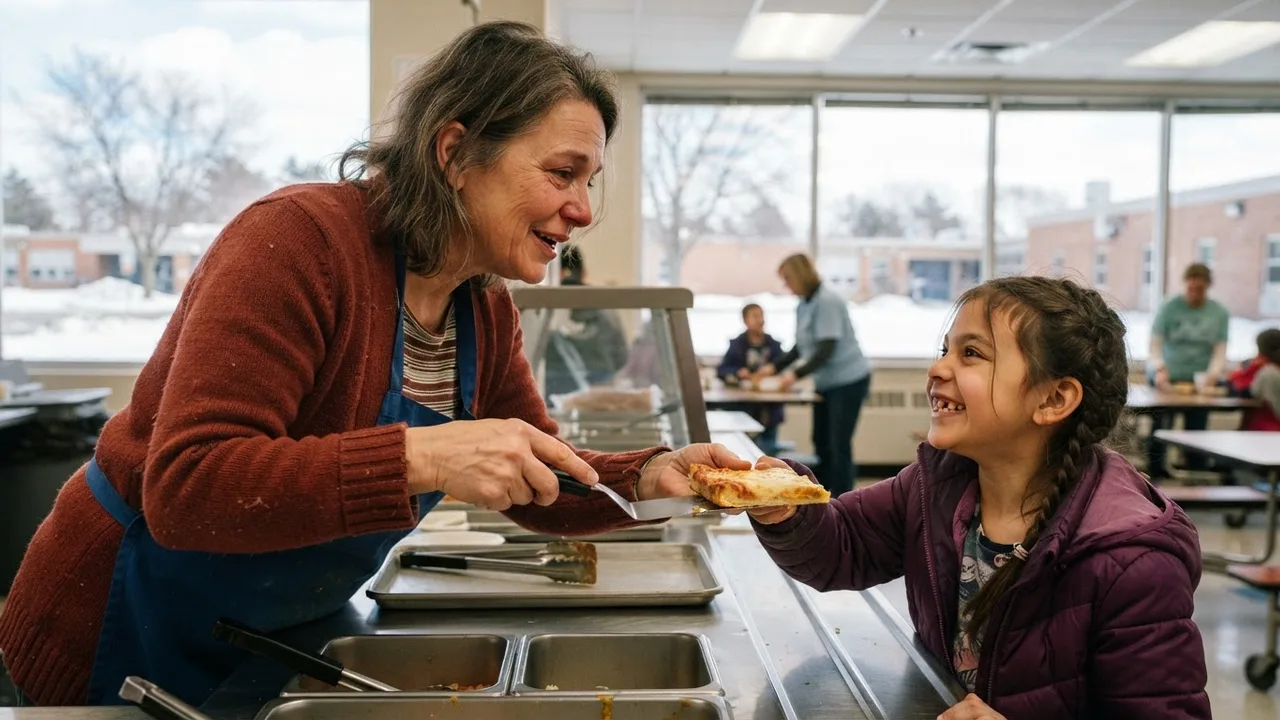
My granddaughter told me across the steam table that she was moving to Madison in June, and she said it the way you'd tell the lunch lady, because nobody had ever told her I was anything more.
"Daddy says there's a school there with a climbing wall," Ava said. She held her tray in both hands, purple puffer zipped to the chin, one braid riding higher than the other. "Can I have the corner piece?"
"Madison's a long way, kiddo."
"A hundred and thirty miles. Daddy looked it up."
I cut the corner out of the pan, the piece with the crisp edge on two sides, and slid it onto her tray. Fern was at the register with her pencil behind her ear. I counted the squares left in the pan out loud, because that's what I do when my hands need something, and Ava told the next kid in line about the climbing wall.
Eighteen months I had served that child lunch. I kept to the line her father drew, and the line was that Miss Rita was the nice lady with the corner pieces.
That Wednesday Fern came into the kitchen office holding the week's negative-balance list against her chest like a hymnal.
"Well, now," she said.
I put down my order sheet. "How bad?"
"Ava's at minus fifty-eight forty. The district letter goes home at minus fifty, and it's gone out already, or it goes today."
"Then Tyler can pay it."
"Tyler could fill out the free-lunch form." Fern studied the pencil in her hand. "It's one page, Rita."
"He'd sooner starve. He'd sooner see her starve, and he'd call it character."
Fern said nothing, which is how she says most things. I took the envelope out of my purse, the one marked BRAKES in my own handwriting with $340 inside from three months of Kwik Trip coffee I'd given up. I walked down the hall to the school office and counted out $150 on the counter, twice, the second time out loud. The secretary wrote me a receipt without looking up.
Back in the office I pushed the receipt down onto the old steel spike on my desk. I'd carried that spike out of the Riverside Diner the week it closed, and the last yellow ticket from Gus's pencil still sat at the bottom of the stack under all the lunch receipts. Looking at it I thought of the fall I spent my Saturdays teaching a waitress named Kay Bruzek the grill, after my own shift, for nothing, with a neighbor keeping my four-year-old for twenty dollars a day I didn't have. Kay's skinny girl sat at the counter in a stocking cap reading tickets off this very spike to her mother, and I called her Ticket. I couldn't have told you her real name for a hundred dollars.
I drove home that afternoon with the Buick grinding at every stop sign on Washington Street.
Tyler came to the back door the next Tuesday at a quarter past two. The alley behind him was grey slush, and out past the roofs the ice on Lake Michigan was breaking up in plates.
He wore the faded Carhartt and a knit cap pulled low, and his hands stayed in his pockets. In four years he hadn't said one word to me.
"The office told me you paid," he said.
"Hello to you too."
"Rita." He took an envelope out and held it toward me by one corner. "That's sixty. It's what I've got. I don't take your money, and you don't do it again."
I didn't take the envelope. "Did you fill out the free-lunch form?"
"The supper club closed the end of February. I've got a line job in Madison starting June 15. We leave June 13." He set the envelope on the flour bin by the door. "So it won't matter long."
"Tyler, wait—"
He was already walking, boots splashing through the slush, and he didn't look back. I stood in the doorway until the cold came through my cardigan. Then I put the envelope in my pocket, because leaving it on the flour bin would have been one more thing to explain to Fern.
That Sunday night I sat at my kitchen table and typed a post to the Two Rivers Neighbors group, under my own name, because I didn't know another way to say it: my son Tyler Janowiak was a good line cook looking for day-shift work so he could be home for his little girl, and anyone with an opening could ask for me at the Riverview kitchen.
Monday two staffing agencies messaged me, each one offering to place him for a cut of his first months' wages. I wrote back to neither.
On Wednesday, just after lunch service, a woman knocked at the back door in a long grey parka zipped to her chin. She wore a Brewers cap and kitchen clogs, and she looked at my kitchen the way a health inspector does, ceiling to drain.
"You're Rita Janowiak?" she said. "I saw the post. How old is he? Days or nights? Ever walked off a line? Can he keep six tickets straight?"
"Who's asking?"
"Does he show up? Never mind where I cook. Answer me that."
"He shows up. Where do you cook?"
"Doesn't matter yet." She had stopped listening to me. She was looking past me through the office door at my desk, and she took a step toward it. "Where'd you get that spike?"
"Riverside Diner. It closed in '08." I folded my arms. "What's the fee?"
"There isn't a fee."
"Everybody's got a fee."
She laughed once, short, and shook her head. "I'll be back," she said, and the door clanged behind her.
Fern had come up beside me with a dish towel. "A third one," I told her. "They smell trouble."
"Well, now," Fern said. "She didn't ask for a cut."
Friday afternoon my phone buzzed with a name I hadn't seen light up the screen in four years.
"Tyler?"
"A friend sent me a screenshot." He breathed in. "You put me on Facebook like a lost dog. Half of Two Rivers tagged me. People I cooked with. People from Ava's school."
"I only wanted—"
"I know what you wanted. I'm somebody's charity now." I heard a pot lid, a faucet. "From Monday Ava brings her lunch from home. She doesn't go through your line."
"Tyler. She likes the corner pieces."
"She'll live," he said, and hung up.
I didn't take the post down. Taking it down was one more announcement, and the comments were still stacking up under it, praying for you both, tagged you honey, my cousin knows a guy. On Monday a pink lunch bag with a unicorn on it went past my steam table to a seat by the window, and I counted trays out loud until Fern touched my elbow.
On Thursday, after service, with Fern gone home and the dish machine ticking as it cooled, someone knocked at the back door again. The woman stood there without the parka, a hospital ID on a lanyard at her chest and the same Brewers cap over her short dark hair.
"Again?" I said. "If it's the same offer, the answer's still no."
"Can I come in? I run food service at Lakeshore Memorial in Manitowoc." She came in and walked straight to my office, as if she'd been there before, and picked the spike up off my desk. "May I?"
"You may not, but go ahead."
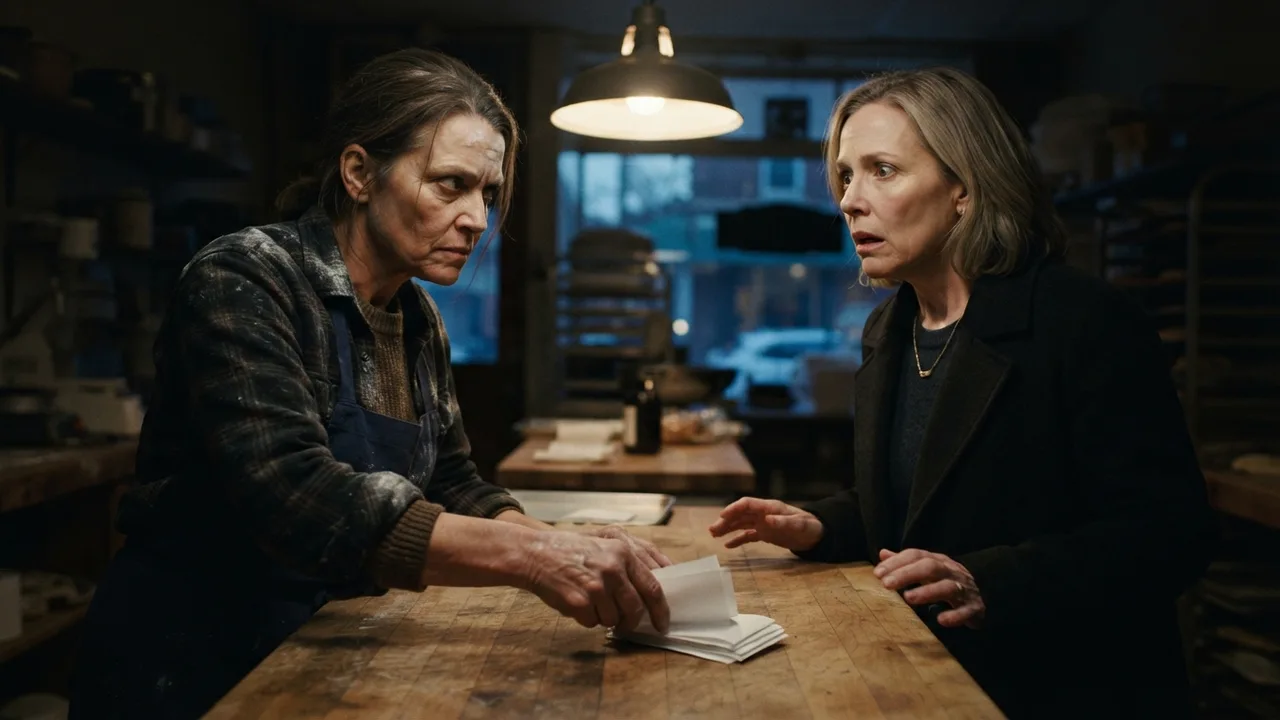
She worked the lunch receipts up off the point, one at a time, until she got to the bottom of the stack. She tilted the yellow ticket toward the light and moved her lips over each word, slowly, as if the pencil were still wet.
"Two over easy, hash, rye." She looked up. "You called me Ticket."
I stared at her. "Ticket was a skinny eleven-year-old in a stocking cap."
"I'm Holly. My mom is Kay Bruzek." The corner of her mouth moved. "She still says Rita Janowiak let her burn four dozen eggs."
And there it was, the whole counter at the Riverside, the cold coffee and the stool that spun, the girl's sneakers hooked on the rail while she read tickets out in a voice like a tiny auctioneer. "The fourth Saturday," I said. "She burned them on purpose, to see if I'd yell."
"I told her you didn't." Holly set the receipts back on the point in order, which a stranger wouldn't have bothered to do. "I read your post on the twenty-third. I've been in that group since high school. I called my mom that night and she told me the whole thing again, the way she's told it for twenty-four years."
"Why didn't you say so last week?"
"I had no job to give you. I wasn't going to hand you a story and nothing else." She sat on my desk edge. "My day cook gave notice Tuesday. The shift's eight to four-thirty, flat-top and line. I'll give Tyler a tryout. I hire on a word, Rita, the way Gus hired my mom on yours."
"No."
She waited.
"He won't take a thing that came through me," I said. "Not after that post. He's right not to. And I'm the last name he'd want behind him. He asked me once for my name on a paper, and I said no."
"Then don't get it for him." Holly took out a pen, wrote on the back of a district notice, and laid it on the desk. "Vouch for him. That's all you ever did for my mom. Thursday the ninth, three o'clock, after the trays go up. I won't call him myself."
She left the way she'd come in. I read the paper four times, and a fifth time standing with the dish machine ticking behind me.
The next morning I wrote Tyler a text and rewrote it until it said what it needed to. A kitchen manager at Lakeshore Memorial had seen the post and wanted to watch him cook at three o'clock on April 9. She'd asked for my word on him and I would give it there in person, and I owed him an explanation.
An hour went by. Then one word came back. *Fine.*
The Lakeshore Memorial kitchen was all steel and floor drains, and Tyler was already at the flat-top when I came in, hairnet over his knit cap, the scars on his forearms shining under the hood light. He didn't look at me. Holly sat on a stool by the pass with a clipboard.
He did eggs three ways, over easy, over hard and scrambled soft, in that order, flipping each with a thumb of butter and a twist of the wrist I'd taught him at six. Then the hash, crisped hard against the plate. Then the soft-diet plate: eggs, potatoes mashed fine, applesauce, nothing on it you'd need teeth for.
Holly tasted each one with a clean spoon and didn't say a word. When she finished she set the spoon down and turned to me.
"I don't hire off a plate. Is he good?"
"He's better than I ever was," I said.
Tyler's back stiffened at the flat-top.
"And I owe him why I never said so." I made myself keep my eyes on his shoulders. "In 2022 I filled out your landlord's guarantor application, Tyler. It came back declined. Your father left a card in both our names in 2011, nineteen thousand dollars of it, and I owe nine thousand two hundred still. I told you no because 'they won't have me' was worse to say than 'I won't.'"
He turned around slowly, the spatula hanging from his hand. "You filled out the form?"
"At my kitchen table. With the dishwasher running so I wouldn't hear myself."
He was quiet a long time. A compressor kicked on somewhere behind the walk-in.
"Four years," he said. "I've been mad at the wrong thing." He wiped his hands on the towel at his belt. "And four years I told Ava her grandmother didn't want us. Now I get to go home and tell a seven-year-old her dad had it wrong."
"Tyler—"
"I'm not done." He looked at Holly. "What's the shift?"
"Eight to four-thirty. Starts April 20."
"Weekends?"
"Off, unless you want the overtime."
"I'll call Madison tonight." He hung the towel on the hook. "I'll take this one."
Holly nodded and pulled her order sheets toward her. Nobody said thank you and nobody clapped. At the swing door Tyler stopped with one hand on the steel, his back to me.
"Ava's coming through your line tomorrow." He pushed the door. "What she gets told about Miss Rita is yours to say. I won't tell it for you."
The door swung shut behind him. I stood there with my hands in my cardigan pockets, and one of them found the sixty dollars in the envelope I'd carried every day since the flour bin.
Friday the pizza came out of the oven at eleven-forty, and Fern took her stool at the register with her pencil behind her ear. At twelve-ten a purple puffer coat came around the end of the line, one braid higher than the other, her hand already out for a tray.
Ava slid the tray along the steam table and looked up at me through the gap where her tooth had been.
"Can I have the corner piece, Miss Rita?"
I cut it out of the pan, the crisp one, and held it out across the steam with my mouth already open to say something more than the lunch lady would.
Comments