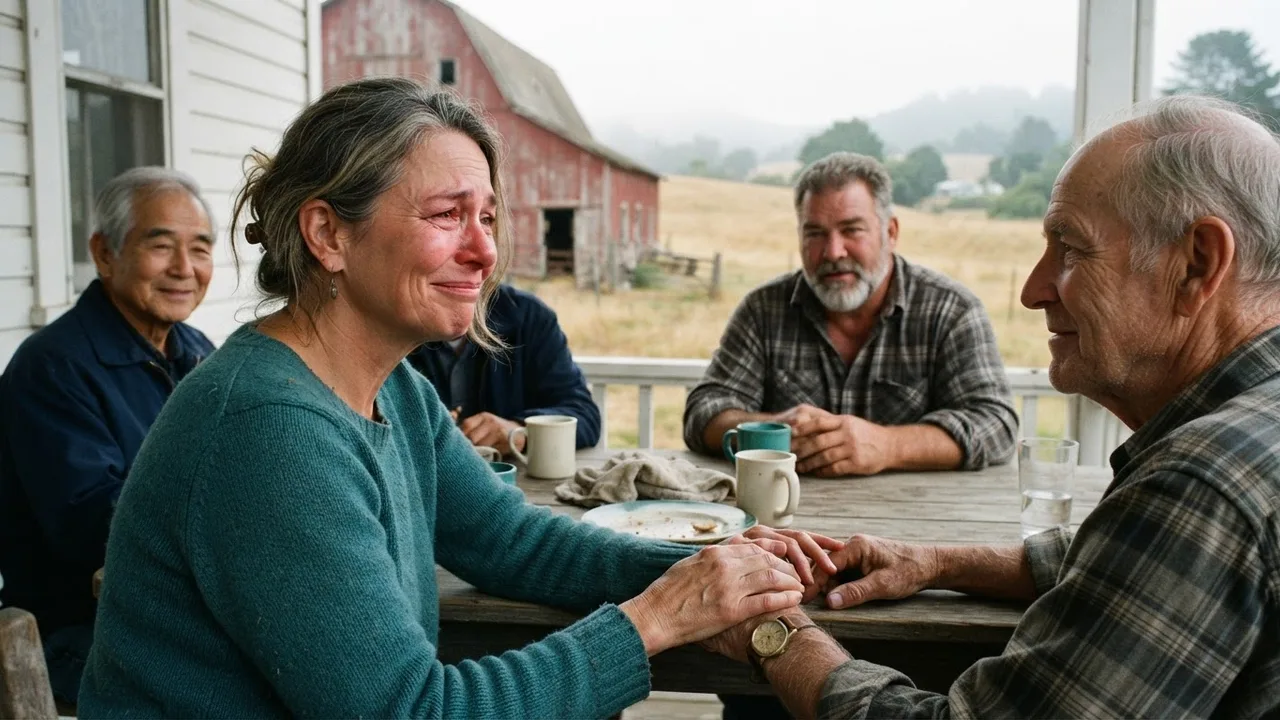
Dad's house on Ocean Avenue had twenty days left before it closed for $412,000, every dollar already promised to his room in Fortuna, when a stranger mailed him a gold watch he swore he'd never owned.
I was in his kitchen that Saturday, wrapping Mom's blue-rimmed dishes in newspaper, when the carrier pushed a padded mailer through the slot. Dad's hands shook too hard for tape, so I slit it with a butter knife.
The return label said *A. Okada, San Jose.* Inside was a man's wristwatch on a worn brown leather strap, and a typed card.
*My mother, Wilma Okada, died August 14. She asked that this be returned to Manuel Furtado.* Under it, a phone number.
I write jewelry riders for half the valley. I know what fourteen karat feels like in the palm, and this was no drugstore gift. Somebody had spent real money on it, and somebody had worn it enough to soften the strap.
I turned it over. The back was engraved: *M.F. from W. 6-17-61.*
My parents married in 1966. My mother's name was Fernanda, and nobody in my family had ever said the name Wilma in my hearing.
Dad came in from the barn with his flannel buttoned to the collar. He saw the watch in my hand and went the color of the newspaper.
"Dad, who's Wilma Okada?"
"That's not mine."
"It says M.F. Manuel Furtado is you."
"I said it's not mine." He took it from me, his knuckles white around it, and shut it in the drawer by the stove. Then he switched off the radio on the windowsill. "That's done."
He went back out to the barn, which has been empty since the herd was sold in 2004. He still walks out there every morning to look at nothing.
I stood in the hall afterward, looking at the wedding portrait. My parents on the courthouse steps in Eureka, two people and no one else. Mom used to say, wiping down this very counter, "We don't keep things in this house."
I went back to my dishes. I wrapped four more plates before I noticed I'd been using the sports page.
---
Dad called Rudy on Monday and told him he might not sign. I learned that on Thursday, because that Thursday morning I took the watch out of the drawer while Dad was in the barn and drove it ten miles to Fortuna.
Rudy runs the feed store in a polo with his name stitched on it. He was ringing up a bag of layer pellets when I laid the watch on the counter between the scratch tickets and the key rack.
"Ro. What's this?"
"Read the back."
He read it. His jaw worked. "So?"
"So Dad's initials, a W, and a date five years before he married Mom. It came Saturday from a woman's son in San Jose. She died last month."
"Okay."
Rudy squared a stack of seed catalogs against the edge of the counter. He didn't look at the watch.
"Okay? Rudy, he said it wasn't his. He went gray."
"Dad called me Monday." Rudy pushed his cap back. "Said he might not sign on the ninth. I figured he was tired. Now I get it. You went poking at this and spooked him."
The compressor on the cooler kicked on behind us, loud in the quiet.
"I opened a package."
"And then you carried it out of his drawer." He picked up the watch, put it down. "Put it back, Ro. Drop it. I paid six thousand five hundred dollars on the second of this month to hold that room, and if he doesn't sign you cost him every cent of it."
"Aren't you going to ask who W. is?"
"No."
Cody, the stock boy, was stacking salt blocks six feet away and not stacking them. Rudy raised his voice for his benefit.
"You're the one who can't leave a thing alone. You never could." He wiped his hands on his jeans. "And Sunday supper's off. I'm not sitting through you looking at me like that."
"Okay," I said, which in my mouth means the opposite.
I drove home with the watch in my cardigan pocket and my brother's voice still in the car.
---
The following Monday I called the number from my desk after hours. The agency was dark except for my lamp and a yellow legal pad with nothing on it.
A man answered. "This is Alan." He sounded like someone reading to a room.
"My name is Rosemary Furtado. Manuel Furtado is my father. I'm sorry, I know this is out of nowhere, I'm sorry about your mother."
"No, I'm sorry. I should have written more than a card. I wasn't sure who'd open it." He breathed. "Mom was married to Manuel Furtado from 1961 to 1963. She left Ferndale for a nursing program in San Jose. She never talked about it much."
I wrote *1961–1963* on the pad and underlined it twice.
"She asked for two things," Alan said. "The watch back to him, and her ashes in the sea at Centerville Beach. She grew up near there. I'll be in Ferndale October sixth through the eighth." He stopped, then went on carefully. "Would Mr. Furtado see me? I'd understand if not."
"I don't know," I said. "I honestly don't."
"Of course. Thank you for calling. Please tell him I'm sorry to trouble him."
After he hung up I sat with the pad. Then I drove to Ocean Avenue and parked at the curb across from my father's house.
The porch light was on, the way Mom always left it. Dad's bedroom window was dark. I sat there with my hands on the wheel, unable to go in and unable to go home, until the fog came up off the pastures and the clock on the dash said past one.
---
Alan Okada came to my office on Main Street the Tuesday after next, October sixth. He was slight, with a neat white beard and a windbreaker over a sweater vest, and he held his hands folded in front of him as if waiting for a class to settle.
I poured him coffee. He thanked me twice.
"I should tell you something I only half understood until I called you," he said. "Mom once told me her first year of nursing school cost eighteen hundred dollars. Paid in cash. 'From someone up north.' She never said who."
I set down the pot.
"Eighteen hundred," I repeated.
"In cash. Yes."
The door opened. Rudy came in with an envelope of renewal papers for his store policy, and he stopped when he saw a stranger at my coffee maker.
Alan turned to him with his hand out. "I'm sorry to intrude. I'm Alan Okada. Your father and my mother were married."
Rudy didn't shake. The envelope bent in his fist.
"Whatever Dad did before our mother stays his business," he said. Then, to me: "I'm taking over the closing. Give me his folder."
"Rudy, wait."
He reached past me to the file drawer, found the folder marked *Furtado, M. — Sale*, and walked out with it under his arm.
I called him that night and the next morning. Both calls went to the same recording of his voice telling me to leave a message.
---
I went to Dad's early the next evening, the half-packed kitchen smelling of newsprint and cold coffee. He sat at the table with the oilcloth between his hands. I took the watch from my pocket and set it down in front of him.
"I talked to Wilma's son. Twice. He's in town. He wants to scatter her ashes at Centerville Beach."
Dad looked at the watch and didn't touch it.
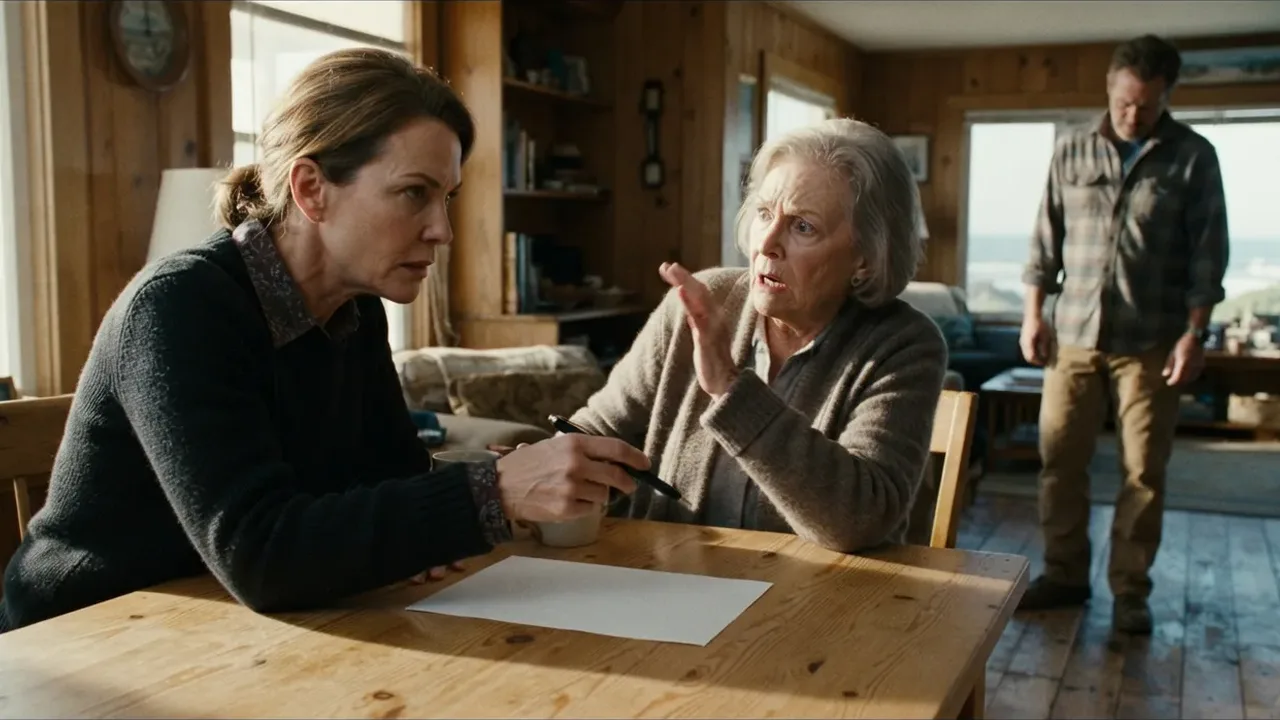
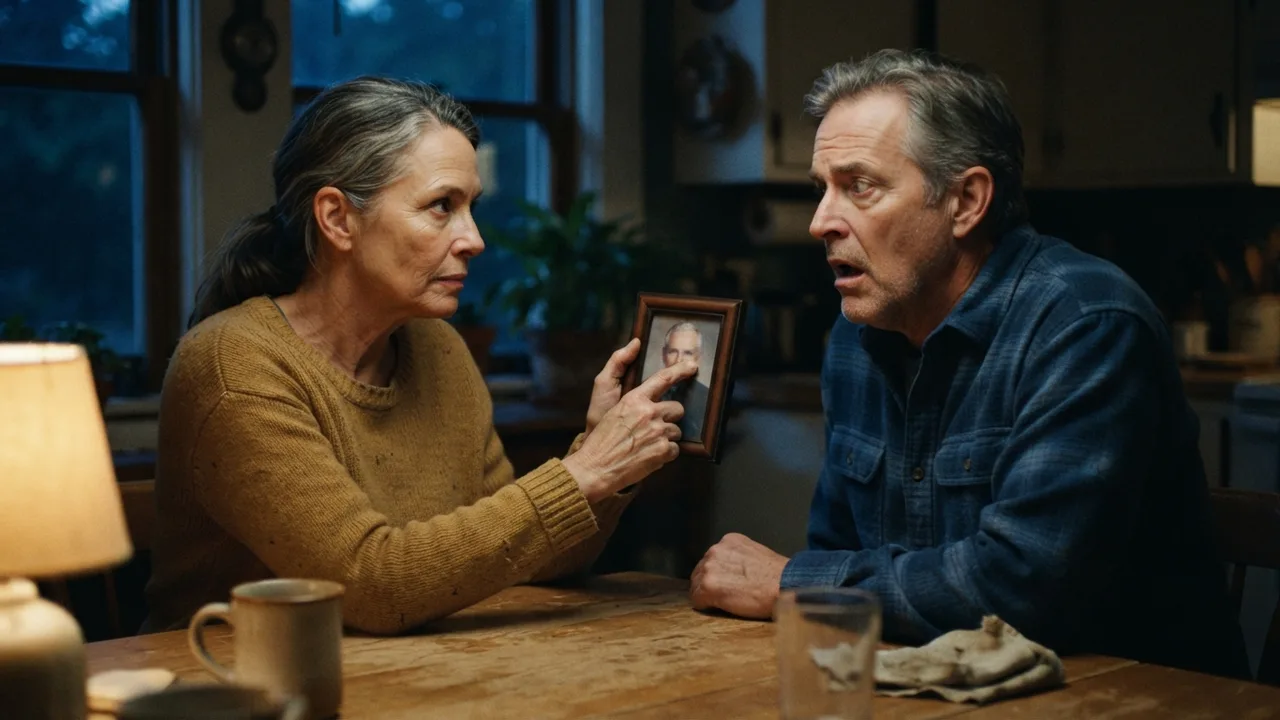
"I've spent fifty-eight years thinking I knew the shape of this family," I said. "Now Rudy won't speak to me, you won't sign, and I don't know what I'm fighting about. Dad, who was she?"
He was quiet so long the refrigerator cycled on.
"I was married," he said. "Two years. She went south. It was over long before your mother."
"Why did she leave?"
"That's old." His thumb moved along the oilcloth's frayed edge. "Your mother asked me never, Rosie. I gave her my word in that bed down the hall."
"She's gone, Dad."
Out the window the barn door stood open on its rail, the way he'd left it that morning.
"My word isn't." He looked up, and his eyes were wet. "Let the boy go home. I won't see him. Put the watch away."
I turned the watch face-down so he wouldn't have to look at it, and I didn't put it away.
"He's driven five and a half hours to put his mother in the ocean."
"I know what it is." He got up, slow, one hand on the chair back. "I held a heifer once through a whole night so she wouldn't lie down in the frost. You do what you promised."
That was all of it. He said nothing about why she left, or why Mom and he had stood alone in Eureka. He went to the barn, and the screen door clapped behind him.
---
That night at my own kitchen table on Berding Street I did what I always do when a number won't sit still. I took out the legal pad.
First, the truck. Every time I wrote Dad an auto policy he told me the same story, word for word. He sold his '58 Ford pickup in the fall of 1963 for $1,800 and called it the worst year of his life. I'd always filed it under *dairy was lean.*
I wrote *$1,800, fall '63*. Underneath it I wrote Alan's words: *eighteen hundred, cash, from someone up north.*
There was no one up north but Dad. He had paid for Wilma to leave him.
Second, the portrait in the hall. Courthouse steps, a woman who went to the 7 a.m. Mass at Assumption every morning of her life, married by a clerk. I put that beside *I was married* and *over long before your mother.* A church that wouldn't marry a divorced man. Mom had walked out of it to marry him anyway, and then she'd asked him to bury the reason.
It went through me and out the other side. The mother who said *We don't keep things in this house* was gone for me, and my parents had not been each other's first.
Then I saw the choices on the pad. I could hand the watch to Alan, tell Rudy it was nothing, and drive Dad to Redwood Manor carrying it myself, the way Mom had carried it. Or I could say it out loud in the kitchen, in front of Dad, and break a promise he'd made to her, because he couldn't.
I wrote down what each one cost. The second column was longer, and I chose it.
I called Alan at his room and asked him to come at nine. Then I sent Rudy one text: *Dad's kitchen, 9 tomorrow. Please come. It's about Dad.*
His answer came after midnight. *I'll be there.*
---
Alan was on the porch before I'd unlocked the door, tote bag on his shoulder, hands folded. Rudy's truck pulled in behind my car. He stayed at the wheel a long time before he got out.
The kitchen was a field of boxes. Dad sat by the stove in his good flannel. When he saw Alan he got to his feet.
"Rosie," he said. "I asked you."
"I know you did."
I set the watch on the oilcloth.
"Dad was married before Mom. Her name was Wilma. This is her son. Dad sold his truck in '63 so she could go to nursing school, and Mom married him on the courthouse steps because Assumption wouldn't."
Nobody moved. Rudy's face was dark red under his cap.
"Mom's not here to say her side," he said.
"She said her side every morning for fifty-three years," I answered. "She chose him with nobody else on those steps. I'm not going to make her keep this for him now."
Rudy sat down hard on a box of Mom's dishes, and something inside clinked.
Dad looked at Alan for a long time. Then he reached out and picked up the watch. His fingers shook against the gold.
"Your mother wanted to be a nurse more than she ever wanted cows," he said. "I put this in her suitcase the night she left. Figured she could sell it if the money ran out."
"She never sold it," Alan said quietly.
"No."
Dad closed his hand. When he spoke again, it was to Rudy and me.
"Your grandmother Bettencourt wouldn't come to Eureka. Stayed home. Your mother stood on those steps with nobody but me." He cleared his throat. "I gave your mother my word, Rosie, and I'm breaking it in her kitchen."
Rudy took off his cap and turned it in his hands.
"I stood up at Assumption," he said, "and told that whole church they were each other's first and only. I've told my girls the same story since they could sit up."
He got to his feet. He took Dad's good coat off the hook by the door, held it open, and spoke to Alan without quite looking at him.
"What time do we need to be at the beach?"
---
That afternoon the four of us rode the five miles to Centerville Beach in Rudy's truck, Dad in the middle, Alan against the window with a cardboard box on his knees.
The fog had burned back to a white seam along the water. The pastures behind us had gone gold. Alan took off his shoes, rolled his trousers, and waded out to his knees with the box.
Dad stood at the tide line with Rudy holding his arm. Somewhere on the drive he had buckled the watch onto his left wrist, and he didn't look at it once.
When Alan came back with the empty box, he and Dad shook hands. Neither of them said anything. Then Dad turned to me.
"I can sign in the morning, Rosie."
Rudy walked him up the sand to the truck. He came back for the keys he'd dropped and stopped beside me.
"I'll need a while, Ro," he said. It wasn't unkind.
"Okay."
He nodded and went. Alan told me he'd drive home to San Jose in the morning, and then he went, too.
Dad signed the next day in Fortuna with a pen Rudy handed him, and he slept that night in his room at Redwood Manor. The closing went through. The $6,500 stayed spent where it belonged.
Rudy still hasn't asked me to supper. I have a mother now who kept something hidden and a father who kept it for her, and I'm still learning to hold both.
What I keep, though, is the tide line, and my father's left wrist, pale for sixty years, carrying the gold watch he swore he'd never owned and ticking above the surf.
Comments