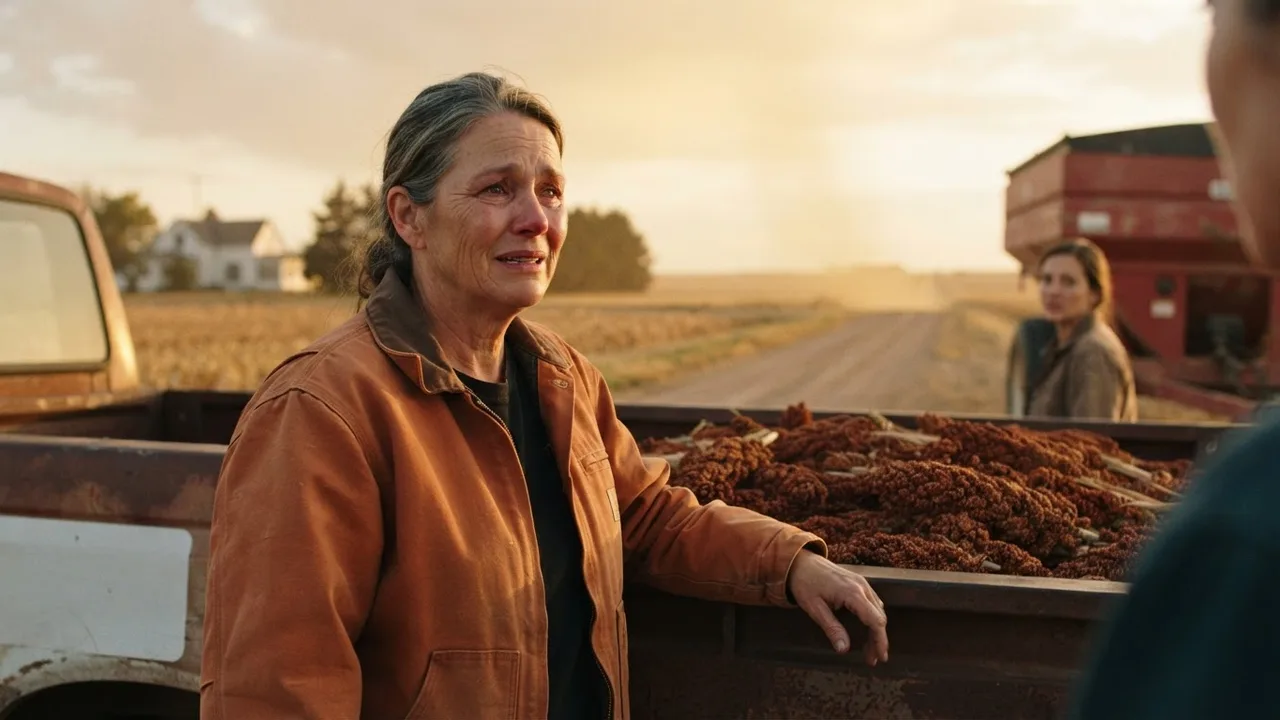
My sister Patrice had not spoken to me in seven years, and I heard from the co-op scale house that her husband had broken his leg with two hundred eighty acres of milo still standing.
Norris told me from the side of the elevator. He was thirty feet up the caged ladder with a new bulb for the red beacon in his bib pocket, and I stood at the bottom with my Casey's coffee while the news came down to me the way grain dust does, on everybody.
"Arlo Hulsey went off his bin ladder yesterday," he called. "Left leg. Fella who just weighed in says it's broken clean."
I said nothing. A truck idled on the scale with its bed full of milo, and I looked at that instead of at him. I have kept payroll upstairs since 1998, and I had learned to take bad news the way I take a time card, look it over and put it where it goes.
Then, because Norris was waiting and I had to say something, I told him a dark elevator is only a lighthouse with the keeper asleep.
"Where'd you get that one?"
"Told it to a harvest kid I drove to Amarillo one night in June of 2003. He counted forty-one lighthouses before Texas."
"That's the time Clifford Maas docked you two days."
Norris grinned down at me through the cage.
"And I'd put eighty dollars of that gas by for rent." I shaded my eyes against the sun. "How bad is the leg, Norris?"
"Bad enough." He came down a rung. "Nobody's going to say a word to you about it. Least of all me."
I went upstairs and ran the payroll anyway.
The casserole went into my mother's Pyrex dish, the one with the chip in the handle. Chicken and rice, the kind you carry to a house where somebody's hurt, and on Sunday I carried it twelve miles south on the gravel with the dish riding on a folded towel on the passenger seat.
Some Sundays I drive that road and don't turn in. That Sunday I turned in.
The milo stood north of the house along the field road, heavy-headed and going dull, and nobody had touched it. Patrice came to the doorway before I had both feet on the porch. She is taller than I am and rawboned, with a long gray braid, and she stood with her arms folded and held herself as straight as a fence post.
"Patrice," I said. "I brought supper."
She said nothing at all. From inside, Arlo's voice came through the screen, slow and mild.
"We're managing, Teresa. My cousin's helping some." A pause, and the creak of a chair. "Patty, let her in."
Patrice looked at the casserole. She did not look at me. She stepped back, shut the door, and I stood there hearing Arlo hear it too.
I set the dish on the porch rail and drove home with my face hot, past the place on the county road where the gravel turns to blacktop.
Two weeks went by, and the milo stood.
On that Monday Norris came up to my office with his pencil behind his ear and stood in the door, which he never did. "I've called every custom operator I know. Nobody can come before November. Arlo's cousin has his own crop down."
"They'll lose it to the rain."
"Rain's in the forecast most any week from here." He looked at my window, where the trucks lined up to the scale. "I'm not telling you anything."
"You're telling me plenty."
I wrote it on the back of a payroll form first, then typed it. My sister Patrice and Arlo Hulsey had two hundred eighty acres of milo south of Oberlin, Arlo was laid up, and any crew that could spare a combine should call Teresa Kubik at the co-op. I would cover the fuel. I signed my own name to it.
"Put it on the co-op page," I said.
"What's the fuel worth to you?"
"Twenty-four hundred dollars. It's what I have put by for winter propane and the car."
Norris took the paper and did not argue. "That's your winter."
"Then I'll wear a coat."
He went downstairs with my sister's business in his hand, and by suppertime the whole county could read it under my name.
The man came up the stairs on a Wednesday, a little after the noon trucks cleared. He had a dusty ball cap and sunglasses pushed up on it, and he stood in my doorway with his hands in his back pockets like a man who had been taught not to touch what wasn't his.
"Ma'am, how many acres do the Hulseys have?"
I looked up over my glasses. Two men had already called that fall asking which families might sell, and I knew the sound of it. "Who's asking?"
"Do they own it or rent?"
My pencil stopped on the time card. "Neither is your business."
"What did the milo make last year, ma'am?" He said it politely. "And are you Teresa Kubik?"
"The ground is not for sale," I said. "The door is behind you."
"Yes, ma'am. Thank you for your time."
He went down the stairs without hurrying. From the window I watched a white pickup with Texas plates pull out past the scale house, and I decided that was one more man who thought a hurt farmer was a sale.
I told Norris about it at the window downstairs. He only said, "Did he give a name?" and I said no.
The phone rang on my desk the next Monday, and before she said anything I knew.
"Teresa."
Nobody else says it like that, all of it, no shortening, the way our mother said it when I had broken something. "Patrice."
"Arlo's cousin showed me what you put on the Internet." Her words came fast, the way they always had. "I will not have this county reading my sister beg for me."
"I wasn't begging. I was—"
"—meddling. You had your chance to help us in 2019, Teresa. Take it down."
The line clicked. I sat holding the receiver, and what I thought was that she had finally spoken to me and I would have given a good deal for any other first words.
I walked downstairs to the scale house. Norris sat at the window with a ticket book and the radio low.
"Take the post down," I said.
He didn't ask why. He took out his phone and did it with his thumb while I watched, and turned the screen toward me when it was done. "Gone."
"Thank you."
"Teresa." He tapped his pencil once. "You can still call her back."
"She hung up on me, Norris. That's her whole answer." I went back up my stairs, and I had no crew and no post, and the order to stay out sat on my desk like a bill.
The knock came on Wednesday after dark. I had a plate of eggs on the table and my reading glasses on their cord, and I opened the door with the porch light on.
It was the man from my office. He held his cap in both hands now. "The man at the scale house gave me your address."
"Ma'am, my name is Tomás Ybarra. I'm sorry about the other day. Did you drive a boy named Abel to Amarillo in June of 2003?"
I stood very still. "I did. He was a hired kid on a Texas crew. What's it to you?"
"Abel's my cousin." He turned the cap once. "I was the other one. I was twelve. I rode in your front seat."
"There was no other one," I said. "I remember Abel counting."
"Abel slept from Oakley to the Texas line, ma'am. I was the one with my face against the window." His voice went plain. "You told me every grain elevator lit up out there was a lighthouse. It means somebody's home. We counted forty-one before Amarillo, and at the last one you said, 'See? Somebody was up the whole way.'"
I stepped back into the kitchen and sat down on the nearest chair.
I could not have told you then what I felt. I could have told you the color of that boy's jacket, if I'd had one to remember, and I didn't, only a smallness in the dark of my own car and a hand on the dash.
"Come in," I said. "Sit."
He sat. He did not take his jacket off. "My father made it the crew's rule after that night. If you can drive somebody, you drive them. I've kept it. Abel saw your post and texted it to me while we were cutting beans near McCook. I came to the co-op to see if it was really you, and to look at the ground before I promised my men anything."
"And I ran you off."
"You did it well." Something moved in his face and was gone. "We finish tomorrow. I'll bring the combine down on its trailer to the co-op lot. From the fifteenth until I leave on the twentieth it's free. I can cut your sister's milo in two days. I'll take nothing but fuel, and my crew runs close to the bone for that. I've got a daughter in Hereford I see too little, and I have to be home to her before November."
The refrigerator shuddered on and hummed. I looked at the eggs.
"No."
"Ma'am—"
He leaned forward, and I held up my hand.
"Teresa. And no." I pushed the plate away. "My sister told me to stay out. That's thousands of dollars of work, and I can't repay it, and I won't carry charity to a gate where I'm not wanted."
"It isn't charity. It's my father's rule." He stood and set his cap back on. "You only have to tell me where the gate is."
"Give me a day."
He took a pen from his jacket and wrote a number on the back of my electric bill envelope. At the door he said, "Somebody was up the whole way, Teresa," and went out to his truck.
I sat at that table until the eggs were cold. I thought about my sister's voice saying I'd had my chance, and I thought of the porch rail, and a shut door.
Then I thought of my mother in the care home, her hand on mine over the checkbook, saying *Promise me, Teresa. Not a word to Patrice.*
She would never take his help from me unless she knew why I'd said no in 2019. And there was no way to hand it to her without opening my mouth and breaking the one thing my mother ever asked me to keep.
I turned off the porch light at midnight, and by then I had decided. Friday I called the number.
"Bring it to the north edge of the Hulsey milo in the morning," I told him. "It's twelve miles south, gravel. You'll see the house."
"Yes, ma'am."
"Teresa."
"Teresa," he said.
The wind came from the south that Saturday, warm for October, and the milo hissed along the field road. Tomás had the combine chained on its trailer behind his pickup, and I stood beside it with my hands in my vest pockets, waiting.
The house sat in plain sight of that road. A combine on a trailer is not a thing you miss.
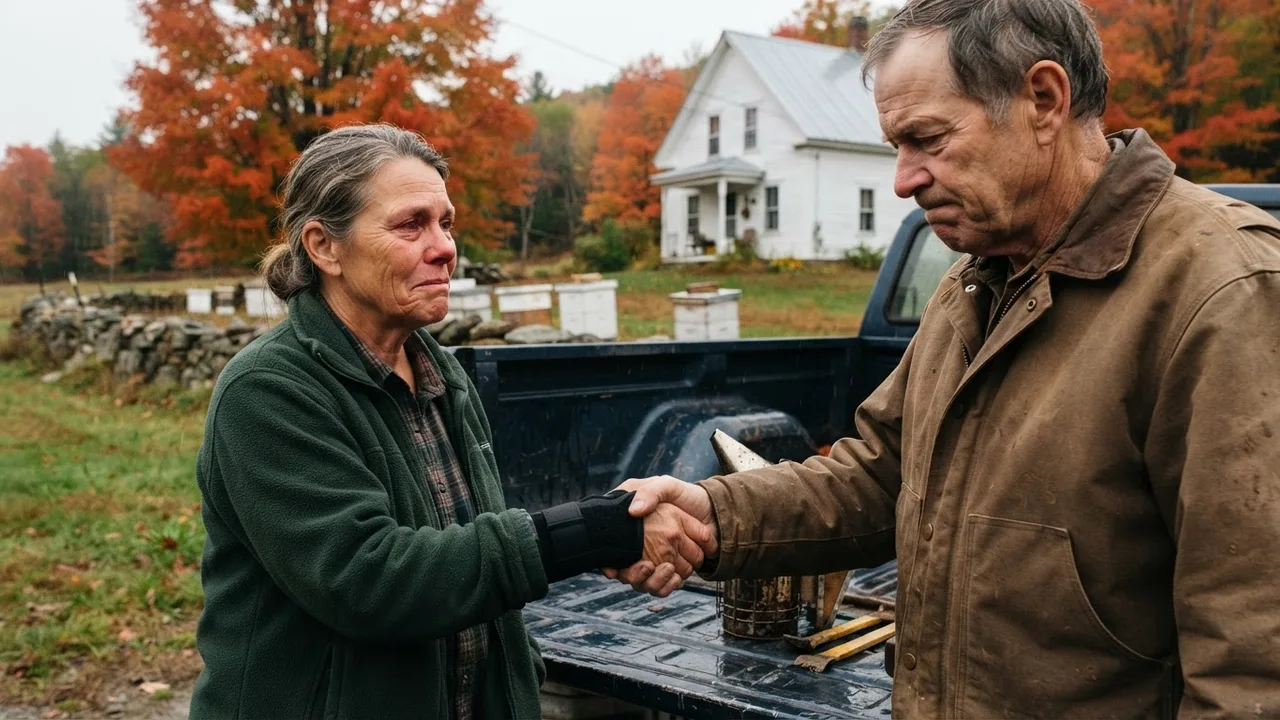
The farm pickup came down the ruts and stopped short of us. Arlo sat on the passenger side with his cast propped on the dash. Patrice got out. She did not come close.
"I told you to stay out."
"I will," I said. "After I say one thing."
"You've had seven years to—"
"Patrice. Let me say it." My hands had begun to shake, and I held on to the vest. "The thirty thousand Mom gave you and Arlo in 2016 got counted as a gift when she went into the care home. Medicaid set a penalty. Five months where nobody would pay her bill."
"What are you—"
"I paid it. Thirty-one thousand dollars. Everything I had." I made myself look at her. "Mom made me swear you'd never know. She didn't want you thinking your gift had cost her own care. So in 2019 there was nothing left to sign against, and I couldn't tell you why without breaking my word."
The wind went through the milo. Patrice stood with her braid blowing across her shoulder.
"You're telling me she knew."
"Every month. She signed what I put in front of her."
From the cab, Arlo said, "Patty." She didn't turn. "Let the man unload."
She looked at me then, at the quilted vest and the glasses on their cord and, I think, at all the small things I had stopped buying. Then she walked to the edge of her milo and stood with her back to us.
"For seven years," she said, "I told my two girls their aunt wouldn't spare us a dime. Tonight I have to call them both and say I was wrong. I don't know how I'll say it."
I had no answer for that, so I gave none.
She turned. "What do you want for it?" she asked Tomás.
"Fuel, ma'am."
"I'll pay the fuel."
"It's mine," I said. "I pledged it in front of the whole county."
"You took it down."
"It stayed up long enough."
Patrice's mouth moved, not quite a smile. "Then you drive the truck."
The old Ford grain truck our father taught me to drive in sat at the end of the field road with its door hanging open. I climbed up into it, and the seat still sat too far back. Nobody thanked anybody. Tomás unchained the combine, and the first header went down into the milo.
The cutting took two days, and the diesel for it came to about $2,100 of my $2,400. On the first of them, at dusk, the grain cart was still running and the dust stood gold over the field. Patrice drove that cart like she had done it for forty harvests, and the combine's lights came on, one hard white eye moving down the rows.
She walked over while I stood at the truck with the tailgate shut.
"When it's in, come eat with us." She looked at the truck, not at me. "Arlo can't carve."
I opened my mouth, and I did not answer. She nodded as though that was an answer too, and went back to her cart.
The twelve miles north went by with the windows down and the load shifting behind me. I came into Oberlin by the tracks, and the elevator stood against the last light with its beacon dark.
The truck rolled onto the scale. Norris leaned at his window with the pencil in his hand and wrote the name on the ticket. *Hulsey.* Above me, the red light he had put a new bulb in came on, blinking slow against the dusk.
I counted it. One.
Comments