My mother's homeplace on Sugar Run Road was under contract for $214,000, and I was the agent who had sworn to the buyers that every room, attic included, would be empty in forty days.
That money was Mama's room at Laurel Ridge in Asheville. My word was the only thing I had to sell in Ivy Fork, where I was the one real-estate agent and had been for twenty-two years.
"Lord, Joetta, I'm fifty-five and my knees don't do ladders," Twyla called up from the foot of the attic stairs. "Throw down what you can and I'll tape it."
"Then tape fast," I called back. "This place has more boxes than the Food Lion."
It was a Sunday, and Twyla had given up her afternoon again. She was Aunt Fern's only girl, silver bob, reading glasses on a beaded chain, a canvas tote of tape and markers on her arm. I had sold her house on Laurel Street myself and she still brought me pound cake for it.
The attic ran steep under the eaves, hot as a skillet, smelling of cedar and mouse. I was dragging a Christmas box out of the low corner when my glove pushed a board and it gave.
Behind it, wedged between two rafters, sat a bundle in red flannel. I knew the shirt. It was Granddaddy Cagle's.
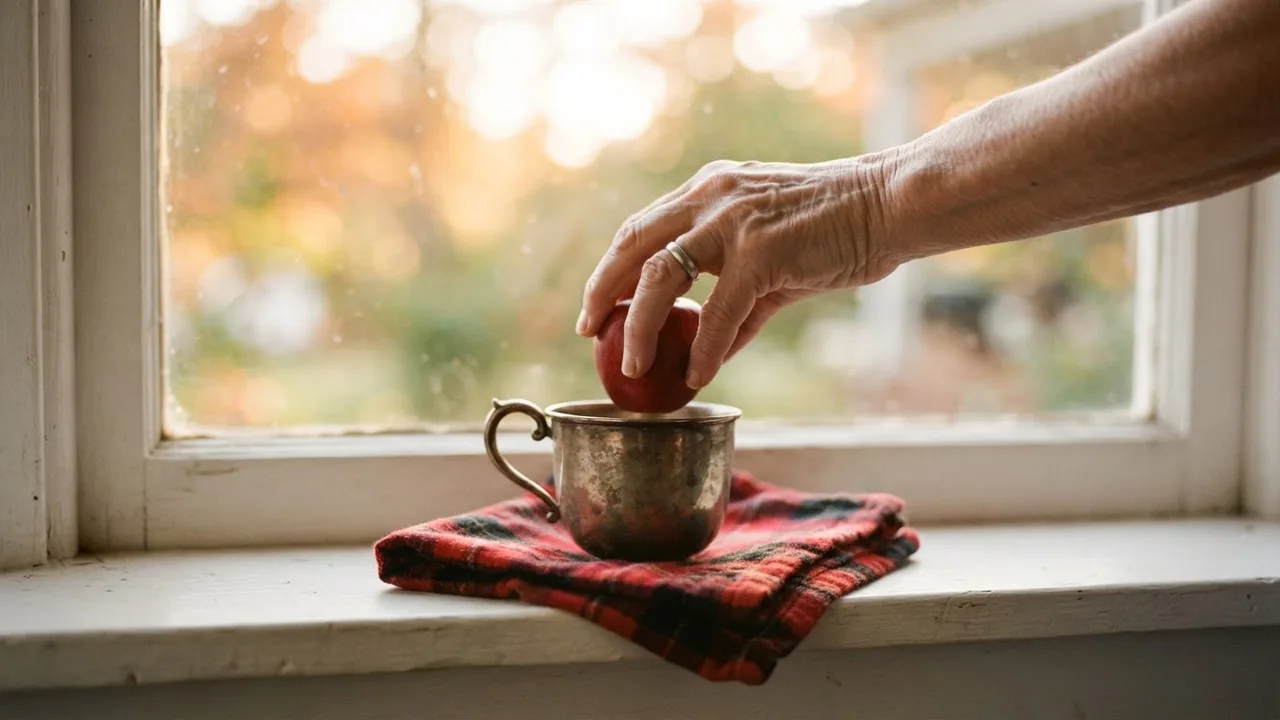
Inside was a baby cup, small enough to close my hand around, black with tarnish, one curled handle. Cut into the side were the letters *R.A. 1971.*
Nobody in my family had those initials. I was born in 1974, Mama's first child. Everyone had always said so.
"Find anything?" Twyla called.
"Mouse nest," I said, and put the cup inside my fleece vest.
---
I showed it to Boone that Saturday, in the stripped living room, where the pale squares on the wall showed where Daddy's pictures had hung. He had come over from Weaverville in his co-op cap with his boots still on.
"Ever hear of an R.A.?" I held out the cup. "It was in the eaves, wrapped in Granddaddy's shirt."
He laughed, too loud. "Probably some church thing."
"It says 1971. Mama was in Knoxville that spring helping Aunt Fern."
"Jo." He folded his arms. "That's Mama's business."
"It's in her house."
"And you're picking over her life like a buzzard before she's even out the door." He took a step toward me, then stopped. "Five weeks, Jo. You upset her now and I'll never forgive it."
He walked out without loading the truck. After that he skipped the next Saturday of packing, and when I texted him he answered with one word each time. *Fine. Busy. Fine.*
---
The Saturday after that I was supposed to be on Bear Wallow Road with the Rathbone sisters, walking their porch and talking commission. Instead I sat on Odell Ramsey's glider on Church Street with the cup in my palm.
Odell was eighty-four, cardigan buttoned wrong, a jeweler's loupe on a cord around his neck. He screwed it into his eye and turned the cup under the porch light for a long time.
"That's my lettering," he said. "I'd know my own R anywhere, ma'am. I cut a thousand of them on Main Street."
"Whose was it?"
"Well, now." He lowered the loupe. "June of 1971, your mother came in. She was Edna Cagle then, just home from Knoxville, thin as a rail. Paid me in quarters from her grill tips. Said she wanted only *R.A. 1971.* Said it was for a baby she'd never get to give it to." He rubbed his thumb along the handle. "And she asked me to keep it between us. I have, fifty-five years."
My phone buzzed in my vest. The Rathbones, wondering where I was.
"Mr. Odell, I may have to ask her about it. I won't say it was you who told me."
"That's kind." He shook his head slowly. "But you tell her it was me. She'd know anyway. I've carried it long enough, and I only hope I'm not hurting her."
"You're not the one hurting her," I said. I didn't know if that was true.
By the end of that week the Rathbone sisters had signed with an agent from Burnsville. About six thousand dollars in commission, gone.
---
I told Twyla on the Sunday we wrapped the china. We were in the dining room with newsprint to our elbows, Mama's gold-rimmed plates stacked between us.
"Twyla, I think Mama had a baby in 1971."
She stopped with a saucer in her hands. "1971? That's my year."
"I know. That's why I'm—"
"Mama Fern always said Aunt Edna came up to Knoxville when I was born and rocked me every night till June." Her mouth went thin. "If Aunt Edna had been carrying a baby, Fern would have known. Fern knew everything about that girl."
"I'm not saying—"
"You're making Fern out a liar in her grave." She set the saucer down so carefully it never rang. "Swear to me you won't put this on Aunt Edna before the move."
"Twyla."
She tore a strip of tape off the gun, and the screech of it filled the room.
"Swear it, Joetta."
"I swear."
She left with half the china unwrapped. She didn't come the next Saturday, and that week I finished the attic alone by flashlight at midnight, with the tape gun squealing and a loose board nailed flat behind me.
---
That Saturday, the one Twyla stayed away, I sat Mama down in the kitchen among the taped boxes. The table was bare except for the cup, and the Rome apple tree she planted by the porch stood dark through the window.
I had sworn to Twyla. I did it anyway.
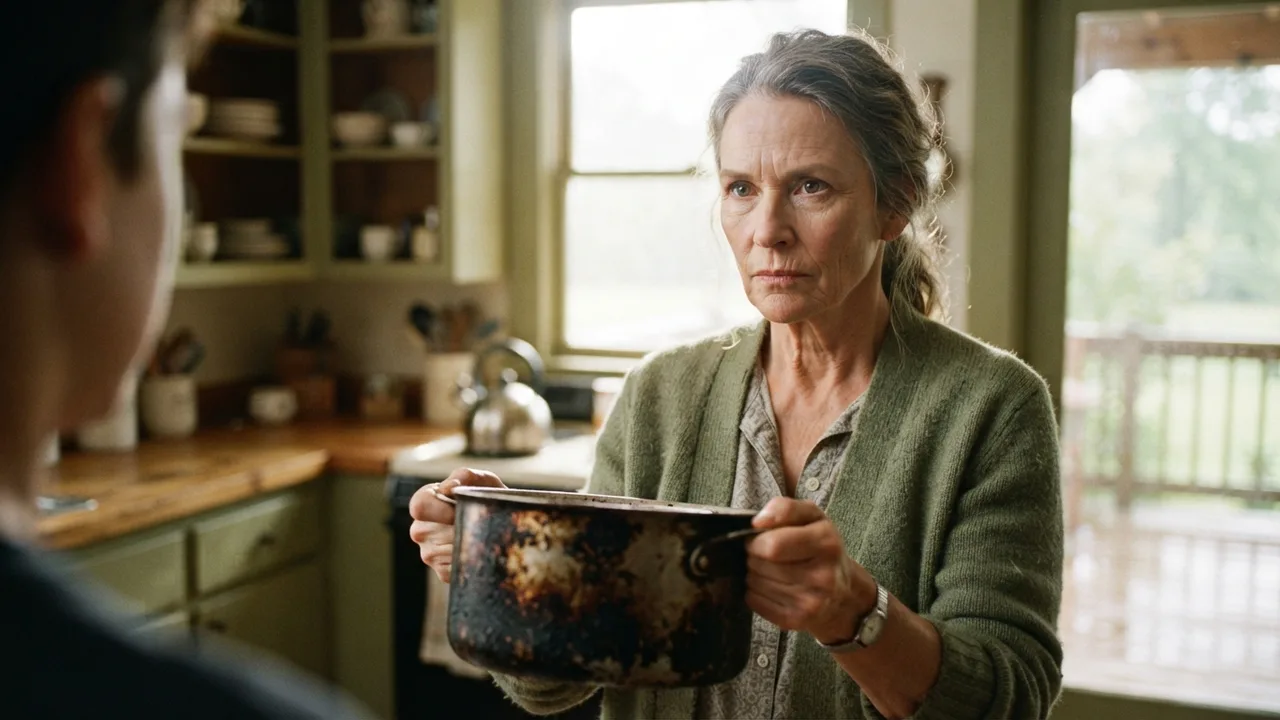
Mama looked at the cup. She was small and straight-backed, white hair pinned up, a tissue in her cardigan sleeve. She picked up a dish towel from the counter and started folding it.
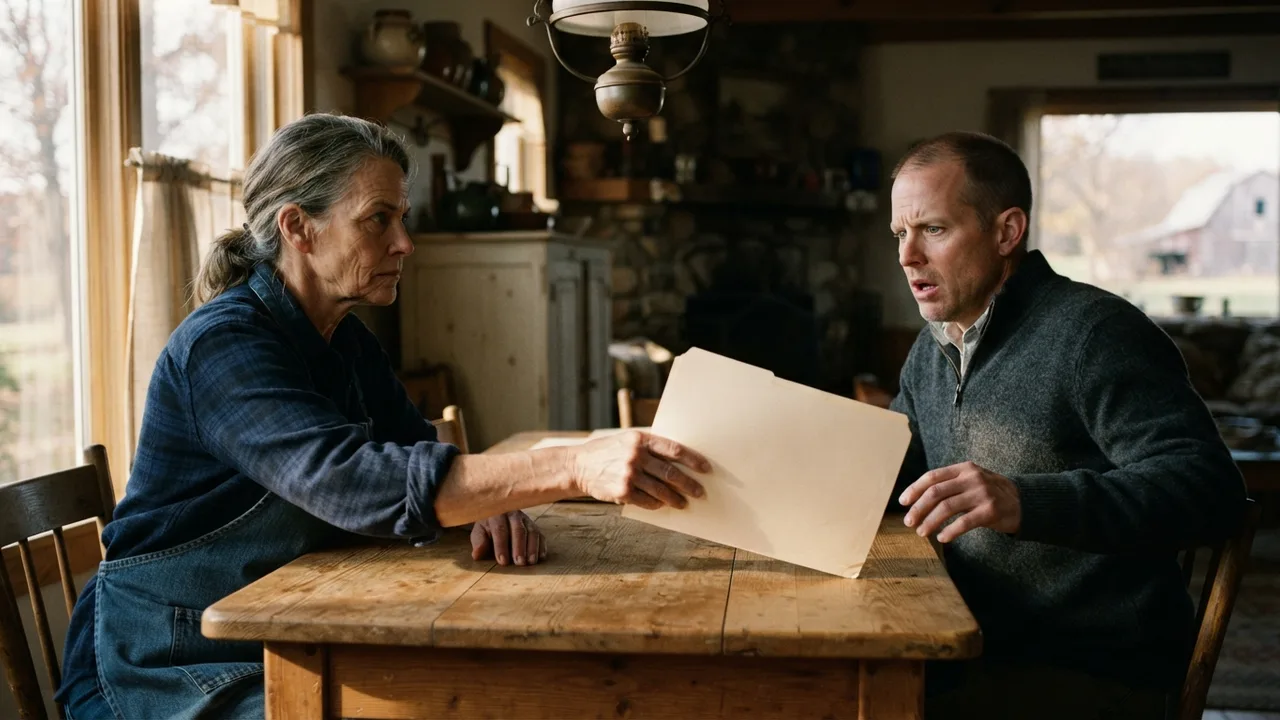
"I found it in the eaves," I said. "Odell Ramsey remembers cutting it for you in June of 1971. I have to know, Mama."
"That's a christening cup. Somebody gave it to the church."
"Mama."
"Folks always are giving the church things." The towel was in quarters now, then eighths.
"When I was little I begged you for a sister," I said. "Every Christmas. You said the Lord hadn't sent one." I kept my eyes on the towel. "When I lost the baby at thirty, you said 'these things happen' and asked if I wanted a sandwich. I spent twenty years believing you didn't know that kind of grief. You knew it all along, and you let me sit alone in it."
The towel stopped.
"I had a girl," Mama said. Her knobbed fingers went white at the knuckle. "In Knoxville, in March of 1971. I called her Rose Ann. Fern found good people for her. I signed the papers and I came home."
My throat closed. "Where is she?"
"She has a mother." Mama pressed her palm against the table until the tendons stood out. "She had a good one. Don't you go digging in that, Joetta. I'm begging you."
"I'll tell Boone and I'll tell Twyla. I'll say it at the last supper, Mama, and then I'm going to find her."
"If you do, it will be the hardest night of my life." She laid the folded towel beside the cup. "I'll thank you to remember I'm the one who has to live through it."
She left the room. I heard her bedroom door, not slammed, just shut.
---
That night I sat at my own kitchen table in the dark, with Merritt snoring down the hall, saying the name under my breath. *Rose Ann. Rose Ann.*
It came to me slowly, from two directions at once.
First I saw a closing table in 2014. I was sliding the deed across to Twyla and watching her sign it in full, *Twyla Roseann Ketner*, and thinking it was a pretty old-fashioned middle name.
Then I heard her in the dining room with the saucer in her hand. Aunt Edna stayed in Knoxville and rocked me every night until June.
Same spring. Same city. Mama bore a girl in March and gave her to good people Fern found, and wouldn't tell me who they were. *She has a mother. She had a good one.*
I put my forehead on the cool wood. The sister I had planned to hunt for in records and registries had been passing me the sweet potatoes every Thanksgiving of my life.
I was sure enough to cancel the search I'd been drafting in my head. Only Mama could say why.
---
Mama made chicken and dumplings for the last supper, the Wednesday before the move, and we ate them off paper plates because the dishes were packed. A bowl of Rome apples from the porch tree sat in the middle of the table.
Boone had come straight from the co-op, boots still on. Twyla came late with a pound cake nobody cut. She hugged Mama but she did not look at me.
After the plates were cleared, I took the cup out of Granddaddy's flannel shirt and set it in the middle of the table.
"Mama had a little girl before me," I said. "In Knoxville, in March of 1971. She called her Rose Ann. I wanted you all to hear that much from me, in this kitchen. The rest isn't mine to say."
"Jo," Boone said, low, like a warning.
Twyla's face went white. I knew she was thinking of my oath.
Then she said slowly, "March of '71. That's my birthday."
Mama said nothing. She picked up the dish towel and began to fold it.
I could have said it for her. It sat right there in my mouth.
"You rocked her every night that spring," I said to Mama instead. "You've sat across this table from her every Sunday since she was eight years old, and nobody ever let you be anything but her aunt. Let her hear it from you before you leave this house."
The towel stopped. A long time went by, long enough to hear the refrigerator hum.
"Twyla," Mama said. "Fern lost three babies. She got down on her knees to me in Knoxville and asked." She swallowed. "Fern and Clell were the good people. I called you Rose Ann and asked Fern to keep the name, and she did."
Twyla had both hands pressed to her mouth.
"I promised your mama on her last day you'd always be hers," Mama said. "I've broke that tonight, and I'll answer to Fern for it."
"She's still my mama," Twyla said.
"She is." Mama's voice cracked on it. "That was the whole of it, honey. That was all I ever wanted for you."
Boone scraped his chair back. I thought he was leaving. He stood with his arms folded, looking at the floor.
"I wanted it left, Jo," he said. "I couldn't stand to see Mama cry in her own kitchen on the last night. I was wrong, and I'd rather have been anything than the one who was wrong tonight."
He pulled his chair next to Mama's and sat, and he stayed there.
Twyla picked up the cup and held it in both hands. For a while nobody spoke.
"Did Mama Fern know you kept this?" she asked.
"She never did," Mama said.
"Is the porch tree as old as I am?"
"It went in the summer I came home."
Boone made coffee that nobody drank. Twyla said she needed some time, and that she would still come Sunday to Laurel Ridge. She left with the cup wrapped in Granddaddy's red flannel shirt, carried against her chest like a loaf of warm bread.
She did not say goodbye to me, and I did not ask her to.
---
Boone and I drove Mama to Asheville the next morning, forty minutes down the mountain with the leaves going gold and red along the ridges. She held her pocketbook in her lap the whole way and said only that the Parkway looked fine this year.
On Friday I closed the house empty, as I had sworn.
I walked the buyers up the attic ladder into the bare eaves. The loose board was nailed flat. Out the gable window I could see the Rome apple by the porch, hung with fruit nobody had picked.
"Empty as promised," I said.
My phone buzzed against my hip. It was Twyla, with no message, only a photograph. The silver cup sat on her kitchen windowsill, and in it, one Rome apple.
Comments